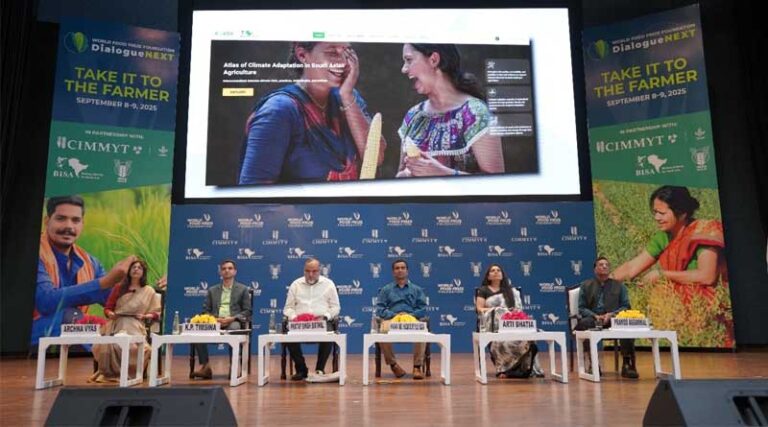
South Asia Gets Its First Climate Adaptation Atlas for Resilient Agriculture
16 September 2025, New Delhi: South Asia is the heart of global agriculture and an essential backbone of food security to nearly a quarter of the world’s population. The region is under growing strain from increasing climatic risks, with the smallholder population facing uncertainty like never before. There is a need to understand where and how these risks unfold—at the correct scale, with the right tools.
To address the situation, two food security organizations, CIMMYT and the Borlaug Institute for South Asia (BISA), launched the Atlas of Climate Adaptation in South Asian Agriculture (ACASA) (www.acasa-bisa.org). The Atlas is co-owned and co-developed by CIMMYT-BISA, Indian Council of Agricultural Research (ICAR), Bangladesh Agricultural Research Council (BARC), Nepal Agricultural Research Council (NARC), and Natural Resources Management Center (NRMC), Sri Lanka, and supported by the Gates Foundation.
The Atlas is a dynamic, web-enabled platform that combines high-resolution data, climate science, and expert-validated adaptation interventions. It assesses 15 crops and six livestock species in one place with visualization of high-resolution climate risks at 25 sq. km resolution (a group of ~4-5 villages). The user can also explore location-specific adaptation options and download open-access data, codes, and scripts instantly. The targeted knowledge base in the Atlas is expected to stimulate greater climate finance investment in agriculture by supporting decisions of credit agencies, governments, agri-food companies, the insurance industry, donors, and civil society.
Reiterating the vision for ACASA, the Managing Director of BISA, Dr B.M. Prasanna, emphasized, “BISA is proud to collaborate with its regional partners and co-develop ACASA, which highlights practical adaptation strategies to guide climate-smart investments and policies to drive more resilient agricultural production decision-making in South Asia”.
In the case of India, increasing incidents of floods, heat, and unseasonal rainfall are growing challenges in the agricultural landscape. The country’s “Amrit Kaal” vision necessitates advanced technological interventions and optimized resource allocation in all development sectors. To this, Dr Mangi Lal Jat, Secretary, DARE and DG ICAR, India, adds, “ICAR values global collaboration to share knowledge and experiences on climate action. Collective efforts, supported by digital tools like ACASA, are key to strengthening climate adaptation strategies.”
“The ACASA project is being implemented across four countries with well-defined objectives. I sincerely hope that the project achieves its intended goals and delivers meaningful benefits to the users it aims to serve”, said Dr Nazmun Nahar Karim, Executive Chairman, BARC, Bangladesh. Further, Nepal is highly vulnerable to climate change, especially in the mid-and far-western hills, mountains, and southern plains. “ACASA complements ongoing efforts and reflects Nepal’s commitment to strengthening its capacity for climate resilience”, adds Dr Krishna Prasad Timsina, Executive Director, NARC, Nepal.
As ACASA connects hazards, practices, tools, and adaptation options, Dr W.A.R.T. Wickramaarachchi, DG Department of Agriculture, Sri Lanka, emphasized, “With Sri Lanka’s journey towards climate-smart agriculture, recent evidence highlights the need for a comprehensive assessment of location-specific climate actions to bridge knowledge gaps within the country. Through the Atlas, we will quantify localized climatic risks today and, in the future, assess their likely impacts on agriculture and identify key adaptation options to mitigate these risks.”
Drawing on the expertise and experience of South Asian nations such as Bangladesh, India, Nepal, and Sri Lanka, which have suffered from extreme heat, prolonged droughts, and severe flooding in key crop-producing areas, ACASA represents an example of collaboration and knowledge exchange to reduce farmers’ risks and offer them ways to adapt.
Also Read: Stag Beetle Price: Why the Stag Beetle Is the World’s Most Expensive Insect and Who Is Buying It
📢 If You’re in Agriculture, Make Sure the Right People Hear Your Story.
From product launches to strategic announcements, Global Agriculture offers unmatched visibility across international agri-business markets. Connect with us at pr@global-agriculture.com to explore editorial and advertising opportunities that reach the right audience, worldwide.