How Hotter Days Increase Risks for Monarch Caterpillars
19 December 2025, California: Monarch butterfly populations have been declining since the 1990s, driven by several factors, including a changing climate. New research from the University of California, Davis suggests rising temperatures may be altering the behaviors monarch caterpillars use to survive, sometimes in ways that increase their risk of death.
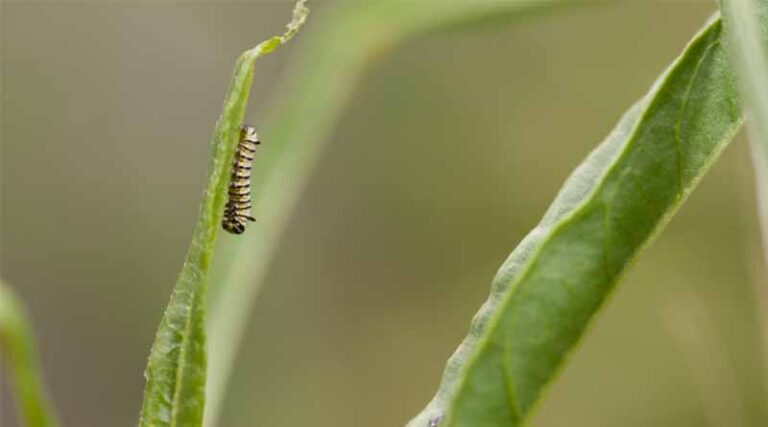
A study published in the journal Oecologia finds that monarch caterpillars change how they respond to predators depending on temperature, but that these adjustments can break down under extreme heat. When threatened by spiders, wasps or birds, monarch caterpillars are known to drop off the plant they’re feeding on to escape. While that behavior can help them avoid predators, increasingly hot ground temperatures can make dropping off a leaf deadly.
“Prey species can either be eaten by predators, which obviously is a big cost. You die, right? Or you alter your behavior. For example, you escape, but you are expending energy to do that, and there’s a cost associated with that as well,” said Prabhjot Singh, lead author and recent UC Davis graduate. “They’re altering their behavior to avoid predators, but that means they’re not feeding, not reproducing and not growing. And we wanted to see how they adjust that cost of ‘should I avoid this predator or stand my ground,’ in the face of climate change.”
Facing the heat
Singh worked alongside Louie Yang, professor with the Department of Entomology and Nematology, to conduct a field experiment at the Butterfly Study Garden within the California Center for Urban Horticulture on campus. They observed monarch caterpillars of different sizes feeding on milkweed plants and measured how temperature affected both behavior and survival.
Using a thermal imaging camera, researchers recorded temperature differences between the plant’s leaves and the ground. They also simulated predator attacks. At first, Singh said he tried hand movements to mimic a bird swooping in but found that gently swiping caterpillars with a paintbrush triggered their dropping response.
At cooler temperatures, caterpillars dropped frequently as expected, when the ground posed little risk. As temperatures increased, dropping became less common until ground temperatures reached about 27 degrees Celsius (approximately 80 degrees Fahrenheit), when dropping behavior unexpectedly increased again, even though survival rates were low.
“In some ways, the research we did sort of exemplifies ‘out of the frying pan and into the fire;’ they’re trying to escape a predator but potentially end up in a place that is lethal or dangerously hot,” Yang said. “It’s a great behavior, when it works. It makes them harder to eat, but in a warmer world, it might not be a good idea to drop off the plant.”
Clues for conservation
Monarch caterpillars are exothermic, meaning their body temperature and activity levels are directly affected by their surroundings. In hotter conditions, they become more reactive, which Singh said can override their ability to make adaptive decisions.
“The idea is that the temperature is messing with their biology, it’s messing with their function, it makes them more over-reactive,” Singh said. “It makes their decision capabilities worse. They’re essentially working in overdrive and they’re not really considering costs. And we see the mortality at these high temperatures is really high.”
The surface of a milkweed leaf is often much cooler than the ground. The study found that when on the plant, smaller caterpillars chose to be in the sun, using warmer temperatures to speed up their growth. Larger caterpillars tended to stay in the shade to avoid predators as they approached metamorphosis.
Yang and Singh said that understanding even subtle factors that affect caterpillar survival could help guide conservation efforts. The study suggests that future warming may make monarch caterpillars more vulnerable, not only by stressing their bodies, but by disrupting their ability to respond effectively to threats.
“I think that there’s still a lot we don’t know about how insects experience temperature,” Yang said. “They’re much smaller than we are so the effects of micro habitats are potentially much more important for them. And we’re only just starting to understand why that is. It does seem like this experiment is relevant to understanding the kinds of threats and adaptive behaviors that monarchs and also other insects could show, and highlights some of the concerns that occur under climate change.”
This project was funded in part with a grant from the National Science Foundation.
Singh, who earned a bachelor’s degree in biological sciences participated in the Research Scholars Program in Insect Biology.
Also Read: BASF | Nunhems to Acquire Noble Seeds, Expanding Presence in India’s Vegetable Seed Market
Global Agriculture is an independent international media platform covering agri-business, policy, technology, and sustainability. For editorial collaborations, thought leadership, and strategic communications, write to pr@global-agriculture.com