Minimal Water Usage, Natural Farming, And Low Risk – These Are The Three Pillars Of Modern Agriculture
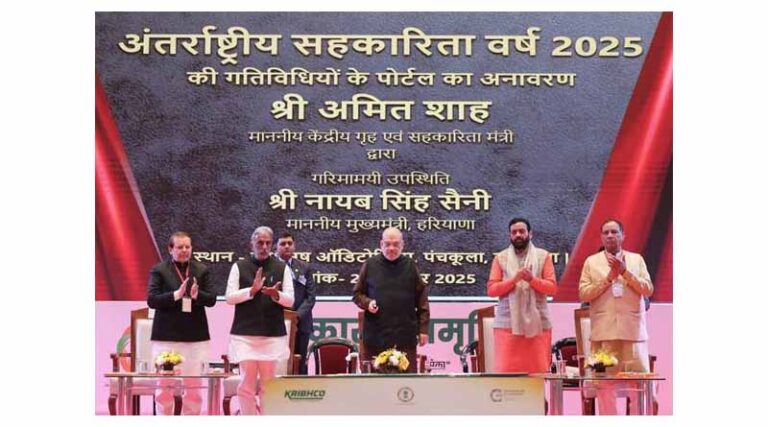
25 December 2025, New Delhi: Union Home and Cooperation Minister Mr. Amit Shah today addressed a Cooperative Conference organized by Krishak Bharati Cooperative Limited (KRIBHCO) on the theme ‘Role of Cooperation in Sustainable Agriculture’ in Panchkula, Haryana. On this occasion, Haryana Chief Minister Mr. Nayab Singh Saini, Union Minister of State for Cooperation Mr. Krishan Pal Gurjar, Secretary, Ministry of Cooperation Dr. Ashish Kumar Bhutani, and several other dignitaries were present.
Union Home and Cooperation Minister Mr. Amit Shah said that Haryana, connected with history, religion, spirituality, and traditions, is today gradually writing new dimensions of farmers’ prosperity through the collaboration between agriculture and cooperatives. He said that on the occasion of the International Year of Cooperatives, Milk chilling centre, HAFED flour mill, distribution of RuPay Platinum Card and registration certificates of model PACS, and the portal on the International Year of Cooperatives were also inaugurated at this Conference organized by KRIBHCO.
Mr. Amit Shah said that nearly 70 percent of the country’s population resides in rural areas, and a large section of our population is directly or indirectly dependent on agriculture, farming, and animal husbandry for livelihood. He said that if agriculture and animal husbandry are viewed as independent businesses, these sectors provide employment to a large number of people. Mr. Shah said that the two sectors generating the maximum employment in the country are agriculture and animal husbandry. However, when agriculture and animal husbandry are linked with cooperation, it not only provides employment to 125 crore people but also plays an important role in making them prosperous.
The Union Cooperation Minister said that in Gujarat, Amul at present distributes approximately ₹90,000 crore every year to 36 lakh women milk producers. If the same quantity of milk were sold at market prices, it would fetch only ₹12,000 crore. He said that the difference between ₹12,000 crore and ₹90,000 crore reflects the strength of cooperation. That is why it is said that by linking animal husbandry, agriculture, and cooperation, ‘Prosperity through Cooperation’ can be achieved. Mr. Shah said that agriculture and animal husbandry were always viewed only from the employment perspective, but Prime Minister Mr. Narendra Modi, by establishing the Ministry of Cooperation at the Centre, gave a new mantra of ‘Prosperity through Cooperation’. He said that now cooperation is being linked not only with employment but also with prosperity.
Mr. Amit Shah said that after becoming Prime Minister, Mr. Modi strengthened the foundation of agriculture and utilized agriculture strengthened through cooperation to make farmers prosperous. He said that low water usage, fewer chemicals, and lower risk form the foundation of the new agriculture policy. This includes achieving higher yields with less water through scientific irrigation methods, reducing fertilizer use through natural farming, and selecting crops with minimal risk through soil testing. Mr. Shah said that steps must be taken to increase farmers’ income through soil health, water security, institutional credit, market access, and processing, packaging, and marketing of produce. Along with this, agriculture dependent on subsidies must gradually move towards sustainable farming, which ensures sustainable profits. He said that for this purpose, the government has worked to promote different verticals like water and soil conservation, their testing, organic farming, climate-resilient agriculture, the Digital Agriculture Mission and cooperation.
The Union Cooperation Minister said that in 2014, when Mr. Modi became Prime Minister, the country’s agriculture budget was ₹22,000 crore, which has been increased to ₹1,27,000 crore by our government. The rural development budget was ₹80,000 crore, which has now been increased to ₹1,87,000 crore. He said that today there is no sarpanch—and certainly not in Haryana—who has not received ₹10 crore, ₹20 crore, or ₹25 crore over the last 10 years for village development. This reflects a very significant change in the approach to development. He said that crop insurance has been made more effective. Under the Pradhan Mantri Kisan Samman Nidhi, every farmer is being provided ₹6,000 annually. A provision of ₹1 lakh crore has been made under the Agriculture Infrastructure Fund. Farmers are getting fair prices through e-NAM. Initiatives such as the Mr. Anna Mission, Pulses and Oilseeds Mission, and the circular ecosystem of the dairy sector have also been undertaken. He said that through nearly ₹1 lakh crore—an amount which will increase from ₹93,000 crore to ₹1 lakh crore by the completion of the scheme—an additional 1 lakh hectares of land have been brought under irrigation over the past ten years. Mr. Shah said that the Ministry of Cooperation was established to ensure that the full profit of agricultural and animal husbandry produce reaches the farmer.
Mr. Amit Shah said that model by-laws have been prepared for Primary Agricultural Credit Societies (PACS), and certificates of multipurpose PACS have been issued to farmers. Fertilizer distribution, pesticide distribution, cleaning, grading, and marketing of agricultural produce, medicine shops, petrol pumps, gas agencies, and water distribution have all been linked with PACS. By integrating nearly 30 different fields with PACS, the government has strengthened them. Mr. Shah said that three multi-state cooperative societies have been established at the national level—National Cooperative Exports Limited (NCEL) for export of farmers’ produce, National Cooperative Organics Limited (NCOL) for marketing and certification of organic products, and Bharatiya Beej Sahkari Samiti Limited (BBSSL) for seed production, procurement, and distribution. He said that these initiatives have laid a strong foundation for increasing farmers’ income.
Union Cooperation Minister Mr. Amit Shah said that when Amul was established, it used to collect only 2,000 litres of milk per day. Today, it collects several crore litres of milk daily (approximately 3 crore litres per day) across the country and has a turnover of around ₹1,23,000 crore. Mr. Shah expressed confidence that after 15 years, there will be at least 20 institutions like Amul in the country, which will be strong cooperative institutions working for farmers. He said that the Haryana government has given the highest prices to sugarcane farmers, and the Nayab Singh Saini government has made Haryana’s farmers prosperous, which is the greatest achievement.
Mr. Amit Shah said that several companies in the country operate taxi services, but the profits go to the owners rather than the drivers. He said that under the initiatives of the Ministry of Cooperation, ‘Bharat’ Taxi will be launched soon, and the entire profit will go to our driver brothers. This will open up several new employment opportunities for taxi drivers. They will receive insurance facilities, advertisements will be permitted on their taxis, and ultimately all profits will go to them. The Cooperation Minister said that this will enhance customer convenience while also making taxi drivers prosperous. Mr. Shah expressed confidence that it will soon become India’s number one taxi operating company. He said that the cooperative movement in India is about 125 years old, but the initiatives taken by Mr. Modi will take it to new heights, particularly making it a major driver of prosperity in rural areas.
Union Cooperation Minister Mr. Amit Shah said that Haryana has always played a significant role in ensuring the country’s food security, milk production, and in bringing a stream of medals for the nation in sports. Whether on the battlefield or in the sports arena, the farmers, soldiers, and sportspersons of Haryana have upheld the pride of our Tricolour on every front. He said that we still remember the period when, despite having a small population, the country had to import red wheat from abroad for food. It is the land of Haryana and Punjab that made the country self-reliant in food grains and earned global respect. Mr. Shah said that despite being a small state, Haryana contributes the highest number of personnel proportionately to the Central Armed Police Forces and all three armed services, and due to their bravery, India’s armed forces and security forces have successfully thwarted numerous attacks. He said that the formidable sportspersons of Haryana lead the country to the top of the medal tally in every sport.
Also Read: White Paper on Data Exclusivity in India’s Agrochemical Sector Released by CCFI
Global Agriculture is an independent international media platform covering agri-business, policy, technology, and sustainability. For editorial collaborations, thought leadership, and strategic communications, write to pr@global-agriculture.com