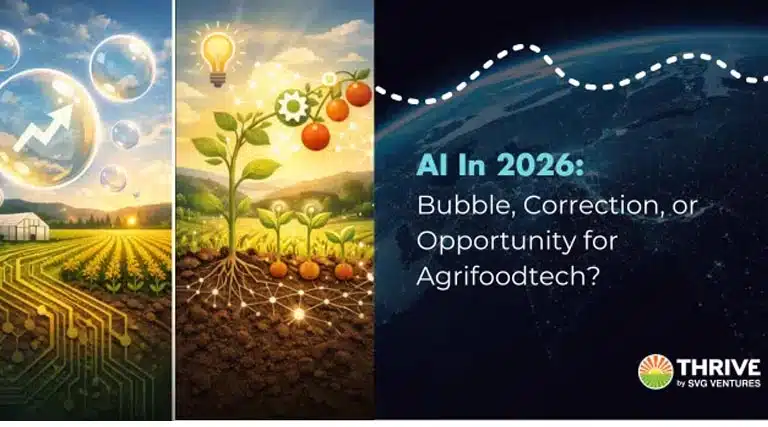
AI in 2026: Bubble, Correction, or Opportunity for Agrifoodtech?
10 February 2026, USA: The chatter that an “AI bubble” has formed and may burst in 2026 is gaining volume in tech media and investor circles. Massive capital inflows, eye-watering valuations, uneven adoption, financial uncertainties, and a proliferation of pilots that never scale have fueled skepticism. For Agrifoodtech leaders, the question isn’t whether the hype will cool—but whether the sector is exposed or well-positioned.
To better understand what an AI correction could mean for Agrifoodtech, we spoke with Dr. Elliott Grant, Visiting Fellow at the University of Cambridge, who provided additional perspective on how today’s cycle compares to past technology bubbles. Grant notes that the dynamics underlying the current AI market are different in several important ways, shaped not only by investor behavior but by real demand and operational adoption. With decades of experience building and scaling agrifood technologies—including leading Alphabet’s agricultural AI venture, Mineral—his insights offer a grounded view of how AI innovation in food and agriculture is likely to evolve beyond the hype.
Déjà Vu? Lessons from the Internet Bubble
Similarities to the dot-com bubble of the early 2000s are hard to ignore—but they only go so far. As Dr. Elliott Grant notes, the dynamics underlying today’s AI market are different in several important ways. During the internet bubble, capital raced ahead of investor understanding and consumer demand, with companies building capacity and going public on flimsy business models before clear use cases existed. Valuations soared on speculation alone, often detached from working products or real customer pull.
In contrast, AI adoption today is being driven by demand that is outpacing supply. AI is being financed and controlled by multi-trillion-dollar companies that have real business models and profits.1While valuations are undoubtedly inflated in parts of the market, there is a meaningful difference between overvalued companies and nonexistent value. Unlike the early internet era, when the market and infrastructure were still thin, AI is entering a fully connected global system, enabling immediate large-scale impact despite uneven and still-maturing deployments. This points to a correction—but not a collapse. Rather than a dramatic “bust” that resets the market to zero, the more probable outcome is a recalibration that narrows the field, removing companies applying AI indiscriminately or without a moat while reinforcing those solving real problems with focus and discipline.
The Reality Check: Most AI Pilots Fail
Recent research from MIT’s Project NANDA highlights a stark reality: roughly 95% of enterprise AI pilots fail to reach full production or generate measurable business impact.2 But that headline number deserves a double-click. Most failures stem from familiar tech patterns: organizations pursuing “AI for AI’s sake,” limiting ownership to R&D teams, and underestimating the operational friction of real-world deployment. Large, company-wide AI initiatives often stall under the weight of integration complexity, brittle workflows, and the difficulty of embedding new systems into existing operations. The failures are real—and they help explain skepticism around AI’s near-term returns.
At the same time, this top-down view masks a parallel bottom-up reality. While many formal AI projects struggle, employees are already using tools like ChatGPT, Gemini, Copilot, Claude and other readily available systems on an individual basis because they are simple to learn, flexible, and require little to no integration. These tools succeed precisely where large enterprise deployments fail: they are easy to adopt, adaptable to personal workflows, and immediately useful. In addition, some organizations are deliberately keeping successful AI pilots quiet, viewing them as sources of competitive advantage rather than scoring PR points—further skewing perceptions of progress.
The same research highlights a sharp divide. The 5% of AI organizations and vendors that succeed in implementing large AI initiatives focus aggressively on learning, memory, and workflow adaptation. Winning solutions are not generic tools or internally built experiments. They are systems that learn from feedback (a priority for 66% of executives), retain operational context (63%), and deeply customize to specific workflows.2 These solutions typically start at the edges of workflows, prove value quickly, and then scale inward.
Strategic partnerships matter. Pilots built with external partners were twice as likely to reach full deployment as internal builds, and employee usage rates were nearly double. Faster time-to-value, lower total cost, and tighter alignment with day-to-day operations consistently drove success.
Finally, it is worth remembering that looking in the rearview mirror is not the same as looking forward over the horizon. Transformational technologies rarely appear smooth in real time. Electricity took decades to displace steam power, marked by long periods of trial and error, inefficiency, and skepticism—yet in hindsight, the transition appears almost instantaneous. AI is likely to follow a similar trajectory. Many systems will fail, and many will fail repeatedly, before durable models emerge.
Agrifoodtech’s Advantage: Domain First, Not Tech First
This is where Agrifoodtech is one of the few sectors with an advantage. Many of the sector’s most promising AI applications are designed around real agricultural and food-system challenges rather than abstract technical capabilities. Successful implementations begin with clearly defined problems and apply AI as an enabling layer to improve outcomes across productivity, resilience, and sustainability.
Today, AI is already delivering value by optimizing crop and soil management through predictive analytics that guide irrigation, nutrient application, and pest control; improving yield forecasting and climate-risk modeling; accelerating seed genetics and trait discovery; and enhancing food quality and safety through computer-vision-based inspection, sorting, and spoilage detection. AI is also reshaping how food moves through the system, improving demand forecasting, inventory planning, and logistics efficiency to reduce waste and increase freshness. In parallel, AI-enabled robotics and autonomous systems are beginning to tackle persistent labor constraints in farming and food processing, while data-driven nutrition and formulation tools are supporting more personalized, efficient, and sustainable food production. Across R&D and product development, AI is increasingly embedded in laboratory workflows—helping teams design experiments, analyze complex biological data, shorten development cycles, and navigate regulatory and approval processes more efficiently.
As Dr. Grant emphasizes, AI in agriculture creates value when it is the appropriate means to solve a real problem—rather than the end in itself. Adding a thin wrapper to a general-purpose LLM, or throwing AI at every problem is not the path to enduring value. Rather, agrifood companies and farmers need ag-specific solutions to the hard problems of unstructured in-field environments, models for biology variability, or reliable models that can run on the edge.
Beyond individual use cases, a growing source of value lies in integration across workflows and adjacent technology sectors. Intelligent sensing and data capture in AgTech, for example, can increasingly be combined with BioTech, FinTech, insurance, and supply-chain platforms to enable more dynamic risk modeling, financing, and decision-making. As AI connects data across biological, physical, and financial systems, it becomes a coordination layer—linking what happens in the field to decisions made across the broader food system.
The next phase of value creation will be less about isolated pilots and more about enterprise integration. Leading agrifood organizations are shifting toward cross-functional AI ownership, internal governance, and scalable deployment across operations, supply chains, and R&D. Crucially, they are also showing a willingness to reshape processes—not just layer AI onto existing ones.
A Little Bubbliness Isn’t All Bad—Especially for Agrifoodtech
From an investor perspective, an AI correction would likely introduce short-term volatility and more selective capital allocation—but it would also accelerate a flight to quality. Similar to the early 2000s internet bubble, periods of market correction tend to flush out companies built on hype, unclear value propositions, or unsustainable business models, while capital concentrates around talented teams solving real problems with durable technology.
From an industry perspective, continued investment during these cycles sustains experimentation and innovation, while market discipline resets expectations around timelines, ROI, and adoption. AI, like the internet before it, is becoming foundational infrastructure—its presence will persist even as individual companies fail. The solutions that endure are not those deploying AI for its own sake, but those embedding it deeply into workflows, systems, and decision-making processes where it delivers measurable operational impact.
For Agrifoodtech, this dynamic points to a selective correction rather than a collapse. Some AI-driven startups will struggle or disappear as capital tightens, and scrutiny increases. At the same time, companies that are domain-driven, adoption-focused, and closely aligned with the realities of food and agriculture will continue to grow—emerging as the long-term leaders in a post-hype AI landscape.
2026 Outlook: From “Is This AI?” to “Does This Work?”
As the AI hype cycle cools, the focus will move from experimentation to execution. The question facing organizations will no longer be whether AI is transformative in theory, but where it can be deployed reliably, scaled responsibly, and integrated into the systems that actually run the food and agriculture value chain. In that shift, Agrifoodtech stands apart—not because it is immune to market cycles, but because its most valuable AI applications are grounded in physical, biological, and operational realities that demand real-world performance.
There may well be a period of correction as expectations reset and weaker models fall away. Yet AI remains a relatively new frontier, and its long-term trajectory is still being shaped. The companies that ultimately succeed may not look exactly like today’s winners—but they are likely to be those that start with real domain problems, prioritize adoption over demos, and use AI as a means to deliver impact rather than an end in itself.
Also Read: Tanmiah Partners with PHYLA and RECYCLEE to Bolster Circular Economy and Food Security
Global Agriculture is an independent international media platform covering agri-business, policy, technology, and sustainability. For editorial collaborations, thought leadership, and strategic communications, write to pr@global-agriculture.com