Beyond the Grain: How Rice-Field Ponds are Forging Climate Resilient Livelihoods in Cambodia
17 January 2026, Cambodia: In Cambodia, where rice is life, climate change is shaking the foundation. Intensifying droughts, falling prices, and unpredictable rainfall means the monoculture model is breaking down.
Integrated rice-field pond systems (RFP) appear to be a solution, as successfully piloted under the CGIAR–Asian Mega Delta initiative. This climate-smart approach is turning vulnerable farms into resilient, biodiverse hubs, securing land, water, and the future of smallholder livelihoods.
What Is an Integrated Rice-Field Pond (RFP)?
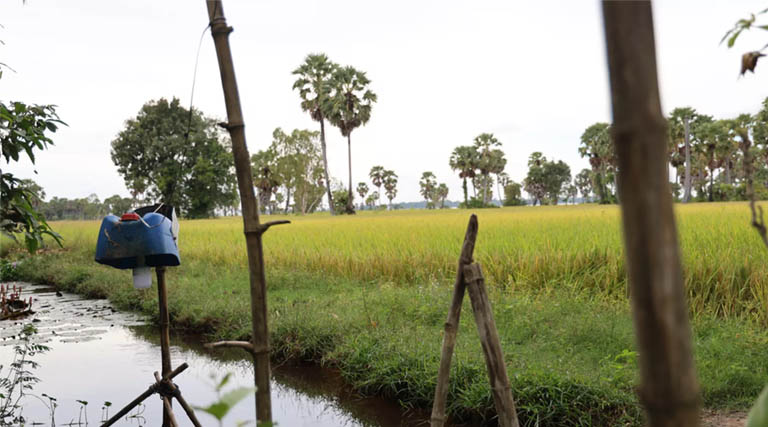
An integrated Rice-Field Pond (RFP) is a small multifunctional, climate-smart reservoir designed and positioned strategically within or adjacent to a rice paddy plot. This simple modification transforms a monoculture rice plot into a highly productive, resilient micro-ecosystem for improving rice-field ecosystem. The pond serves as a key component of the entire system, providing crucial and complementary functions:
- Water security and irrigation: The pond serves as an on-farm reservoir, capturing rainwater and runoff during the wet season and storing it for supplementary irrigation, helping rice crops survive dry spells.
- Aquatic Food Production and Biodiversity: The ponds act as a permanent aquatic habitat for fish and other beneficial aquatic life. They are a refuge for broodfish, enabling natural restocking of the flooded rice fields year-round. This increases the availability of resilient aquatic food sources and supports the overall rice-field ecosystem.
- Diversification of food and income: RFPs form the foundation for integrated farming. The stored water and available nutrients support the cultivation of vegetables on the dikes and surrounding land and provide water for small-scale livestock. This helps families to significantly diversify their food sources and income streams beyond rice alone.
- Climate Resilience: By intrinsically linking rice cultivation with fish, vegetables, and livestock, RFPs create a multifunctional, climate-resilient landscape capable of buffering the impacts of climate change, specifically withstanding droughts, erratic rainfall fluctuations.
The RFP system moves away from intensive rice monoculture toward a holistic, resilient livelihood strategy.
Evidence from Prey Veng and Kampong Thom
Recent field demonstrations under the CGIAR–Multifunctional Landscapes implemented by WorldFish offer a few examples of the strong and high potential benefits that integration of RFP systems can yield in Cambodia:
- Aquatic Productivity: Better pond management practices, including fish passages, aquatic vegetation management, and retention of high quality broodfish, led to almost doubling fish harvests. This shows that simple, targeted interventions can go a long way in enhancing the productivity of the pond.
- Exponential Profit Increase KHR/m2: Integrated farming delivers higher profits than rice monoculture. The profit from rice alone ranged from 133 to 263 KHR/m². But the integrated profit from RFP system increased, ranging from 1,428 to 3,717 KHR/m². This increment is driven by the high-value components of the combination of fish, vegetables, and livestock, that clearly demonstrate the strong livelihood benefits of diversification.
- Household nutrition improved: As it was integrated, fish and diversified vegetables were able to play a crucial role in improving nutrition in households, along with dietary diversity in their families.
- Strong Community Adoption and Learning: Community engagement was high in the demonstrations, with over 100 farmers, around one-third of them women, actively participating in the field days to learn, share, and gain experiences, and together assess the best practices of the RFP system. The model requires low investment, making it highly adaptable and suitable for scaling to 5,000 families around Boeng Sneh and potentially reaching millions of households nationwide.
“The rice-field pond is very important for my family, not only for harvesting fish, but also for growing vegetables and other crops with its water, especially during the dry season when water is scarce.” – Mrs. NUT Neang, owner of Theay Commune, Prey Veng Province.
Challenges and Opportunities
Current Practices and Management Gaps in RFP Systems: Evidence from a 2025 Study in the Boeng Sneh catchment in Prey Veng, shows potential for improvement:
| Practice Gap | Prevalence | Impacts on System Resilience |
| Pond Draining | 67% of Households | Reduces year-round broodfish availability, hence compromising natural restocking and future fish yield, extensive use of chemical pesticides in rice fields |
| Passive Use | 24% of Households | Use the ponds mainly as simple fish traps, limiting productivity rather than actively managed |
| Inconsistent adoption | 53% of households | Have adopted at least one good practice, such as vegetable irrigation of fish shelter, but long-term sustainability requires consistent application of at least three core practices. |
These findings show strong interest but highlight the need for improved training, better water management, and consistent adoption of integrated practices.
Scaling the Vision: “One Pond, One Family”
Imagine if every rural household had its own fully functioning RFP. Cambodia’s vast rice landscapes could become interconnected matrices of productivity and resilience, rich in fish, vegetables, and diverse food sources throughout the year, especially during the critical dry period. However, this vision cannot be realized without addressing the widespread and increased use of chemical pesticides in rice production, which undermines aquatic biodiversity, reduces fish survival, and weakens the resilience of rice–fish systems. To achieve this transformation, scaling efforts must shift from simple pond construction toward consistent, high-quality management and strong policy alignment:
- Capacity Building: Provide targeted, high-quality training not only for farmers but also for commune agriculture officers. Training should emphasize advanced pond system management, vegetable diversification, nutrient recycling, sustainable pest management, and the use of compost and Black Soldier Fly (BSF) feed to reduce reliance on chemical pesticides.
- Governance and Coordination: Enhancing local governance for sustainable water and fish management. More importantly, link RFP scaling with the District Working Group on Food Security and Nutrition under the National Working Group to ensure national coordination, policy alignment, and long-term adoption.
- Policy Alignment: National policies should be aligned to formally recognize integrated RFPs as essential assets for climate-smart agriculture. Cambodia’s NDC already acknowledges the importance of rice-field ecosystems; therefore, RFPs should be explicitly positioned as a key climate adaptation intervention. This alignment would help direct public investment, strengthen institutional support, and reinforce coherence with the National Strategy for Food Security and Nutrition.
Authors
Vichet Sean and Kosal Mam, Worldfish
Also Read: Brazil 2025 Pesticide Approvals: Company-wise List with Brand Name, Product and Type
Global Agriculture is an independent international media platform covering agri-business, policy, technology, and sustainability. For editorial collaborations, thought leadership, and strategic communications, write to pr@global-agriculture.com