
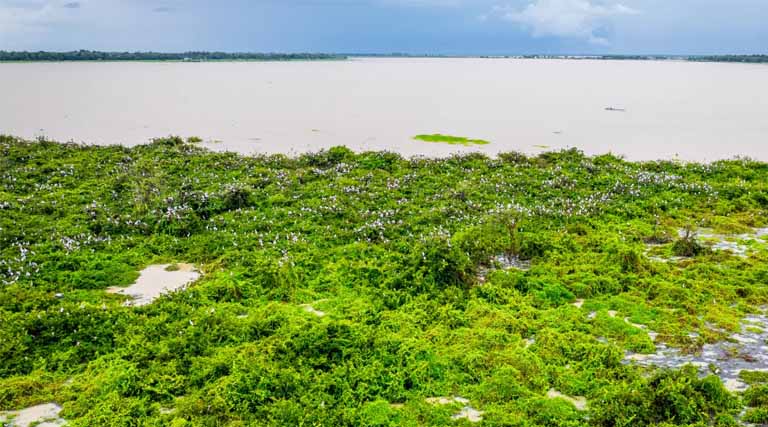
Boeng Sneh Lake: Water, Life, and Our Shared Future
02 February 2026, Cambodia: Hidden in the heart of Prey Veng Province lies Boeng Sneh Lake (BSL) – a 3,924-hectare freshwater treasure that sustains life, livelihoods, and biodiversity for thousands of people and countless species.
With a capacity of up to 80 million cubic meters of water, BSL acts as a crucial buffer against seasonal flooding that would otherwise inundate and damage the local livelihoods of nearby communities. During the wet season, its annual connection to the Mekong River supplies water that sustains 22,899 hectares of surrounding rice fields. For 10,911 households across 44 villages that depend on it, the lake is indispensable – providing water for farming, fish for daily nutrition, and a measure for stability amid an increasing unpredictable climate. Nearly one in five households depends on fishing, making every drop of water count.
BSL is also rich in nature. It is home to more than 50 species of water birds and many important fish species. Recognizing this value, the Fisheries Administration (FiA) established four Community Fisheries (CFis), protecting 40 hectares of core fish refuge areas and nine deep-water zones inside the lake. The Ministry of Environment has further designated 3,557 hectares as a Multiple Use Area and established a bird sanctuary at Tuolporn Taley, supported by community-based ecotourism that invites visitors to experience Boeng Sneh’s natural beauty.
But today, Boeng Sneh faces growing pressure.
Water from the lake feeds 11 irrigation schemes, multiple water supply stations, and expanding rice production – now intensified from one to three crops per year. At the same time, climate-induced drought, increased agro-chemical use, overfishing, and land encroachment are putting the lake’s ecosystems and biodiversity at risk. Without strong coordination across sectors, competing demands for water threaten both livelihoods and nature.
There is hope.
In 2024, WorldFish and IWMI, together with Inland Fisheries Research and Development Institute (IFReDI) and supported by Asian Mega Deltas (AMD) and Resilient Aquatic Food Systems initiative (RAqFS), now advancing to CGIAR – Scaling for Impact (S4I) and Sustainable Animal and Aquatic Food program (SAAF) – established a District Technical Working Group (DTWG) in Ba Phnom District to protect BSL. This platform brings communities, government agencies, and partners together to promote dialogue, resolve conflicts, and manage BSL’s resources more sustainably – for people, food, and nature
Also Read: Sahyadri Farms: A Farmer-Led Collective Transforming Indian Agriculture
Global Agriculture is an independent international media platform covering agri-business, policy, technology, and sustainability. For editorial collaborations, thought leadership, and strategic communications, write to pr@global-agriculture.com


