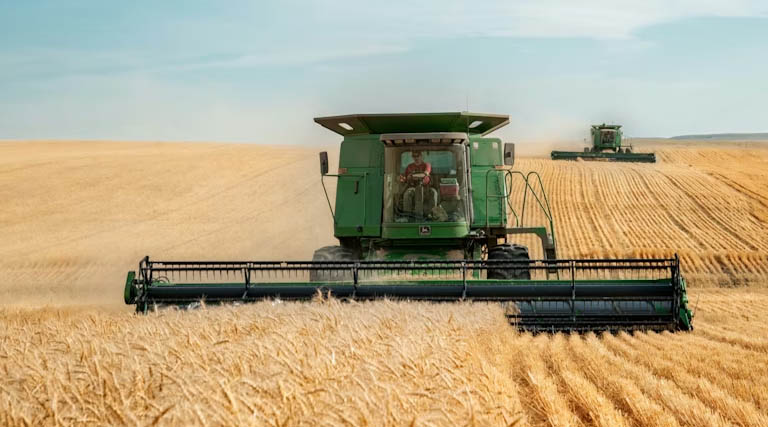
Global Wheat Production Faces a Climate Tipping Point as Heat Stress Overtakes Drought as Primary Threat
New research warns that extreme temperatures during critical flowering period could devastate harvests in major breadbaskets by 2090
23 February 2026, London: In the delicate calculus of global food security, wheat has long been considered the stable cornerstone. It is a resilient crop that feeds billions across cultures and continents. But a comprehensive new study published today in Climatic Change reveals that climate change is fundamentally rewriting the rules of wheat production. This could have potentially devastating consequences for the world’s most widely consumed grain.
The research, led by Dr. Nimai Senapati and colleagues at Rothamsted Research in the United Kingdom, delivers a stark message. While drought has historically been the greater enemy of wheat yields, extreme heat during the plant’s vulnerable flowering period is emerging as the more serious threat under climate change. And it is accelerating faster than previously understood.
According to the study, drought stress around flowering will actually decrease slightly in future decades due to earlier flowering. However, heat stress is rising sharply and poses a growing danger to major wheat-producing regions.
The Delicate Dance of Reproduction
Wheat’s vulnerability during flowering is a matter of biological precision. The 15 day window surrounding flowering, from 10 days before to 5 days after, represents one of the most critical periods in the plant’s life cycle. During this time, even brief encounters with extreme temperatures or water scarcity can permanently damage reproductive development.
When temperatures exceed 30 degrees Celsius in the days leading up to flowering, meiosis is disrupted, pollen becomes sterile, and fertilization rates plummet. After fertilization, temperatures above 35 degrees Celsius can halt endosperm development, permanently limiting grain size. The damage is swift, severe, and irreversible.
The research emphasizes that these are not gradual, season long stresses. They are short bursts, sometimes just a few days of extreme heat, that can destroy an entire season’s harvest. The models show these events are going to become much more frequent.
A Global Analysis
The study’s scope is unprecedented. The research team analyzed 53 representative sites across 33 wheat growing countries, covering approximately 91 percent of global wheat production. Using climate projections from 15 different global climate models in the latest Coupled Model Intercomparison Project (CMIP6), they simulated conditions under the highest emissions scenario (SSP5-8.5) for both near future (2050) and far future (2090) timeframes.
The Sirius wheat model, a state-of-the-art simulation tool refined over decades, allowed researchers to isolate the specific impacts of heat and drought during the flowering period. This would be impossible to study experimentally on a global scale.
The researchers essentially ran millions of virtual experiments. For each location and each future climate projection, they simulated 100 years of weather patterns. This provides statistical power to understand not just average conditions, but the extreme events that occur once every 20 years. These are the ones that cause catastrophic yield losses.
The Numbers Tell a Story of Transition
Under current baseline conditions from 1985 to 2015, drought around flowering causes more than three times the yield loss of heat stress. There is a 37 percent reduction compared to 11 percent for extreme heat events occurring once every two decades.
But the future looks dramatically different.
By 2050, global yield losses from drought around flowering are projected to decrease by 9 percent, and by 18 percent by 2090. This counterintuitive finding stems from warmer temperatures accelerating wheat development. Plants flower earlier, reducing water consumption before reproduction and leaving more moisture available in the soil during the critical flowering window.
Earlier flowering acts as a drought escape mechanism. The plant essentially outruns the dry season. In many regions, this provides meaningful protection against water stress.
Heat stress tells the opposite story. By 2050, heat-related yield losses are projected to increase by 32 percent globally. By 2090, they will have jumped by 77 percent compared to baseline. This means heat stress at flowering will approach the magnitude of damage currently caused by drought.
The study identifies heat as the emerging threat. Drought is not going away. It remains extremely serious in many regions. But heat is accelerating rapidly, and the world is not prepared.
Breadbaskets at Risk
The study identifies specific countries facing the greatest threats. Many of them are critical to global wheat supplies.
China faces the most severe heat stress of any major producer, with projected yield losses exceeding 40 percent by 2050 and 50 percent by 2090 from extreme heat events around flowering. Russia, Kazakhstan, Pakistan, the United States, and Ukraine all face heat-related losses exceeding 30 percent by mid-century.
For drought, the highest future impacts cluster in China, the United States, Argentina, Iran, Turkey, Spain, and Romania. All face potential losses of 70 to 80 percent from extreme drought events at flowering, even with the overall global decline in drought stress.
Particularly concerning are countries that face both threats simultaneously. China, the United States, Russia, Romania, Turkey, and Kazakhstan all rank among the highest-risk nations for both heat and drought stress at flowering under future climates.
When multiple breadbaskets are threatened simultaneously, the global food system faces synchronous shocks. This can lead to price spikes, export restrictions, and food insecurity cascading through the system. The interconnected nature of global wheat trade means a bad year in the Northern Hemisphere wheat belt affects families across the world.
The Adaptation Challenge
The research carries urgent implications for wheat breeding programs worldwide. Historically, drought tolerance has dominated breeding priorities. This focus is understandable given its current dominance as a yield-limiting factor. But the study suggests this focus must broaden rapidly.
Breeding programs typically take 10 to 15 years from initial crossing to variety release. The varieties planted in 2040 are being conceived in breeding nurseries right now. If heat tolerance is not incorporated into those programs immediately, farmers will be facing the 2050 climate with varieties suited to yesterday’s conditions.
The challenge is complicated by the nature of heat tolerance itself. Unlike drought escape, which can be achieved through earlier flowering, heat tolerance requires physiological mechanisms that protect reproductive processes during high-temperature events. These mechanisms are complex, involving heat-shock proteins, membrane stability, and metabolic adjustments that vary among genotypes.
Simply flowering earlier will not solve the heat problem. While plants do flower earlier under warmer conditions, temperatures are rising so sharply that even earlier flowering still exposes plants to damaging heat. True physiological tolerance is needed.
Beyond Breeding: A Portfolio Approach
While genetic improvement is essential, the researchers emphasize that no single solution will suffice.
The idea of breeding a single “super wheat” that solves all problems is seductive but dangerous. A portfolio approach is needed. Better varieties are essential, but improved management practices, conservation agriculture, and policy frameworks that support farmers through transition are equally important.
Early sowing, for example, can help crops avoid peak summer heat in some regions. Improved soil management can increase water holding capacity, buffering both drought and heat stress. Insurance programs and social safety nets can help farming communities survive catastrophic years.
The study also highlights the importance of uncertainty in climate projections. By using 15 different global climate models, researchers could assess the range of possible futures, some more severe, some less. This uncertainty must be incorporated into adaptation planning.
Perfect predictions are not possible, but the signal is clear enough: heat stress is coming, it is serious, and action is needed now. The exact magnitude may vary, but the direction of change is unambiguous.
A Call to Action
The research concludes that building tolerance to short-term, extreme high temperature and drought stresses at flowering must become a target for wheat breeders. These results should be acted upon now to reduce global wheat yield vulnerability.
For the international agricultural research community, which has invested heavily in drought tolerance through initiatives like the CGIAR’s Excellence in Breeding platform, the study suggests a need to rebalance priorities.
The Green Revolution was about yield potential. The next revolution must be about yield stability under climate stress. The tools, models, and knowledge exist. What is needed now is the will to act before the window of opportunity closes.
Also Read: Bayer Launches Multi-Crop Seed Brand ‘newgold®’ to Help Farmers Tap the Low-Carbon Biofuel Economy
Global Agriculture is an independent international media platform covering agri-business, policy, technology, and sustainability. For editorial collaborations, thought leadership, and strategic communications, write to pr@global-agriculture.com