Introducing CRISP: Satellite Data For Global Rice Climate Resilience And Food Security
20 February 2026, Philippines: With rice feeding over half of the world’s population, rice production is crucial for food and livelihood security for millions of rice farmers globally, especially amid climate uncertainties. Production data frequently lacks regional consistency and spatial granularity, while they are often delivered long after the harvest and fail to properly account for unexpected severe climate events. CRISP (Consistent Rice Information for Sustainable Policy), developed by a consortium led by sarmap with CGI and IRRI, intends to address some of these shortcomings. CRISP is the first digital mapping platform dedicated to rice that offers the possibility of generating production data globally, leveraging Earth Observation (EO) data to support timely rice mapping over large regions.
The technology is rooted in RIICE (Remote sensing-based Information and Insurance for Crops in Emerging Economies), a rice production monitoring service developed and implemented by sarmap and IRRI and initially co-financed by the Swiss Development Cooperation. In its over 12 years of service, RIICE was piloted and used across diverse rice ecosystems in South and Southeast Asia (India, Vietnam, Cambodia, Thailand, Indonesia, Philippines), Africa (Kenya, Mali, Ivory Coast, Nigeria, Senegal, Tanzania), and South America (Uruguay).
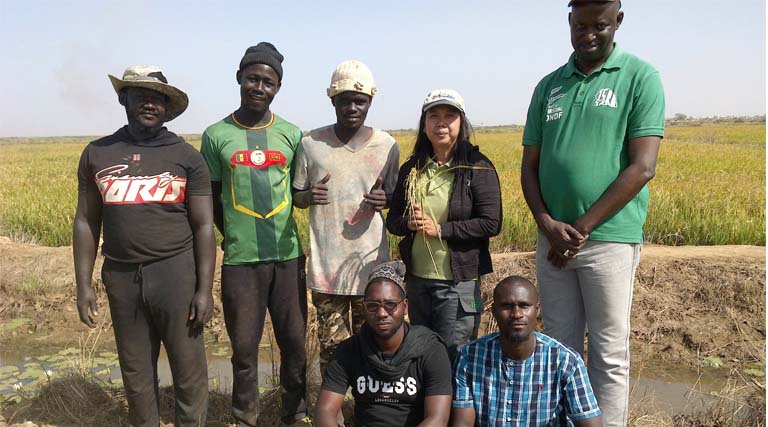
The CRISP platform is funded by the European Space Agency (ESA) and hosted on Insula, a cloud-native platform developed by CGI. It offers a shift from static reporting to dynamic, user-driven analysis. CRISP can process multi-temporal Sentinel-1 and -2 data to generate seasonal rice maps to provide governments, international organizations, and the private sector with consistent, detailed, timely, and actionable information on rice production. As part of the first phase, the platform architecture was designed and built, including the modules for data processing and integration, map production, yield modelling, and data visualization modules. CRISP was tested and validated over five sites selected across diverse agro-ecological zones in Asia (Andhra Pradesh, India; Luzon, Philippines) and Africa (Senegal River Valley, Senegal; Kano State, Nigeria; and Mwea Irrigation Scheme, Kenya).
The validation across the sites confirmed the system’s reliability and robustness for operational monitoring, achieving an average overall mapping accuracy of rice area 87%. In large-scale, structured irrigation schemes, accuracy exceeded 90% (e.g., 94.2% in Srikakulam, India), while in more complex and fragmented ecosystems like Kano (Nigeria), the system maintained high reliability with accuracies above 80%. In controlled environments like the Senegal River Valley and irrigated areas in Kano, the rice yield was estimated with a high precision and with an error as low as 0.10–0.11 t/ha. In rainfed or more variable contexts, the model successfully captured key spatio-temporal patterns, such as drought-induced yield reductions, validating its utility for e.g. index-based insurance and policy planning even where absolute yield quantification remains challenging.
“The next phase will involve the transition from a ‘demonstration’ to a full operational status.”, said sarmap Engineer and Project Manager Giaime Origgi. “To ensure sustainability and wider adoption, the CRISP platform will be available in the near future through the ESA Network of Resources (NoR). This offers maximum flexibility to authorized users ranging from national agencies to development organizations.” Origgi shared that interested users from the mentioned institutions can either independently generate monitoring products through the cloud-based platform or request the service to be executed for their specific Areas of Interest. Generated data will be available to the public. Technologically, the focus is on scalability and user autonomy. “Ultimately, this ensures the transformation of complex data into accessible, actionable intelligence that effectively supports stakeholders in their decision-making processes.”, Origgi continued.
Also Read: FMC and the Two-Engine Dilemma: When the Present Devours the Future
Global Agriculture is an independent international media platform covering agri-business, policy, technology, and sustainability. For editorial collaborations, thought leadership, and strategic communications, write to pr@global-agriculture.com