IRRI Showcases High-Quality, Low-Emission Rice Farming Practices and a Circular Economy Business Model to the World Bank and the Vietnam Government
09 December 2025, VN: A high-level delegation from the World Bank and Vietnam’s Ministry of Agriculture and Environment (MAE) visited the New Green Farm Cooperative to observe a high-quality, low-emission rice farming model. The delegation was led by Dr. Carlos Felipe Jaramillo, Vice President for the East Asia and Pacific Region at the World Bank, and Dr. Tran Thanh Nam, Vice Minister of MAE. They reviewed the implementation efforts of the International Rice Research Institute (IRRI).
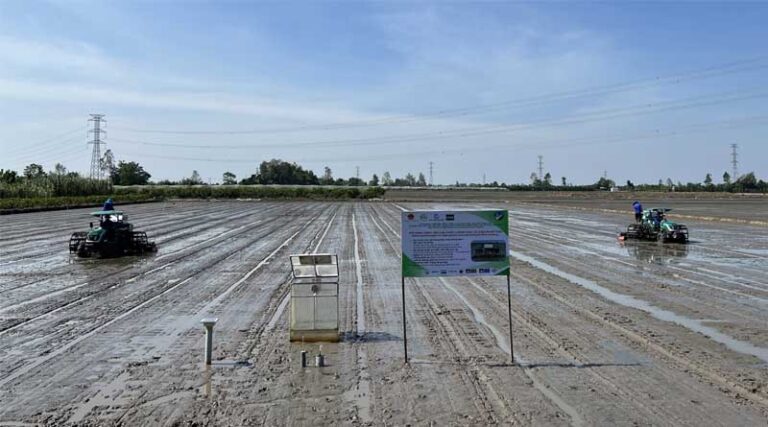
The delegation observed key components of the high-quality, low-emission rice farming model, including mechanized direct seeding combined with deep placement of fertilizers, water-level monitoring devices used for AWD water management, outdoor straw mushroom cultivation, and rice straw-based composting. New Green Farm Cooperative currently engages more than 100 farming households in its rice production value chain, covering an area of over 148 hectares.
With technical support from IRRI, the cooperative has not only adopted advanced agronomic practices and mechanization for high-quality, low-emission rice cultivation but has also developed an efficient utilization of rice straw by-products following a circular economy approach. These innovations have enabled farmers to enhance production efficiency, increase profitability, and reduce greenhouse gas emissions.
Vice Minister Tran Thanh Nam highlighted that over the past two years, authorities and experts have established the technical, legal, and operational foundations for the One Million Hectares High-Quality and Low-Emission Rice (1mHa) Program. Pilot models show promising results, with Monitoring, Reporting, and Verification (MRV) data providing a basis for results-based payment mechanisms. He emphasized that scaling up these models will enable farmers to achieve sustainable benefits and higher incomes through green production. Currently, nearly 400,000 hectares of rice are under sustainable cultivation practices, including 20,000 hectares registered to implement the MRV protocol in the 2025–2026 Winter-Spring season.
Ms. Mariam J. Sherman, World Bank Division Director for Viet Nam, Cambodia, and Lao PDR, emphasized the World Bank’s strong support for accelerating the One Million Hectares Rice Program, highlighting it as a flagship model of Vietnam’s green transformation and a reference for other low-emission agricultural initiatives. She noted that once the final feasibility study is completed, the project can move immediately into the implementation phase.
The mission not only provided additional momentum for local authorities but also marked an important step toward harmonizing financial and technical mechanisms between the World Bank and the Government of Vietnam. This alignment is essential to ensure that the One Million Hectares of High-Quality, Low-Emission Rice Program in the Mekong Delta is implemented on schedule and becomes a pioneering model for the region.
The innovation of 1mHa rice production was partially supported by the World Bank through MOM-P project and the CGIAR Scaling for Impact program.
Also Read: Cargill Chair and CEO Brian Sikes joins Deere & Company’s Board of Directors
📢 If You’re in Agriculture, Make Sure the Right People Hear Your Story.
From product launches to strategic announcements, Global Agriculture offers unmatched visibility across international agri-business markets. Connect with us at pr@global-agriculture.com to explore editorial and advertising opportunities that reach the right audience, worldwide.