Making Adaptation Measurable: CGIAR, the Global Goal on Adaptation, and the COP30 Outcome
17 January 2026, UAE: CGIAR played a direct role in shaping the Global Goal on Adaptation (GGA) outcome at COP30, contributing scientific expertise to the development of the Belém Adaptation Indicators under the United Arab Emirates–Belém work programme.
While expectations for a fully operational framework for GGA were tempered during the negotiations, the outcome is still crucial, particularly for food, land, and water systems, and for the role of scientific expertise in shaping global adaptation policy.
The GGA aims to enhance adaptive capacity, strengthen resilience, and reduce vulnerability to climate change. Yet adaptation has long lagged behind mitigation in one critical respect: how to measure progress in ways that are credible, comparable, and policy-relevant without becoming prescriptive or punitive.
At COP30, Parties adopted the Belém Adaptation Indicators, formally concluding the United Arab Emirates–Belém work programme on indicators for measuring progress toward the GGA. Of the 100 indicators proposed by technical experts, 59 were adopted (9 water indicators, and 5 agriculture indicators – two themes where CGIAR scientists served as technical expert), accompanied by strong language emphasizing that they are voluntary, non-prescriptive, non-punitive, facilitative, and country-driven, and that they should not create additional reporting burdens or be linked to access to finance.
The decision also launched the Belém-Addis Vision on Adaptation, a two-year, Party-led policy alignment process aimed at developing further guidance on how these indicators can be operationalized, refined, and applied in national contexts. The cautious nature of the outcome reflected persistent political tensions, particularly concerns from developing countries around data availability, methodological gaps, and the risk that adaptation tracking could become misaligned with national priorities.
Despite these tensions, the adopted indicators send a clear signal: food, agriculture, and water are now firmly embedded within the core architecture of the Global Goal on Adaptation. Their inclusion reinforces a critical point for CGIAR: adaptation in food and land systems is no longer peripheral to the global adaptation agenda; it is central to it.
Water emerged as the most robustly articulated thematic area within the adopted framework. Of the indicators proposed by technical experts under the UAE–Belém work programme, nine out of ten water-related indicators were retained in the final decision, making water the thematic target with the highest number of adopted indicators under the GGA.
This outcome reflects not only the systemic importance of water for climate resilience across sectors, but also the strength of the technical work and sustained engagement between experts and Parties throughout the negotiation process. The breadth of the water indicators, spanning water scarcity, efficiency, infrastructure resilience, basin-level planning, and equitable access, signals a shared recognition that adaptation progress cannot be credibly tracked without addressing water systems in a comprehensive and integrated manner.
A defining feature of the COP30 outcome was the explicit recognition of expert input. The CMA decision expresses deep appreciation to the experts convened under the UAE–Belém work programme and recognizes their final list of proposed indicators as a key knowledge product.
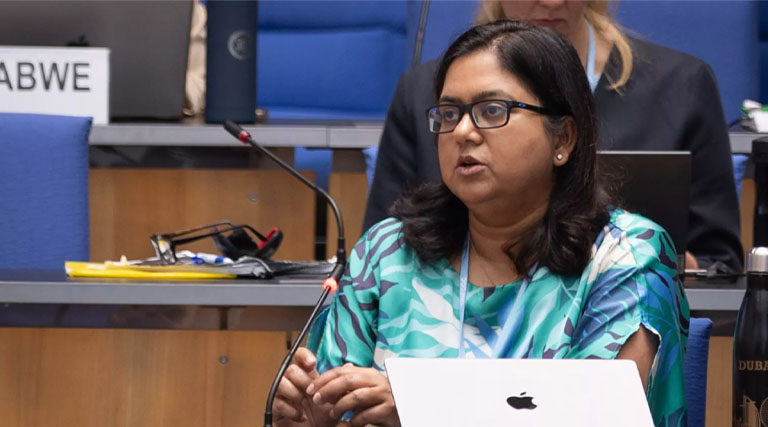
Among these experts were two CGIAR representatives: Aditi Mukherji (ILRI), contributing to indicators on water, and Lucy Njuguna (Alliance of Bioversity and CIAT), contributing to indicators on food systems and agriculture.
Both experts were part of a geographically balanced, multidisciplinary group supporting the technical design of the indicators adopted in Belém, working alongside Parties and other institutions to ensure scientific robustness while remaining attentive to national circumstances.
Negotiations in Belém made one point unmistakably clear: indicators alone do not deliver adaptation. Many Parties emphasized that without clearer methodologies, stronger data systems, and significantly increased finance and capacity support, adaptation tracking risks becoming an exercise detached from on-the-ground realities.
This recognition creates a strategic opening for CGIAR. The COP30 decision explicitly acknowledges gaps in data, baselines, and methodologies, and invites international organizations, research institutions, and climate funds to support the technical work ahead, particularly under the Belém-Addis Vision and the Baku Adaptation Road Map.
CGIAR is uniquely positioned to respond to this demand by: Stress-testing the Belém Adaptation Indicators using long-term, real-world data from diverse agro-ecological and socio-economic contexts; Supporting country-driven monitoring systems that align global indicators with national adaptation plans and local priorities; Helping bridge the gap between adaptation metrics and finance, ensuring that indicators used to justify investment reflect real resilience outcomes in food, land, and water systems; And keep directly supporting the UNFCCC Secretariat and Parties with our scientist part of the group of experts.
COP30 did not deliver a fully operational framework for the Global Goal on Adaptation. But it did something arguably more important: it made explicit the limits of negotiation without evidence.
By adopting indicators while openly acknowledging their limitations, Parties have signaled a growing reliance on scientific and applied research organizations to help close the gap between global ambition and national implementation. Through the direct contribution of its experts to the UAE–Belém work programme, CGIAR has already helped shape the foundations of this framework.
As the Belém–Addis policy alignment process unfolds and Parties move toward implementation and review, CGIAR’s research, data, and partnerships will be critical to ensuring that the GGA becomes not just measurable, but meaningful for farmers, communities, and food systems on the frontlines of climate change.
Also Read: Brazil 2025 Pesticide Approvals: Company-wise List with Brand Name, Product and Type
Global Agriculture is an independent international media platform covering agri-business, policy, technology, and sustainability. For editorial collaborations, thought leadership, and strategic communications, write to pr@global-agriculture.com