Seed2Grow Spotlight: Elysia Creative Biology’s Eli Hornstein
05 February 2026, North Carolina: Elysia Creative Biology, one of the N.C. Plant Sciences Initiative’s first Seed2Grow startup companies, continues to gain ground in its quest to create bioengineered feed crops that tackle key livestock production challenges.
The company is gearing up for animal trials to test the effectiveness of its feed crops in improving cattle yields while reducing emissions of methane, a greenhouse gas. At the same time, it’s exploring ways to create feed crops with traits that would boost animal health and farm efficiency in other ways — by allowing for better fertility management, for example, or improved disease and parasite control.
Elysia founder Eli Hornstein says that over the last 18 months, the company has progressed its technology, hit major funding milestones, built a six-member team and produced its first crop varieties.
We started in 2022 with the goal of reducing methane, but … we realized that there was no particular reason to stop there.
With headquarters in the agricultural technology incubator at NC State University’s Plant Sciences Building, Elysia is one of seven Seed2Grow companies. The program helps university faculty, students, young alumni and others bring their plant sciences discoveries to the marketplace.
Since joining the program, Hornstein has won funding from Spark Climate Solutions, Safar Partners and Blueridge Climate Ventures, and a highly competitive Activate Fellowship for science entrepreneurship.
Hornstein, who earned a Ph.D. from NC State’s Department of Plant and Microbial Biology in 2022, recently discussed how he taps into Seed2Grow, provided an update on the company’s progress and his plans for 2026.
What’s new with Elysia?
We started in 2022 with the goal of reducing methane, but as we talked to people in the industry, we realized that there was no particular reason to stop there. So we’ve taken the one approach we are using and spread it out into a bigger pipeline, working with traits for eight different biological compounds.
Our intellectual property has moved ahead with new patents and international filings.
Our team has grown. In addition to me, we have two people full-time in the lab, someone leading the business side of things who has been an executive several times in agriculture and several part-time team members.
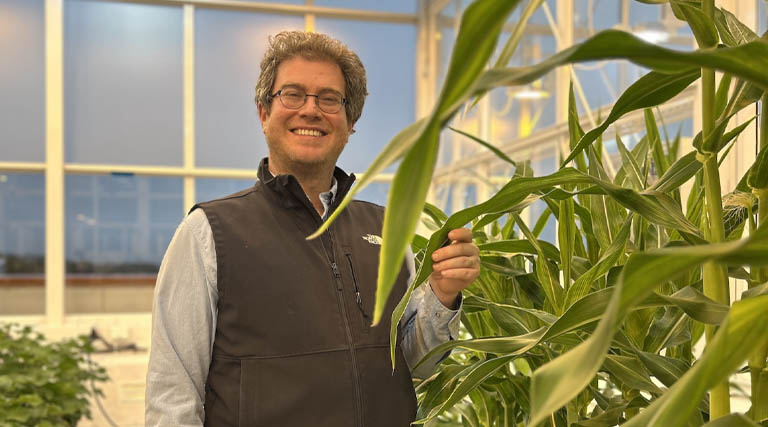
On the technical side, we went from having something in the lab to our first elite crop varieties. We have corn in the greenhouse and multiple types of plants in our growth chambers. That’s a big jump. Behind the scenes, our intellectual property has moved ahead with new patents and international filings.
What are the advantages of expanding the focus?
To me, figuring out how to make things move faster is key to the whole industry of plant biotechnology. The biggest barrier has always been that it’s slow. Working on multiple candidates gets rid of the downtime that comes while we’re waiting on things to grow.
There’s always something moving ahead, and I like the idea of figuring out ways to do the work better and faster.
Also, at an early stage, it reduces our risk. Having a pool of products to work on allows us to avoid putting all our eggs in one basket.
There’s always something moving ahead, and I like the idea of figuring out ways to do the work better and faster.
Another consideration is that while pretty much every farmer we have talked to is aware of the methane problem and would like a solution, farmers never mention it as one of their top concerns. It’s feed inefficiency. It’s disease. And, at this moment, it’s often water and drought. If you’re talking to dairy farmers, it’s how many cows had a calf this year.
We realized, ‘Wait, we have things for everything on this list.’ Some of the plant traits we originally tested to reduce methane look like they also get at one or more of these other problems. If we can bundle these traits together, it’ll be something that people really want.
And if it gets widespread use, that’s where the impact will come from.
What are you focusing on right now?
Since the beginning of 2025, we’ve been firming up relationships with other companies in biotech and animal nutrition, because the whole benefit of our approach is that we fit into the existing supply chain. That’s our superpower. We’ve been talking to the most important companies in the space, asking them what they need from us to do pilot projects, what types of partnerships interest them and which things we’re working on look relevant to them.
Relationships take time to build, but getting them in place by the time we bring something to market — which is coming up sooner than I might’ve once thought — is important.
Companies on the other side of the farm are also key — dairy co-ops and those that buy meat and milk from farmers and bring them to customers. There are also third parties that are purchasing milk and turning it into yogurt or ice cream or other items. They have a lot of say about how things are produced on the livestock farm, and we need to make sure that what we are proposing fits their standards.
Relationships take time to build, but getting them in place by the time we bring something to market — which is coming up sooner than I might’ve once thought — is important. That, fundraising and tech development fill my time.
What’s next for Elysia Creative?
We’re moving all those traits ahead on the conveyor belt from the lab to crops to further studies. I hope our animal trial will be done this year. That’ll be a third-party trial under farm conditions, with greenhouse-grown plants fed to livestock. It could be our turning point. Once you have that type of data in hand, you can move into the regulatory process and attract more commercial attention.
While it continues to be a very hard time for startups, especially in agriculture, I’m pleased that we’ve got enough money to keep the work going for quite a while. We hope to be able to share news of additional funding soon, and with a little more in the bank, we’ll be able to expand and move faster.
How have you benefited from your Seed2Grow membership?
You don’t know how hard it is to build a great team until you start hiring for the first time. Having space in the Plant Sciences Building is an incredible asset for this. We get to know the research groups in the building and understand how they work, as well as all the people from the state and national plant science community that are drawn into the PSB for events. That puts us in a great position when it comes to hiring.
Being part of Seed2Grow has also helped us bring in other types of support. We’ve gotten funding from national programs, and I think we were able to do it because we were able to say, ‘We have a great network, and we have a great facility to do the work. We’re ready.’
We’ve learned enough that we can help other researchers who are interested in commercializing their technology and new startups that are coming in, and that’s rewarding.
It also helps that the N.C. PSI has a system for getting startups in front of industry leaders and investors. Those connections often lead to other introductions that are important to us. We’ve been able to meet fine people in government and in biotech crop development who’ve generously shared their advice.
Now, we’re trying to return that generosity. I feel like we’ve learned enough that we can help other researchers who are interested in commercializing their technology and new startups that are coming in, and that’s rewarding.
Also Read: UPL Q3FY26: Revenue Up 12%, EBITDA Up 13% as Seeds and Crop Protection Drive Growth
Global Agriculture is an independent international media platform covering agri-business, policy, technology, and sustainability. For editorial collaborations, thought leadership, and strategic communications, write to pr@global-agriculture.com