Small “Superhero” Robots to Transform Labour-Intensive Vegetable Farming
27 January 2026, New Delhi: At first glance, grocery store shelves stacked with fresh tomatoes and peppers may seem unremarkable. Yet behind this abundance lies some of the most labour-intensive work in agriculture, much of it still done by hand. At North Carolina State University, researchers are working to change that narrative with a new generation of intelligent farm robots inspired, quite fittingly, by superheroes.
In the Marvel universe, Thor is known for his mythical hammer and superhuman strength. At NC State, Thor is a hammer-wielding robot being trained for a far more down-to-earth task: supporting vegetable crops in the field.
Researchers at the N.C. Plant Sciences Initiative (N.C. PSI) are developing AI-powered robotic systems designed to take on some of the most physically demanding and repetitive jobs in fruit and vegetable production. From staking tomato plants to harvesting ripe produce, these machines aim to ease labour shortages while improving efficiency and precision on farms.
From her home office, Andrea Monteza, Director of the N.C. PSI Makerspace and a mechatronics engineer, shared renderings of Thor alongside another robot known as SpiderBot, designed to weave twine around crops. Mounted on an autonomous platform roughly the size of a golf cart, the system uses onboard stereo cameras for 360-degree vision, while LiDAR sensors scan and map crop rows and help the robot navigate uneven terrain.
“It’s similar to how a Roomba uses cameras and sensors to map a house,” explained Emmanuel Torres, Professor of Horticultural Science at NC State, who is collaborating with Monteza on the project.
While large-scale mechanisation is common in crops such as corn, wheat, soybeans and cotton, many fruit and vegetable systems remain heavily dependent on manual labour. Crops like tomatoes and peppers become top-heavy as they grow and must be supported with stakes and layers of twine to prevent them from collapsing onto the ground, where they are more vulnerable to disease.
Installing these support systems requires workers to drive thousands of stakes into the soil using heavy tools and repeatedly add twine as plants grow taller. The work is physically demanding, costly, and increasingly difficult to staff.
Torres and Monteza believe robotics could help automate these tasks, reducing the strain on farm labour while maintaining crop quality.
Building Super-Powered Agricultural Tools
Thor is one of several robotic tools under development, each named after a superhero and designed for a specific function. For a tomato-staking robot to work effectively, it must hammer stakes at precise intervals without damaging plants, a challenge that requires advanced sensing and decision-making.
To train robots to recognise crops and distinguish them from weeds or obstacles, the team first needed vast amounts of visual data. That led to the creation of another system: Hawkeye.
In the Marvel universe, Hawkeye is known for exceptional eyesight. At NC State, Hawkeye’s strength lies in computer vision. Developed with support from the North Carolina General Assembly-funded Ag Analytics Platform and the U.S. Department of Agriculture, Hawkeye is a tractor-mounted imaging system equipped with high-resolution, wide-angle cameras and low-cost computing hardware.
The system captures top-down and side-view images of tomato plants, generating large datasets used to train AI models. During its first field trials last summer, Hawkeye collected more than 50,000 images, which will help improve the accuracy and reliability of robotic decision-making in the field.
Looking ahead, Monteza said similar systems could automate crop scouting, monitoring fields for pests, diseases and nutrient deficiencies, tasks that currently require workers to walk through fields and visually inspect plants.
“We’re trying to make tools that are flexible enough for multiple potential uses,” she said.
Teaching Robots to Harvest with Care
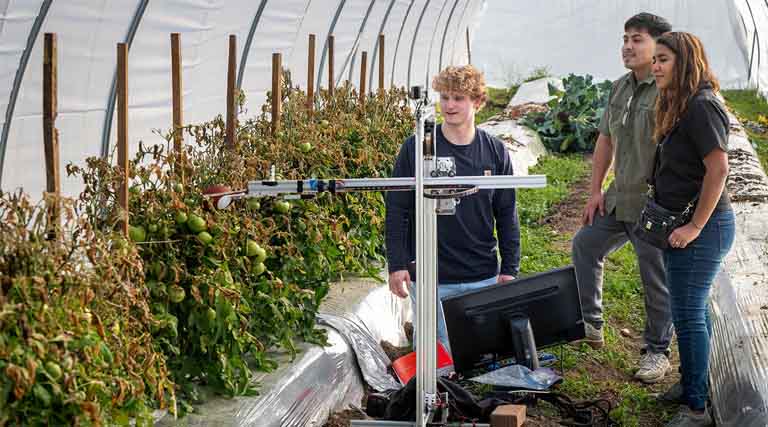
Beyond crop support, researchers are also tackling one of the most complex challenges in specialty crops: harvesting. In late November, students from an electrical and computer engineering senior design course tested prototypes for a robotic tomato harvester at NC State’s horticultural field lab.
The goal sounds simple but is technically demanding: identify ripe tomatoes, locate them precisely, and pick them without damaging the fruit. Tomatoes grow in unpredictable positions; some fully visible, others partially hidden among leaves, making automation far more complex than harvesting uniform grain crops.
One prototype, demonstrated by student Luke Holt, features a mechanical arm guided by artificial intelligence and a depth-sensing camera. A soft silicone gripper allows the robot to grasp tomatoes gently, reducing the risk of bruising.
While human workers are still faster and more efficient, the gap is narrowing.
“The beauty of machines is that they don’t need to stop,” Torres noted. “They can work all day and into the night.”
Beyond Superheroes
Not every robot has a superhero-inspired name. Another project underway, in collaboration with N.C. PSI faculty affiliate Lorena Lopez, focuses on pest monitoring. Lopez, an NC State Extension specialist in integrated pest management, is working with the team on a robotic system designed to collect insects from fields to identify pest populations more efficiently.
For now, the researchers are calling it simply “the bug vacuum,” with a prototype expected by March.
Together, these projects highlight how robotics, AI and engineering are steadily reshaping the future of horticulture, one superhero-inspired tool at a time.
Also Read: John Deere Enters a New Era of Excavators
Global Agriculture is an independent international media platform covering agri-business, policy, technology, and sustainability. For editorial collaborations, thought leadership, and strategic communications, write to pr@global-agriculture.com