FAI Annual Seminar 2025 Ends with Clear Push for Green Fertilisers, Digital Farming and Farmer-Centric Reforms
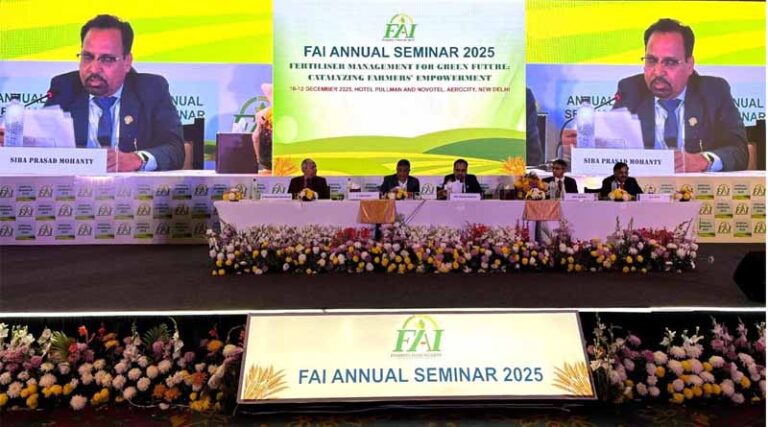
15 December 2025, New Delhi: The Fertiliser Association of India (FAI) on Friday concluded its 61st Annual Seminar 2025 in the national capital with a strong policy and industry consensus on accelerating green fertiliser pathways, strengthening domestic production, and placing farmers at the centre of India’s nutrient management strategy.
Held over three days at New Delhi, the seminar emerged as a key platform for shaping India’s fertiliser and nutrient roadmap at a time when the country is preparing for the next phase of climate-smart agriculture. Senior government officials, global experts, industry leaders, scientists and farmer representatives deliberated on policy reforms, sustainability, innovation and digital solutions to build a future-ready fertiliser ecosystem.
Industry Backs Responsible and Precise Nutrient Use
FAI President and Managing Director & CEO of Coromandel International Limited, S. Shankar Subramanian, said the transition to a green future must begin with the responsible and scientific use of fertilisers. He underlined that the fertiliser industry is working to enhance domestic manufacturing capacities, promote balanced and precise nutrient application, and ensure that farmers have timely access to modern technologies.
He added that FAI will continue to serve as a unified voice of the industry, supporting key policy reforms while working closely with farmers to promote sustainable farming practices. Special focus, he said, is being placed on the development and responsible marketing of new technologies, including nano fertilisers, to ensure their benefits are clearly understood and effectively delivered at the farm level.
Focus on Innovation That Reaches Farmers
Chief Guest Dr Himanshu Pathak, Director General, ICRISAT, Hyderabad, said the seminar played a critical role in strengthening dialogue on sustainable nutrient management and advancing innovations that directly benefit farmers. He emphasised the importance of aligning scientific innovation with on-ground realities to improve productivity while safeguarding natural resources.
FAI Director General Dr Suresh Kumar Choudhary said the seminar discussions were organised across four focused technical sessions. He noted that the inaugural session reflected key concerns and priorities outlined by Rajat Kumar Mishra, Secretary, Department of Fertilisers, Ministry of Chemicals and Fertilisers. Agriculture-centric deliberations were further strengthened by inputs from Devesh Chaturvedi, Secretary, Ministry of Agriculture and Farmers Welfare.
Policy, Production and Marketing in Focus
The first technical session, chaired by Anita C. Meshram, Additional Secretary, Department of Fertilisers, examined India’s evolving green fertiliser policies. The second session, chaired by Devesh Chaturvedi, focused on efficient nutrient management with farmer empowerment at its core. Solutions for green fertiliser production were discussed in the third session under the chairmanship of K. J. Patel, Managing Director, IFFCO, while fertiliser marketing and outreach formed the focus of the fourth session chaired by Dr Siba Prasad Mohanty, Vice President, FAI.
Experts across sessions highlighted the urgent need for reforms in the urea segment and stressed the strategic importance of boosting indigenous phosphorus and potassium (P&K) production to enhance India’s self-reliance. Global trends in green fertiliser policies and sustainability-driven transitions were also discussed in the Indian context.
Roadmap for a Self-Reliant Fertiliser Ecosystem
Concluding the seminar, Dr Siba Prasad Mohanty, Managing Director, HURL, presented the vote of thanks, acknowledging the collective contributions of policymakers, industry leaders, scientists and farmers. He said the discussions reflected a shared commitment to advancing sustainable, farmer-centric solutions in the fertiliser sector.
The 61st FAI Annual Seminar closed with a clear message: India’s fertiliser future will be driven by green technologies, digital agriculture, policy reforms and closer collaboration between government, industry and farmers—aimed at building a resilient, self-reliant and climate-smart agricultural ecosystem.
Also Read: DCM Shriram and Bayer Partner to Expand Work Across Agri-Inputs and Value Chains
📢 If You’re in Agriculture, Make Sure the Right People Hear Your Story.
From product launches to strategic announcements, Global Agriculture offers unmatched visibility across international agri-business markets. Connect with us at pr@global-agriculture.com to explore editorial and advertising opportunities that reach the right audience, worldwide.