CropLife India Flags Rising Risks from Unauthorised Pesticide Sales on E-Commerce Platforms
Calls for a joint government–industry framework to strengthen regulation, enforcement and platform accountability
27 January 2026, New Delhi: CropLife India has raised serious concerns over the unchecked sale of unauthorised crop protection products through e-commerce platforms, urging policymakers to urgently strengthen regulatory supervision, enforcement mechanisms and accountability in online pesticide sales.
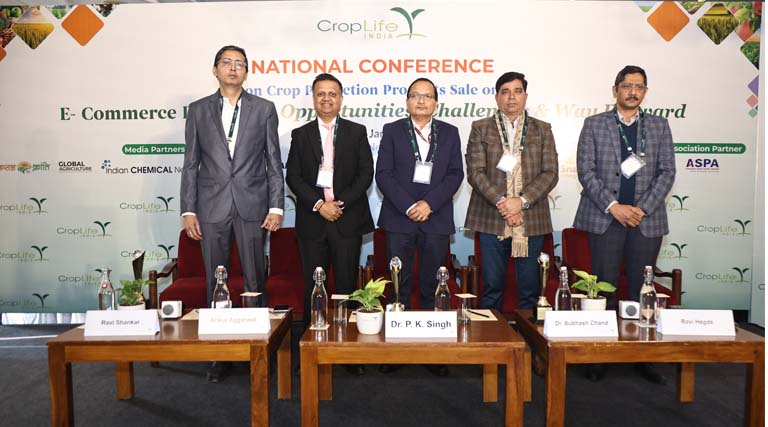
The issue was deliberated last week at CropLife India’s National Conference on Crop Protection Products Sale on E-Commerce Platforms, held in New Delhi. CropLife India highlighted that as the Government of India undertakes a comprehensive review of pesticide regulation through the Draft Pesticides Management Bill, 2025, the emerging risks associated with online sale and delivery of hazardous agri-inputs must be explicitly addressed.
Speaking at the conference, Dr. P. K. Singh, Agriculture Commissioner, Ministry of Agriculture & Farmers Welfare, observed that basic compliance checks by e-commerce platforms—such as verification of GST documents—are insufficient when hazardous products like pesticides are sold online. He emphasised the need for stronger quality assurance, traceability and accountability across the supply chain, noting that these aspects warrant careful consideration under the proposed legislation.
Dr. Subhash Chand, Secretary, Central Insecticides Board & Registration Committee (CIB&RC), underlined that while digitisation and e-commerce are expanding rapidly in rural India, they also introduce new regulatory challenges. He stressed that pesticides are inherently hazardous products and that responsibility for compliance, quality assurance and farmer safety must be shared by manufacturers as well as online platforms as digital sales grow.
Highlighting the role of digital infrastructure, Mr. Ravi Shankar, Domain Lead – Agriculture, ONDC, called for improved product cataloguing, advisory information and traceability mechanisms to help farmers identify genuine products and reduce the circulation of spurious inputs in online marketplaces.
Addressing the gathering, Mr. Ankur Aggarwal, Chairman, CropLife India, clarified that the industry is not opposed to online sale of pesticides. “This engagement is about ensuring that regulatory and enforcement frameworks evolve alongside digital commerce,” he said. “Tackling unauthorised products is a shared priority for policymakers and the crop protection industry, and it is critical for farmer safety, food security and consumer trust. The objective of this conference was to bring all stakeholders together to identify gaps and work towards an effective framework.”
CropLife India explained that crop protection products are currently regulated under the Insecticides Act, 1968 and the Insecticides Rules, 1971, which establish a tightly controlled system for sale and distribution. Under this framework, pesticides can only be sold by licensed sellers, for specific products endorsed on their licences, within approved geographic areas and supported by a valid Principal Certificate issued by the manufacturer or importer. These provisions are designed to ensure product authenticity, traceability and accountability throughout the supply chain.
However, the association pointed out that e-commerce platforms facilitating pesticide sales are not presently required to obtain licences or approvals under pesticide law, nor are they subject to explicit statutory obligations to verify whether products listed online are endorsed on a seller’s licence or supported by valid Principal Certificates. This regulatory gap, CropLife India warned, increases the risk of unauthorised products reaching farmers through digital channels.
The association further noted that pesticides are being sold online through both marketplace and inventory-based e-commerce models. In inventory-based models, products may be stored, handled and dispatched from warehouses that are not licensed under the Insecticides Rules—despite identical activities requiring licensing in the offline supply chain. This weakens regulatory oversight and makes inspection, sampling and traceability significantly more challenging.
CropLife India also clarified that Rule 10E of the Insecticides Rules, introduced through a 2022 amendment, permits online or doorstep delivery of pesticides but does not dilute existing requirements related to licensing, Principal Certificates, approved premises or geographic restrictions. The association noted that this provision has, in some cases, been misconstrued to suggest that online sale removes the need for statutory authorisations, thereby enabling unauthorised sales.
Under the current enforcement architecture, inspections and sampling are primarily conducted at licensed premises. In contrast, storage and movement of pesticides within e-commerce supply chains often fall outside routine regulatory supervision, limiting the ability of authorities to trace responsibility and take timely action against illegal or spurious products.
Mr. Aggarwal reiterated that while the Draft Pesticides Management Bill, 2025 aims to modernise and strengthen India’s regulatory framework, it does not yet explicitly address several e-commerce-specific gaps, including platform-level accountability, licensing requirements for inventory-based models and digital traceability across online supply chains. CropLife India said it will submit its consolidated recommendations through the formal consultation process.
“Digital commerce is an important and growing channel for agri-inputs,” Mr. Aggarwal said. “The way forward is regulated enablement. As sales models evolve, regulatory and enforcement frameworks must evolve as well—so that farmers receive genuine, compliant products and confidence in the system is maintained.”
Also Read: John Deere Enters a New Era of Excavators
Global Agriculture is an independent international media platform covering agri-business, policy, technology, and sustainability. For editorial collaborations, thought leadership, and strategic communications, write to pr@global-agriculture.com