Perth Hills Grower Now Ready For Mite Challenge
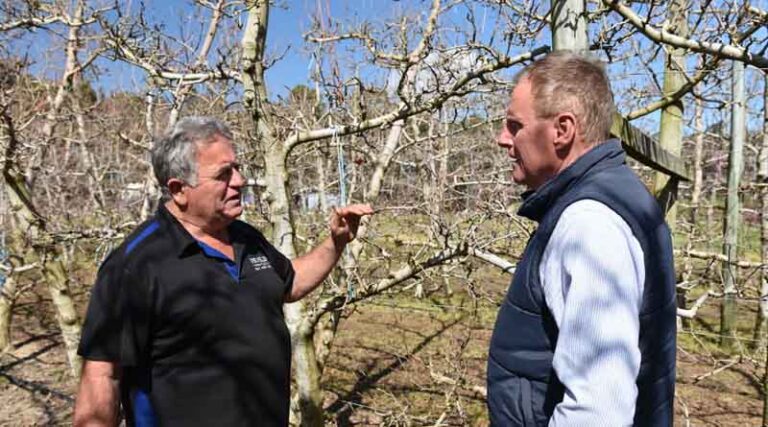
11 December 2025, AU: Tony Trichilo has been orcharding by himself in the Perth Hills for some time, however he says two-spotted mites have always kept him company.
“It’s not ‘if’ mites come. They are here every year and when you pick fruit, you know they are there because they crawl all over you – it’s horrible,” Tony said.
He said the mites can be more prevalent in hot and dry conditions and the last two summers in Perth have been some of the hottest on record.
“The year before last, the trees just cooked. We had a lot of 40-degree days in a row and it was very challenging. With limited water, burning fruit and without an effective mite control program, you end up with reduced quality.”
Ian Cook, Territory Business Manager in the region for Bayer, spends plenty of time driving through the region and echoed the recent challenges.
“The mites like a dry and dusty environment and breed prolifically in these conditions, and from around December onwards we see a build-up of dust on the leaf,” Ian said.
“Warmer night-time temperatures during this period also contribute to an increase in mite populations, as it aids a more rapid life cycle.”
Tony said the early new year period was fruit development stage for his apples, and it was still a while away until harvest in May, so an effective crop protection program was critical to ensure optimum yields and quality.
“The mites suck the nutrients out of the leaf and you will end up with small fruit. I have seen very ordinary fruit off trees that are not treated for mites.”
The only child of Italian migrants, Vince and Philomena, who settled into the Jarrahdale area in 1955 and initially grew vegetables before establishing an orchard in the 1960s, Tony today grows a range of pome and stone fruit on the property.
Whilst predominantly growing Pink Lady apples, he also grows Sundowner, Granny Smith and Gala apple varieties, and a range of stone fruit including white and yellow flesh nectarines and peaches.
Vince earlier worked at the local sawmill or helping to clear agricultural land before gradually increasing the family’s Longvalley Orchard holding to 20 hectares. About 12 hectares is under cultivation and Tony has continued to establish higher density tree plantings, more recently of peaches, nectarines and Pink Lady apples, including some via trellising.
The property’s produce finds a home in WA supermarkets through local wholesaler, Mercer Mooney.
Tony said the fruit could be hit with a 50% downgrade if miticides were not available to be applied against the two-spotted mites.
He said fortunately, many products had become available over the years, however many were now less effective, particularly if not applied in combination with other miticides.
“We’ve had SanMite, Apollo, Calibre, Acramite, Omite, Vertimec, Kanemite, Pyranica, Paramite. It’s seven different (insecticide chemistry) groups.”
“Some growers are mixing Omite and Paramite and that tank-mix can be satisfactory, but it’s expensive.”
Tony was on the lookout for a new miticide last season and spoke with Michael Murray of local rural retailer, Delta Agribusiness at Hazelmere, before taking an opportunity to trial the new Interrupt® 240 SC Miticide from Bayer.
“It’s a new active in Australia (spiromesifen) and is newer Group 23 (chemistry) into these crops,” Tony said.
Ian said Interrupt acted on all life stages of two-spotted mite, mostly through contact and via translaminar movement across the full leaf, and it provided up to 21 days residual control.
“Interrupt acts on eggs and nymphs via contact, but it also drastically reduces the ability for adult female mites to lay eggs. If eggs are laid following an application, they will not be viable,” he said.
“This impact across all life stages leads to a rapid reduction in mite numbers.”
Tony said he applied Interrupt to some dense, trellised apple trees in mid-January through his airblast sprayer at a rate of 50 mL/100 L to the point of run-off.
“I chose the lower label rate because the mite threshold at the time wouldn’t have been more than 10%, but applying early gives better longevity of control. And why wouldn’t you apply less chemical if you can. I want to apply less, not more.”
“The total spray solution was 2000 L/ha, so it was effectively 1 L/ha of product. You have to get good coverage and a good calibrated sprayer at 2000 L/ha is great.”
He said the application was performed early in the morning before a warm day followed, and he quickly noticed a decrease in mite numbers.
“When I monitored it another two to three days later, it was hard to see anything moving – and you could just touch them and they were dead. Other products can still be good, but you will see them moving a few days later.”
Tony said he was also impressed with the length of control provided by Interrupt, aided by the fact it offered the new mode of action for controlling two-spotted mites.
“It was only mid-January and still a long way to go until harvest in May, but I didn’t have to go back with any other product, so it was a saving in chemical and time.”
“For other areas I sprayed with another product, I had to follow up with another spray.”
He said Interrupt was an excellent product and it was very important to now have it in his insecticide arsenal, including as another option for resistance management.
“Having a product in the shed that you know works takes the pressure off. In my experience, I can have 10 things in the shed, but they don’t work as well.”
“The 14-day (harvest) withholding period is also good. It’s good for stone fruit, because nectarines can get ripe and be harvested in February, so you can apply and know you have got 14 days.”
Tony said he planned to make good use of Interrupt during the upcoming season.
“I will definitely do all the pome fruit with it and will do one block of stone fruit. Using just 1 L/ha has opened the door to say that I will definitely use it on all of the apples.”
📢 If You’re in Agriculture, Make Sure the Right People Hear Your Story.
From product launches to strategic announcements, Global Agriculture offers unmatched visibility across international agri-business markets. Connect with us at pr@global-agriculture.com to explore editorial and advertising opportunities that reach the right audience, worldwide.