Bharat-VISTAAR: India’s AI-Powered Farmer Advisory Platform — Key Questions Answered
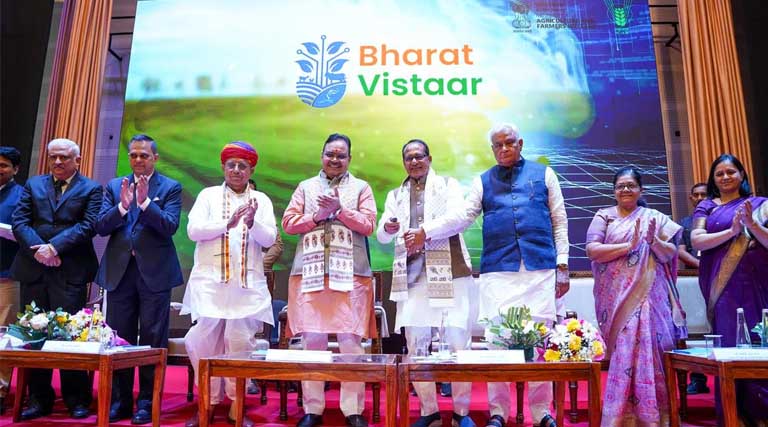
17 February 2026, New Delhi: India has taken a significant step toward embedding artificial intelligence into its agricultural extension ecosystem with the launch of Bharat-VISTAAR, an AI-enabled platform designed to provide farmers with real-time, voice-based advisory services. Positioned as a public digital infrastructure initiative, the platform seeks to bridge the long-standing gap between agricultural research, government services, and on-ground decision-making.
Below is a comprehensive FAQ to help understand what Bharat-VISTAAR is, how it works, and why it matters in the context of global agricultural transformation.
What is Bharat-VISTAAR?
Bharat-VISTAAR is an AI-driven agricultural advisory platform launched by the Government of India to deliver timely, science-based information directly to farmers. It combines artificial intelligence, institutional agricultural knowledge, and government scheme databases to provide a single access point for crop guidance, weather insights, market intelligence, and policy support.
The initiative reflects India’s broader strategy of integrating digital public infrastructure into agriculture, similar to how fintech and identity platforms transformed service delivery in other sectors.
How can farmers access the Bharat-VISTAAR service?
The platform is designed as a voice-first system, ensuring accessibility even for farmers without smartphones or internet connectivity. Farmers can dial the dedicated number 155261 and ask questions in natural language. The AI system processes the query and delivers immediate, contextual responses.
This approach reduces dependence on apps, downloads, or physical visits to extension offices.
What kind of information can farmers receive?
Bharat-VISTAAR provides advisory across the agricultural value chain. Farmers can seek guidance on optimal sowing periods, pest and disease management, fertiliser application, irrigation scheduling, and localised weather forecasts. The system also offers mandi price information across markets, helping farmers make informed marketing decisions.
In addition, the platform connects users to details of government programmes, eligibility criteria, and application status, creating a unified advisory-and-services interface.
How is artificial intelligence being used in the platform?
AI functions as the platform’s decision-support engine. It interprets farmer queries conversationally, draws from agronomic databases, weather models, and institutional recommendations, and generates tailored responses. Over time, the system is expected to improve accuracy through continuous learning and integration of field-level data.
Unlike static advisory models, AI enables dynamic, real-time problem solving, which is especially critical in climate-sensitive agriculture.
Which institutions are supporting the initiative?
The platform is being developed in collaboration with India’s agricultural research and extension ecosystem, including ICAR institutes, agricultural universities, and Krishi Vigyan Kendras (KVKs). Their validated scientific knowledge forms the backbone of the advisory framework delivered through the AI interface.
This integration ensures that recommendations remain research-driven rather than purely algorithmic.
In which languages is Bharat-VISTAAR available?
The initial rollout supports Hindi and English, with plans to expand into multiple Indian languages. The multilingual strategy is essential in a country where agricultural practices and communication patterns vary widely across states.
Language localisation is expected to be a key factor in adoption, particularly among smallholder farmers.
How does this differ from existing agri-advisory apps?
Most digital agriculture tools rely on smartphone penetration and user literacy in navigating applications. Bharat-VISTAAR removes that barrier by using voice as the primary interface, making it inclusive for farmers with limited digital familiarity.
It also integrates advisory, scheme access, and grievance support into one system, rather than functioning as a standalone information app.
Will the platform replace traditional extension services?
No. Bharat-VISTAAR is intended to complement, not replace, existing agricultural extension networks. Field officers, local institutions, and demonstration-based learning will continue to play a vital role. The AI platform enhances these systems by providing continuous, on-demand access to information between physical interactions.
Globally, hybrid models combining human expertise with digital intelligence are emerging as the most effective extension strategy.
What role does this play in India’s broader agri-digital strategy?
The launch signals India’s transition toward a data-enabled, decision-support agriculture model. By linking advisory services with farmer databases, soil health records, and scheme delivery systems, Bharat-VISTAAR could evolve into a foundational layer for precision policy implementation.
Such integration aligns with international trends where governments are investing in digital advisory ecosystems to improve productivity, traceability, and climate resilience.
What are the potential benefits for farmers?
If implemented effectively, the platform can reduce information asymmetry, shorten response time during crop stress, and enable better input and marketing decisions. This may lead to cost optimisation, improved yields, and stronger alignment with market demand.
For smallholders, in particular, the value lies in democratising access to knowledge that was previously fragmented or delayed.
Are there challenges to scaling such a platform?
Adoption, accuracy, and trust will determine success. AI systems must remain regionally contextual, scientifically validated, and linguistically precise. Ensuring last-mile awareness, continuous data updating, and seamless coordination between digital and physical extension services will be critical.
These are challenges faced by digital agriculture initiatives worldwide, making Bharat-VISTAAR an important case study for large-scale public-sector AI deployment in farming.
Why is this launch significant globally?
India manages one of the world’s largest and most diverse agricultural systems. Deploying AI at this scale demonstrates how emerging economies can leverage public digital infrastructure to deliver advanced services inclusively. As countries explore climate-smart and data-driven agriculture, Bharat-VISTAAR represents a model of integrating technology with national extension frameworks rather than relying solely on private agri-tech solutions.
Also Read: France Becomes First Market to Approve Syngenta’s X-Terra Hybrid Wheat
Global Agriculture is an independent international media platform covering agri-business, policy, technology, and sustainability. For editorial collaborations, thought leadership, and strategic communications, write to pr@global-agriculture.com