Banni Buffalo: The Resilient Dairy Breed of the Kachchh Grasslands
16 February 2026, New Delhi: The Banni buffalo is an indigenous dairy breed found primarily in the Banni grasslands of the Kachchh district of Gujarat, one of India’s most distinctive agro-ecological regions. This landscape is characterised by highly calcareous, saline, sandy-loam soils with poor water-holding capacity, low permeability, and vulnerability to erosion. Despite such harsh conditions, the breed has evolved into a remarkably hardy animal, deeply integrated into the pastoral lifestyle of the Maldhari community.
Historically, the Maldharis are believed to have migrated from Halieb in Afghanistan nearly 500 years ago, bringing their livestock in search of grazing resources. Over time, the buffaloes adapted to the unique ecosystem of the region and came to be known as “Banni,” named after their native tract.
Native Tract and Production Environment
The breeding tract lies between longitudes 68°56′ to 70°32′ E and latitudes 23°19′ to 23°52′ N, covering the arid and semi-arid grassland ecosystem of Banni. The environment experiences extreme climatic variability, yet the breed thrives under these stress-prone conditions, demonstrating exceptional adaptation to local climate and traditional management systems.
Banni buffaloes are primarily reared for milk production and are well suited to extensive production systems, particularly night grazing—a distinctive practice in which animals graze during cooler nighttime hours to cope with daytime heat and sparse forage availability.
Community-Based Breed Conservation
The breed is closely associated with pastoral management traditions. Maldhari households typically maintain herds ranging from 15 to 25 animals, although herd sizes may vary between 10 and 150 animals depending on grazing access and family resources. A herd book has been established, and conservation and promotion efforts are supported by the Banni Pashu Ucherak Maldhar Sangathan, a community-led breeders’ organisation working to sustain the genetic identity of the breed.
Physical Characteristics and Breed Identity
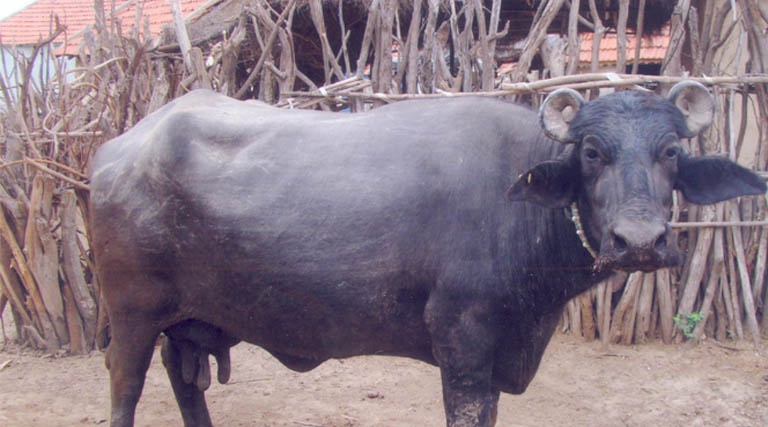
Banni buffaloes are visually striking and well adapted structurally to extensive grazing conditions. The animals are predominantly black in colour, though copper-toned individuals are occasionally observed. Their horns are one of their most recognisable features—medium to large, heavy, and curved vertically upward, often forming an inverted single or double coil, with a diameter of 24 to 30 cm in adult animals.
Morphologically, females are slightly longer-bodied than males, a characteristic linked to dairy functionality. Average measurements indicate a height of about 137 cm in females and 138 cm in males, with heart girth measuring roughly 204 cm and 214 cm respectively, reflecting strong thoracic development essential for endurance grazing.
Management Practices: Designed by Ecology
The production system remains largely extensive and pasture-based. Animals graze freely in the Banni grasslands, particularly at night, allowing efficient utilisation of natural forage while minimising heat stress. In some parts of Kachchh and elsewhere in Gujarat, livestock keepers have adopted semi-intensive systems.
Supplementary feeding is selectively provided to lactating and advanced pregnant animals to maintain productivity, but the breed largely depends on natural grazing resources, making it highly economical to rear under low-input systems.
Dairy Performance and Product Quality
The Banni buffalo is recognised for its strong dairy potential under minimal-input conditions. The average age at first calving is about 40.3 months, while the calving interval averages 12.24 months, indicating steady reproductive efficiency.
Milk production averages approximately 2,857 kg per lactation, with recorded yields ranging from 1,095 kg to as high as 6,054 kg in well-managed animals. One of the breed’s most valued attributes is its high milk fat content, averaging 6.65 percent and reaching up to 12.1 percent in some cases, making the milk highly suitable for traditional dairy products such as ghee, khoa, and fermented preparations.
Adaptation: The Breed’s Greatest Strength
Perhaps the most defining trait of the Banni buffalo is its ecological resilience. The animals are uniquely adapted to survive and produce under saline soils, scarce water availability, and seasonal fodder fluctuations. Their ability to walk long distances, utilise coarse grasses, and maintain productivity under stress makes them an important genetic resource for climate-resilient dairying.
This adaptability is increasingly relevant in the context of climate change, where breeds capable of sustaining production in marginal environments are becoming strategically important for livestock-based livelihoods.
Population Trends and Conservation Concerns
Livestock census and survey estimates highlight fluctuations in population over time. The breed recorded a population of 525,115 animals in 2007 according to the 18th Livestock Census of Gujarat. Subsequent estimates in 2013 placed the population at around 239,572, indicating the need for continued conservation attention and structured breeding programmes.
Such changes underline the importance of community institutions, scientific breeding strategies, and policy support to ensure that this locally adapted genetic resource does not decline under pressures of crossbreeding and changing land-use patterns.
A Model for Climate-Smart Indigenous Livestock
The Banni buffalo stands as a compelling example of how indigenous breeds evolve alongside culture, ecology, and livelihood systems. Its survival in one of India’s most fragile grassland ecosystems, combined with strong milk quality and low-input management requirements, positions it as a model for sustainable dairy development in arid and semi-arid regions.
Also Read: JK Tyre Launches ‘Shresth Plus’ Tractor Tyre for Modern Agricultural Applications
Global Agriculture is an independent international media platform covering agri-business, policy, technology, and sustainability. For editorial collaborations, thought leadership, and strategic communications, write to pr@global-agriculture.com