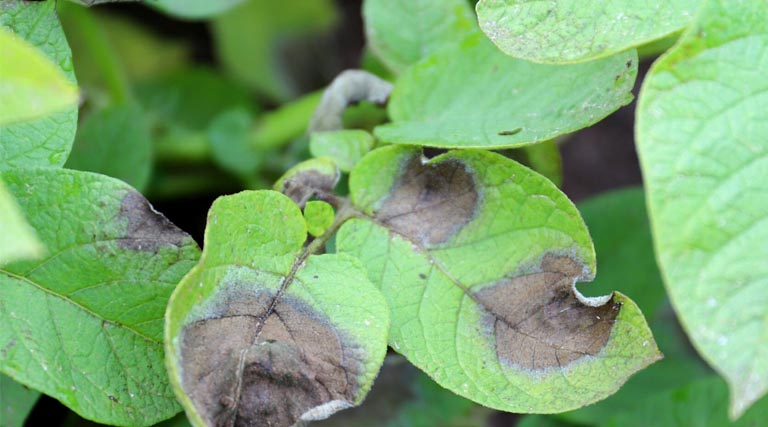
Early Release Of Euroblight Blight Monitoring Results For The 2025 Potato Crop
14 February 2026, UK: The EuroBlight monitoring team, which identifies and tackles the challenges that early and late blight pose in Europe and worldwide, has published its first set of results for the 2025 potato season. This early update comes as growers continue to be concerned about the impact of newer late blight strains, particularly the EU43 and EU46 clonal lineages of Phytophthora infestans.
Scientists from The James Hutton Institute play a key role in both the management group of EuroBlight, a multi-disciplinary, multi-actor consortium and network, launched with initial funding from the EU, and on the analysis of samples received. Dr David Cooke said, “Warm and dry weather across many potato-growing regions last year, especially from March to July, reduced blight pressure for much of the season. More than 1,200 samples from sponsors across Europe were genotyped.”
Key findings so far
- The P. infestans population in Europe remained dominated by the EU36 genotype, which made up around one third of samples.
- The decline in EU43 has stabilised. Its overall frequency rose slightly but increased strongly in France. EU43 was also found in Switzerland and Latvia for the first time.
- EU46 increased from 4% to 7% of samples and spread to more countries, including England, Norway, Sweden, Latvia and France.
- EU36 dominated in western and central Europe, while more genetically diverse “other” types were more common in north-eastern Europe.
- The relatively new clones, EU43 and EU46, with reported resistance to some active fungicide ingredients, have been broadly suppressed through modified approaches to fungicide use, with more mixing and alternation of the Fungicide Resistance Action Group (FRAC) active ingredient groups. More information on EU43 and EU46 and fungicide resistance can be found in this recent paper, New Mechanisms of Resistance to CAA and OSBPI Fungicides in Phytophthora infestans
Late blight remains a major threat to potato and tomato crops globally. In Europe alone, late blight costs an estimated €900 million each year in control measures and crop losses, rising to more than €5 billion worldwide.
The overall frequency of EU43 had decreased from 23% in 2023 to 9% in 2024 with a slight increase to 12% of all early samples in 2025, and a marked variation between countries
- Netherlands reported 20%, from a sample of 69
- Germany,12% from a sample of 58
- Belgium, 13% from a sample of 30
- Denmark 4% from a sample of 103
- France a notable increase from 10% to 25%, from a sample of 345
Although the frequency of EU46 sampled across European crops increased from 4% in 2024 to 7% in 2025, again there was considerable regional variation.
- Decreased in the Netherland to 1%, from a sample of 69Not detected in Denmark, from a sample of 103Increased in Belgium to 5%, from a sample of 39Increased in Great Britain to 20%, from a sample of 278Broadly the increase due to a range expansion to England, Norway, Sweden, Latvia and France
- EU36 made up 43% of samples in the Netherlands
- 64% in France, and74% in BelgiumBar a single sample in Denmark, it was not found in the Nordic countries
- EU41 increased slightly from 2% in 2024 to almost 5% in 2025 and remains localised, mainly in Norway and Denmark, where it comprised 2-5% of the population and in Scotland, where it comprised 25% of the 113 samples. In Denmark, all 10 isolates of EU41 were found at the same trial location
- EU45 which had been steadily expanding after its initial sampling in 2019, to comprise 4% of the samples in 2024, fell to 1% with its range expanded to eight countries, including Poland
- EU37, which is resistant to fluazinam, stayed at a very low level, around 1%, compared to its high of 14% in 2017 and 2018
- EU47, which has novel virulence against R8 and R9 resistance genes, was first reported in 2024 but was not detected in 2025. This may be linked to the reduced blight pressure and smaller population size
Around one third of samples fell into the highly diverse “Other” category, double the proportion seen in 2024. This is due to a higher proportion of 2025 samples from northern and eastern regions that are not dominated by clonal populations of P. infestans. In Denmark and Norway, for example, 85% of samples were classed as “Other”. Data from many years show a consistent incidence of highly localised and ephemeral multi-locus genotypes that do not reach the threshold for being named as clones. This is consistent with oospore inoculum in the soil that germinates and causes local infections.
Also Read: John Deere Unveils Redesigned 1 Series Compact Utility Tractors for 2027
Global Agriculture is an independent international media platform covering agri-business, policy, technology, and sustainability. For editorial collaborations, thought leadership, and strategic communications, write to pr@global-agriculture.com