
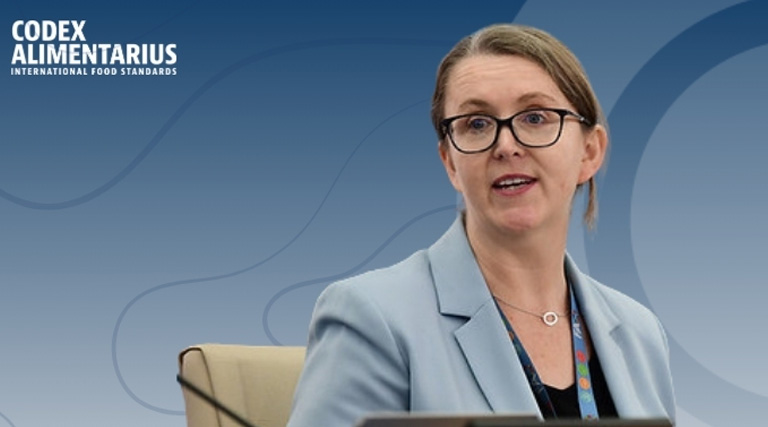
“The beating heart of Codex” – Interview with Codex Secretary, Sarah Cahill
15 January 2026, Rome: As the Codex Alimentarius Commission (CAC) returns to its traditional July meeting cycle, Codex Secretary Sarah Cahill outlines the roadmap for 2026 and beyond. In this recent interview, she details how the Codex Secretariat is working to stabilize the global meeting schedule, leveraging digital transformation, and assisting Members and Observers in developing international food standards.
From AI-assisted drafting to digital traceability, the Codex Secretary describes the need to balance cutting-edge technology with the human consensus required to protect consumers over the next five years. The goal remains clear: to deliver standards that are both scientifically robust and practically implementable for regulators and businesses worldwide, ensuring greater safety and transparency across global food chains.
Sarah, happy New Year! What are your New Year resolutions?
A very Happy New Year to the global Codex Family. I have several Codex Resolutions for 2026: the first of these is around the Codex meeting schedule. This year CAC moves back to July, so with that settled, I want to stabilize the schedule of Codex meetings moving forward for at least the next three years. Secondly, is to progress our digital transformation; we have already committed to work on the Codex databases but will also look for other opportunities to use technology to support and improve the way we work. And thirdly, to continue to build and support the Codex family, which is the key to the achievements and successes of the Codex Alimentarius Commission.
You have just mentioned it: the next CAC meeting is just six months away as it has moved back to its summer slot. It’s going to be a busy time. What are you most looking forward to in committee discussions?
Indeed, it is literally around the corner. I’m looking forward to the kind of discussions that only Codex can host—science-based, practical, and global. Having just come back from CCFH in Nashville, I am reminded that the beating heart of Codex lives in these committees. Committees are advancing work where the scientific base is strong, and the public-health and trade benefits are clear. I just witnessed that in food hygiene with a couple of texts revised in just one session.
I’m also eager to see continued progress on additives and residues in the coming months, as well as progress on methods of analysis, giving regulators and industry the tools they need. In terms of commodity standards, there are some interesting discussions coming up next month. In the area of fats and oils, this includes discussions on new and emerging commodities as well as seeing how we can ensure that Codex standards are supporting Members to meet commitments to reduce or eliminate TFAs. Another exciting area is that of Precautionary Allergen Labelling (PAL) which will be discussed in CCFL; this can have a big impact on allergen management in food production systems and in terms of the information consumers will have access to.
I often say our standards only have an impact if they are actually applied. That’s why I’m encouraged by our recent focus on how Codex standards work on the ground, identifying what drives or hinders their uptake, and how we can work together with FAO and WHO to help Members implement them effectively.
Imagine it’s December 2026 and you are writing your annual review in the Codex magazine. What’s the success story you are most excited to tell the Codex family?
That 2026 was a year in which we delivered with purpose and that I can refer to this interview rather than write an article [she laughed, ed]. Seriously though, I hope to say we adopted a strong set of science-based standards and related texts that will measurably improve consumer protection and support fair practices in the food trade; that our schedule has been stabilized; that we are making progress towards timely development of standards without compromising scientific rigor or inclusivity; that time to publication of standards was shorter than the previous year and that more standards than ever are available in all six languages; and that despite the resource challenges many are facing, we maintained strong Member and Observer engagement in Codex work. Most of all, I hope to celebrate how Members, Observers, FAO, WHO, and the Codex Secretariat worked as one team: respectful, transparent, and solutions-oriented.
If that is the goal for the end of the year, where does the momentum take us in the long run? Five years from now, how will Codex have evolved—both in the new frontiers it covers and the technologies that power its global operations?
That’s a difficult question, but if we look back five or six years, when we were still pre-COVID, we realize how much can change in a period of five years. With the current pace of technological development, and to quote the well-known phrase that “the pace of change has never been this fast, and it will never be this slow again,” I imagine the way we work, the technology we use, and the scientific underpinning of our standards will all have evolved.
I would like to think hybrid and virtual work modalities will feel more natural and inclusive. Codex EWGs will co-draft in secure, multilingual environments; our e-tools will better integrate structured commenting, standards elaboration, and version control. Responsible use of AI, under human oversight, will hopefully help summarize large comment sets, flag areas of consensus and those of substantive differences, quickly identifying those areas that need more attention. Committees will use shared dashboards to see in real-time where each text stands and identify links to work across committees with modalities that facilitate timely and interactive cross-committee work. Translation and interpretation will remain essential, with technology supporting, but not replacing human expertise. And navigating the Codex Alimentarius to find the texts you need will be much easier. However, I am under no illusions that achieving this will take significant investment and effort.
Technology will also hopefully be supporting the elaboration of scientific advice, with tools facilitating access to more data, improved methodologies, and the responsible use of AI undertaking initial reviews of information and data sets, expediting the rate of delivery.
However, what I really want to see is that we keep what makes Codex special: openness, transparency, inclusiveness, collaboration, consensus building, and a science-based approach, with technology as an enabler by lowering barriers to participation, not by deciding outcomes. I would like to see the Codex family more energetic and more connected than ever. I think it will still be hard to beat that in-person interaction, but perhaps we will have found a better balance than was possible during the COVID pandemic, such that we keep the energy and connectivity while traveling a bit less.
What will food standards and food safety look like in five years and beyond, not just in terms of the texts adopted, but also in how technologies will have changed it?
I think with the discussions ongoing in CCFICS right now, we can expect to see greater use of digital traceability and data exchange across borders, but we need to ensure these approaches leave no one behind. I think the methodology used in enforcement will probably detect hazards faster and closer to the source; as new methods evolve, we will need, in CCMAS, to work on ways to ensure equivalence between these methods. I expect, or rather hope, that the risk assessments that underpin Codex standards will incorporate larger, more diverse datasets. This would be great, as data representativeness in risk assessment is an area we have extensive and ongoing discussions on in CAC.
When it comes to commodity standards and their essential characteristics—with climate and growing areas contributing to those characteristics changing—we may need to look at other formats for these standards. For example, matrix-type approaches to characterizing products so that we are inclusive but also sufficiently specific for fraud prevention purposes. New areas of standards setting, such as food from new production systems, will benefit from Codex’s steady, evidence-driven approach. Amid all this change, however, we must not lose sight of the core purpose of our work: to protect the health of consumers and ensure fair practices in the food trade.
Is there anything you would like to ask or wish our Members and Observers?
Thank you for your expertise, your commitment, and your patience and persistence, all attributes necessary to develop Codex standards. In 2026, I invite you to do three things with us: engage early, champion our core values, and stay working together.
Also Read: Tagros Chemicals to Acquire Bayer’s Global Flubendiamide Business
Global Agriculture is an independent international media platform covering agri-business, policy, technology, and sustainability. For editorial collaborations, thought leadership, and strategic communications, write to pr@global-agriculture.com


