The Science Of Grapes
12 February 2026, Rome: Despite growing up in Kakheti, a well-known wine region and the agricultural heart of Georgia, Sophio Khutitdze saw herself as a doctor. She was always drawn to the sciences with chemistry and biology being her favourite classes in high school. She even applied to medical school and took the national exam, but she slowly started to realize that medicine wasn’t for her.
Looking for a new vision for her life, where she could combine her loves for science and nature, she decided to enrol at the Agricultural University. When it came time to choose a specialisation—agronomy, winemaking, chemistry, or biology, she chose viticulture and winemaking.
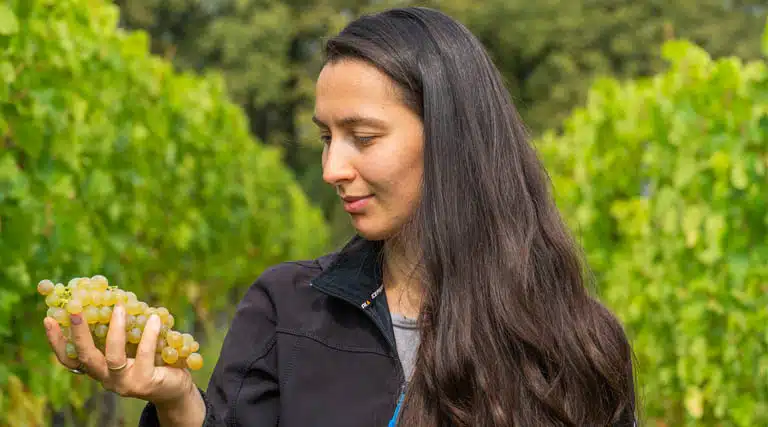
Now at 25 years old, she works as a viticulturalist and winemaker for a private wine company in the vineyards of Kakheti, managing 40 hectares of grapevines.
She saw that just like humans, wine is formed by biology and science. “Wine is a living product — shaped by yeast, biological processes and carefully coordinated vineyard management practices.”
And for her that meant starting at the beginning, the building blocks of wine: grapes.
“To make quality wine, you need quality grapes. That starts in the vineyard.”
She turned to winemaking with the same scientific approach that she had in school.
“I focus on learning every day and applying new approaches in both the vineyard and the cellar,” she adds. Her work depends on the season: monitoring growth and disease control in spring, managing pests in summer, overseeing harvest and fermentation in autumn and planning for winter vineyard care.
Six hectares of the vineyard she manages are already organic, and she plans to help convert the remaining 34 in three years. She emphasizes the link between viticulture and winemaking: “A winemaker must know their raw material. High-quality grapes are the foundation that lead to good wine.”
Reducing Pests with Pheromones
Science is an essential component of agriculture, and nowhere is that clearer than in the fight against plant pests. Winegrowers in Georgia have faced a major pest affecting grape yields and quality: the European grapevine moth (Lobesia botrana). Its larvae feed on the grapes, causing wounds that also facilitate secondary fungal infections like grey mold. Both lead to reduced yields, deterioration of grape quality and increased risks to food safety.
Looking for ways to combat this pest without relying solely on pesticides, in 2023, Sophio joined a project implemented by the Food and Agriculture Organization of the United Nations (FAO). This project, funded by the European Union (EU) and Sweden as part of the European Neighbourhood Programme for Agriculture and Rural Development (ENPARD IV), is based on the mating disruption approach, where synthetic pheromone diffusers are utilized to prevent moths from mating, significantly reducing their numbers and therefore the crop damage.
“We have been implementing it for two years. This has minimized moth presence in our vineyards,” Sophio explains. “Most importantly, we eliminated the use of chemical pesticides. The Mating Disruption Programme fits perfectly with our plan to transition to organic production,” Sophio adds.
Learning in the Field
For Sophio, hands-on training, covering topics ranging from pheromone application to careful pruning techniques, has been one of the programme’s most important components. Building on this and to further disseminate this knowledge, FAO organized Training of Trainers sessions encompassing all aspects of integrated vineyard management.
“We learned directly in the vineyard,” says Sophio, who has herself become one of the new trainers coming out of the programme. “I have further shared this knowledge with my colleagues, and we are now bringing it to practice — young vines responded well, and over time, results will be visible even in older vines.”
Additionally, alongside educational opportunities on integrated vineyard management, FAO regularly organizes different training sessions for the Georgian wine sector, covering topics such as export and market development. As a result, more than 700 representatives from the wine sector have participated in these FAO trainings through the ENPARD programme.
Sophio and Georgian winemakers are successfully reducing pesticide use, improving grape and wine quality and promoting environmentally responsible practices. The combination of pheromone-based pest management and sustainable vineyard management ensures that vineyards are healthy, sustainable and economically viable.
“It’s the continuous experimentation and application of knowledge that will help me improve our wines and vineyard management practices,” concludes Sophio.
“I’m quite happy with that decision. I like my profession. It’s diverse, I’m constantly in contact with nature, and nature is balance. Every organism is connected to one another, creating harmony.”
Across Georgia, 23 wineries covering 875 hectares in four regions have adopted integrated pest management methods through FAO’s programme. 86 percent of participants reported improvements in grape quality and food safety, while nine out of ten companies expressed a clear intention to continue using pheromones independently.
Science, passion and youth are a good bouquet for Georgia’s wine industry and its agriculture in general.
Also Read: Indian Agricultural Products Will Get Zero-tariff Market Access In The US
Global Agriculture is an independent international media platform covering agri-business, policy, technology, and sustainability. For editorial collaborations, thought leadership, and strategic communications, write to pr@global-agriculture.com