AI Reaches India’s Villages as Gram Panchayats Use Technology to Summarise Meetings
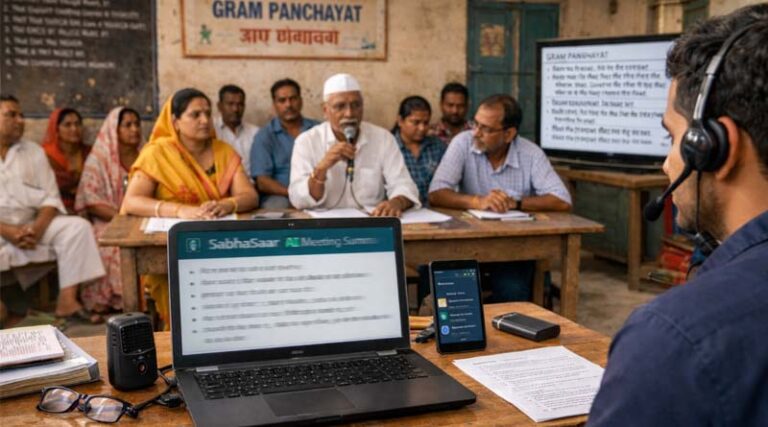
18 December 2025, New Delhi: Is artificial intelligence quietly making its way into India’s village governance system? The answer appears to be yes, as Gram Panchayats, the village-level local self-government institutions, begin adopting AI-based tools to record and summarise their meetings.
The Ministry of Panchayati Raj has introduced SabhaSaar, an artificial intelligence powered meeting summarisation tool aimed at strengthening the functioning of Gram Panchayats. Launched on 14 August 2025, the platform automatically generates structured Minutes of Meetings from Gram Sabha and other Panchayat meetings using audio and video recordings. The tool relies on advanced Natural Language Processing technology to convert spoken discussions into written records.
To address India’s linguistic diversity, SabhaSaar has been integrated with BHASHINI, the National Language Translation Mission of the Ministry of Electronics and Information Technology. Through this integration, the tool currently supports 22 Indian languages for text-to-text translation and 13 Indian languages for voice-to-text transcription, making it accessible across regions with different local languages.
But how widely is this technology being used at the grassroots level? Early data indicates a steady rise in adoption. During the initial rollout, all 1,194 Gram Panchayats in Tripura were encouraged to use SabhaSaar for the Special Gram Sabhas held on 15 August 2025. On that day alone, 12,667 Gram Panchayats across the country used the tool. Usage increased significantly during the Gram Sabha meetings held on 2 October 2025, when 77,198 Gram Panchayats adopted AI-based meeting summarisation. By 28 November 2025, a total of 92,034 Gram Panchayats had used SabhaSaar to automatically summarise their meetings.
The growing use of this AI tool raises important questions about the future of village-level governance. Traditionally, preparing minutes of Gram Sabha meetings has been a manual and time-consuming task, often affected by delays and inconsistencies. Automated summarisation has the potential to improve efficiency, standardisation and transparency, while allowing elected representatives and officials to focus more on decision-making rather than documentation.
The Ministry has made SabhaSaar available to all States and Union Territories, and adoption by Gram Panchayats is expected to expand further in the coming months. Whether this technology remains a support system or becomes a core part of rural governance will depend on how effectively it integrates into everyday Panchayat functioning.
This information was provided by Union Minister Shri Rajiv Ranjan Singh, also known as Lalan Singh, in a written reply in the Rajya Sabha.
As India advances its digital governance agenda, the use of artificial intelligence in Gram Panchayats signals a notable shift. The real question now is whether AI will simply help record village meetings or eventually influence how local democracy is managed and strengthened at the grassroots level.
Also Read: Indian Sugar Production Jumps 28%, but Falling Prices Raise Alarm for Mills and Farmers
Global Agriculture is an independent international media platform covering agri-business, policy, technology, and sustainability. For editorial collaborations, thought leadership, and strategic communications, write to pr@global-agriculture.com