Budget 2026-27 India: Finance Minister Nirmala Sitharaman Sets the Fiscal Direction for Agriculture and Farmers
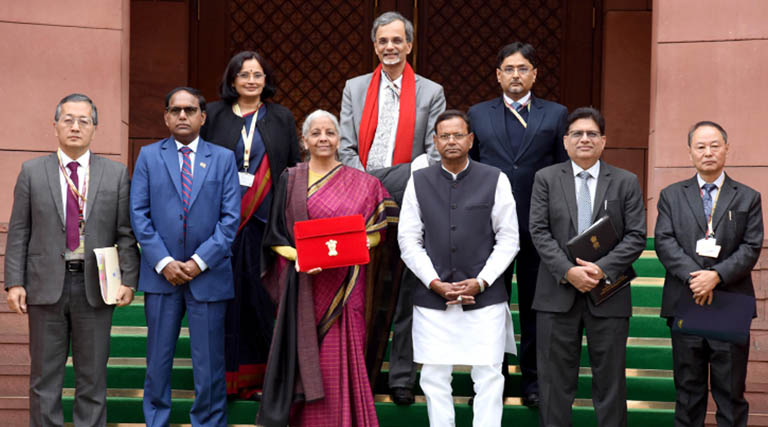
02 February 2026, New Delhi: The Union Budget 2026-27, presented on February 1 by Finance Minister Nirmala Sitharaman, outlines the Indian government’s fiscal priorities for agriculture, rural development and allied sectors, with calibrated increases across ministries that directly shape farmer incomes and the rural economy.
While agriculture, rural development and farmers’ welfare are often discussed together, they have distinct budget heads with separate ministries, policy orientations and financial frameworks. In this analysis, the Ministry of Food Processing Industries has been kept out, as its interventions begin largely post farm-gate and focus on downstream value addition rather than on-farm agricultural practices. A closer look at the allocations shows moderate growth for core agriculture, steady expansion for rural development, and a sharper push towards allied sectors such as animal husbandry and dairying.
Key Budget Allocations for Farmer and Rural Centric Ministries
| Ministry / Department | Budget 2026-27 | Budget 2025-26 | Growth over last year (%) |
|---|---|---|---|
| Ministry of Agriculture & Farmers’ Welfare (Total) | ₹1.40 lakh crore | ₹1.37 lakh crore | +2.19% |
| └ Department of Agriculture & Farmers’ Welfare | ₹1.30 lakh crore | ₹1.27 lakh crore | +2.36% |
| └ Department of Agricultural Research & Education | ₹9.98 thousand crore | ₹10.46 thousand crore | −4.59% |
| Ministry of Chemicals & Fertilizers | — | — | — |
| └ Department of Fertilizers | ₹1.70 lakh crore | ₹1.56 lakh crore | +8.97% |
| Ministry of Rural Development (Total) | ₹1.97 lakh crore | ₹1.90 lakh crore | +3.68% |
| └ Department of Rural Development | ₹1.94 lakh crore | ₹1.87 lakh crore | +3.74% |
| └ Department of Land Resources | ₹2.65 thousand crore | ₹2.65 thousand crore | 0% |
| Ministry of Fisheries, Animal Husbandry & Dairying (Total) | ₹8.90 thousand crore | ₹7.54 thousand crore | +18.04% |
| └ Department of Fisheries | ₹2.70 thousand crore | ₹2.70 thousand crore | 0% |
| └ Department of Animal Husbandry & Dairying | ₹6.15 thousand crore | ₹4.84 thousand crore | +27.07% |
| Ministry of Panchayati Raj | ₹1.19 thousand crore | ₹1.18 thousand crore | +0.85% |
Ministry of Agriculture & Farmers’ Welfare
The Ministry of Agriculture and Farmers’ Welfare has received a total allocation of ₹1.40 lakh crore for 2026-27, up from ₹1.37 lakh crore in the previous year, reflecting a growth of 2.19 percent. Within this, the Department of Agriculture and Farmers’ Welfare accounts for most of the increase, with its allocation rising to ₹1.30 lakh crore.
In contrast, the Department of Agricultural Research and Education has seen a reduction in allocation to ₹9.98 thousand crore from ₹10.46 thousand crore in 2025-26. The decline in research funding stands out within the agriculture portfolio, even as policy emphasis increasingly highlights productivity enhancement and technology-led interventions.
Fertilizers: Continued Fiscal Weight
Fertilizer support remains one of the largest expenditure components linked to agriculture. The Department of Fertilizers has been allocated ₹1.70 lakh crore for 2026-27, marking a growth of nearly 9 percent over the previous year. This underlines the continued importance of fertilizer support in sustaining farm input availability and price stability. The fertilizer support is routed through the Ministry of Chemicals and Fertilizers, while agriculture-focused interventions remain under the Ministry of Agriculture and Farmers’ Welfare.
Ministry of Rural Development
The Ministry of Rural Development has received ₹1.97 lakh crore, compared to ₹1.90 lakh crore in 2025-26. Most of this increase is reflected in the Department of Rural Development, while the Department of Land Resources has retained the same allocation as last year, indicating continuity rather than expansion in land-related programmes. There are multiple schemes that indirectly contribute to the agriculture but are under the purview of the Ministry of Rural Development.
Allied Sectors: Animal Husbandry Drives Growth
The most pronounced increase is visible in allied sectors. The Ministry of Fisheries, Animal Husbandry and Dairying has recorded a growth of over 18 percent in 2026-27. While allocations for fisheries remain unchanged, the Department of Animal Husbandry and Dairying has seen a sharp rise of more than 27 percent, signalling a policy push towards livestock, dairy and poultry as key drivers of rural employment and income diversification.
Panchayati Raj
The Ministry of Panchayati Raj has been allocated ₹1.19 thousand crore, marginally higher than last year. The increase is modest, suggesting continuity in funding support for local governance institutions rather than a significant fiscal expansion.
Increasing Farmer Incomes: Policy Direction from the Budget Speech
During the budget speech, the Finance Minister outlined a series of initiatives aimed at increasing farmer incomes. These included integrated development of 500 reservoirs and Amrit Sarovars for fisheries, strengthening coastal fisheries value chains through market linkages involving start-ups, women-led groups and Fish Farmer Producer Organisations, and entrepreneurship-focused support in animal husbandry through credit-linked subsidies, modernisation of livestock enterprises and promotion of livestock Farmer Producer Organisations.
High-value agriculture also featured prominently. The Finance Minister stated that the government would support crops such as coconut, sandalwood, cocoa and cashew in coastal regions, agar trees in the North East, and nuts such as almonds, walnuts and pine nuts in hilly areas. She announced a Coconut Promotion Scheme to improve productivity by replacing old and non-productive trees and proposed dedicated programmes for cashew and cocoa to enhance self-reliance, export competitiveness and global branding by 2030. Focused efforts were also proposed to restore the Indian sandalwood ecosystem through cultivation and post-harvest processing.
The speech further referred to initiatives for rejuvenating old orchards and expanding high-density nut cultivation, with youth engagement and value addition as key elements. In addition, the Finance Minister proposed the launch of Bharat-VISTAAR, a multilingual AI-based advisory platform integrating AgriStack portals and ICAR agricultural packages to provide customised, risk-reducing advisory services to farmers.
These initiatives were articulated as part of the Finance Minister’s budget speech, and no scheme-wise financial allocations were specified at the time of presentation.
Political Response
Reacting to the Budget, Shivraj Singh Chouhan said the Union Budget is aimed at realising the vision of a developed India by 2047. He described it as a budget framed with villages, farmers, youth, women and the poor at its core, and said it lays the foundation for a self-reliant and empowered rural economy.
Overall, Budget 2026-27 reflects continuity with selective emphasis on allied sectors and high-value agriculture. While fiscal expansion remains measured across most ministries, the policy direction articulated in the budget speech highlights diversification, value-chain development and technology integration as central to improving farmer incomes in the years ahead.
Also Read: Sahyadri Farms: A Farmer-Led Collective Transforming Indian Agriculture
Global Agriculture is an independent international media platform covering agri-business, policy, technology, and sustainability. For editorial collaborations, thought leadership, and strategic communications, write to pr@global-agriculture.com