India Launches AI-Driven “Bharat-VISTAAR” to Deliver Real-Time Advisory to Farmers
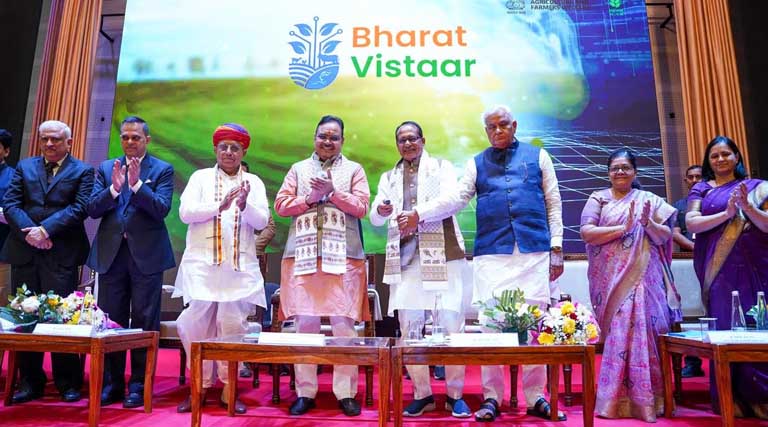
17 February 2026, New Delhi: At a time when artificial intelligence is rapidly entering mainstream governance and agriculture globally, India has unveiled “Bharat-VISTAAR,” an AI-enabled farmer advisory platform, positioning it as a nationwide digital interface to deliver real-time, voice-based agricultural guidance. The platform’s Phase-1 launch was announced in Jaipur by Union Minister for Agriculture & Farmers’ Welfare and Rural Development, Shri Shivraj Singh Chouhan, alongside state leadership, agricultural scientists, and farmer representatives.
The launch coincided with broader national conversations on AI adoption, underscoring the government’s intent to integrate advanced analytics, multilingual interfaces, and advisory services into India’s farm ecosystem.
An AI Interface Designed for Direct Farmer Access
Bharat-VISTAAR has been conceived as a voice-first advisory system aimed at simplifying access to agricultural intelligence without requiring smartphones or complex applications. Farmers can dial a dedicated number — 155261 — to receive instant responses on crop management, weather forecasts, pest and disease solutions, sowing windows, and mandi prices across regions.
The platform demonstrated live interactions during the launch event, where AI responded to farmer queries in conversational format, signalling a shift from static extension models to dynamic, data-driven advisory.
Officials described the initiative as an attempt to build a “digital safety net” for farmers by integrating agronomy, meteorology, market intelligence, and government schemes into a single access point.
Scientific and Institutional Integration
The launch brought together representatives from ICAR institutes, agricultural universities, and Krishi Vigyan Kendras (KVKs), many of whom joined virtually, reflecting an effort to align India’s research ecosystem with real-time field dissemination.
By linking institutional knowledge with AI delivery systems, Bharat-VISTAAR aims to reduce the long-standing gap between laboratory recommendations and farm-level adoption — a challenge repeatedly highlighted in Indian agricultural policy discourse.
Multilingual Expansion Planned
The platform has initially been rolled out in Hindi and English, with plans for expansion into 11 Indian languagesincluding Gujarati, Tamil, Bengali, Assamese, and Kannada. This linguistic scaling is intended to ensure inclusivity across India’s diverse agro-ecological and socio-cultural regions.
Officials indicated that the system will progressively incorporate farmer-specific data layers, potentially linking soil health records, crop histories, and scheme eligibility through a unified farmer identity architecture.
Integration with Government Schemes and Services
Bharat-VISTAAR is expected to function as an access gateway for multiple flagship programmes, including income support, crop insurance, irrigation initiatives, mechanisation schemes, and agricultural infrastructure financing. Beyond information dissemination, the platform is being positioned as a grievance-redressal and eligibility-tracking interface.
This convergence signals a broader move toward platformisation of agricultural governance, where advisory, subsidies, and compliance systems operate through a single digital backbone.
Market Intelligence and Trade Sensitivities Addressed
During the announcement, policymakers also addressed questions around agricultural trade, imports, and domestic safeguards, reiterating that sensitive commodities such as cereals, maize, and dairy remain protected under current policy frameworks. Clarifications were also offered regarding import balancing in commodities such as apples and edible oils, framed as supply management rather than structural shifts.
The discussion reflects the ongoing tension between domestic farm protection and calibrated trade engagement — an issue increasingly relevant as India negotiates global agreements while maintaining price stability for producers.
Linking Technology Adoption to Rural Economic Strategy
Beyond advisory, Bharat-VISTAAR has been positioned as part of a wider rural transformation agenda. The platform is expected to support decision-making that can influence productivity, reduce input misallocation, and improve market timing — areas where AI-enabled analytics are gaining traction globally.
The initiative aligns with a growing international trend in which governments are deploying AI not merely for yield enhancement, but for risk mitigation, supply-chain intelligence, and climate-responsive agriculture.
A Step Toward Digitally Mediated Extension Systems
India’s agricultural extension architecture has historically relied on field officers and periodic advisories. Bharat-VISTAAR represents a structural transition toward on-demand, conversational extension, potentially redefining how knowledge flows to the farmgate.
If scaled effectively, such platforms could complement existing advisory networks rather than replace them, enabling hybrid human-AI models that combine contextual expertise with real-time data processing.
What It Means for India’s Agri-Digital Trajectory
For a country managing one of the world’s largest smallholder systems, the success of Bharat-VISTAAR will depend on last-mile adoption, language accuracy, trust in AI recommendations, and integration with local extension services.
Yet its launch marks a clear signal: India is entering the AI-enabled agriculture phase not only through startups and precision tools, but through public digital infrastructure aimed at mass farmer access.
Also Read: France Becomes First Market to Approve Syngenta’s X-Terra Hybrid Wheat
Global Agriculture is an independent international media platform covering agri-business, policy, technology, and sustainability. For editorial collaborations, thought leadership, and strategic communications, write to pr@global-agriculture.com