Telangana’s Priority Sector Credit Potential Pegged at ₹4.43 Lakh Crore for 2026–27, Up 15%: NABARD
10 February 2026, New Delhi: The National Bank for Agriculture and Rural Development (NABARD) on Monday assessed a priority sector credit potential of ₹4.43 lakh crore for Telangana for FY 2026–27, marking a 15 per cent year-on-year increase.
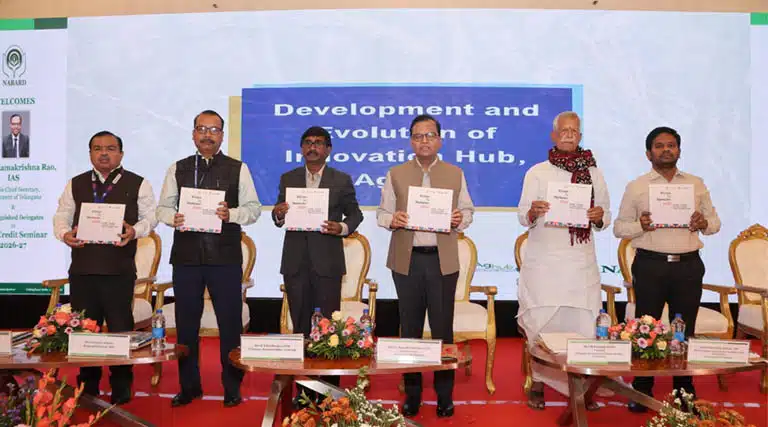
The assessment was unveiled at the State Credit Seminar 2026–27 for Telangana, organised by NABARD on 10 February 2026 in Hyderabad, aimed at strengthening credit flow from banks to priority sectors, including agriculture and allied activities.
The seminar saw participation from senior officials of the Government of Telangana, the Reserve Bank of India, the State Level Bankers’ Committee, commercial banks, cooperative institutions, RRBs, agricultural and horticultural universities, research institutions and other key stakeholders engaged in rural and economic development.
State Focus Paper sets credit roadmap
On the occasion, NABARD released the State Focus Paper (SFP) for FY 2026–27, which provides a district-wise and sector-wise assessment of credit potential and absorption capacity under priority sector lending. The SFP estimates total priority sector credit at ₹4.43 lakh crore, reflecting expanding opportunities in agriculture, MSMEs, housing, infrastructure, renewable energy and social sectors.
Addressing the gathering, B. Uday Bhaskar, Chief General Manager, NABARD Telangana Regional Office, said the SFP has been prepared through a participative, district-level consultative process and will serve as the base document for formulation of the Annual Credit Plan (ACP) 2026–27 by SLBC. He noted that the paper identifies sector-specific and region-specific opportunities across all 33 districts, while also highlighting infrastructure gaps and avenues for policy–credit convergence to support inclusive growth.
Focus on tenant farmers, FPOs and technology
Kodanda Reddy, Chairman, Telangana Farmers’ Commission, urged banks to enhance lending to tenant farmers, highlighting various State government schemes supporting the farming community. He appreciated NABARD for bringing out granular data on agricultural credit potential and advised cooperative banks to adopt technology-enabled solutions for efficient crop loan delivery.
Chinmoy Kumar, Regional Director, RBI, said the Telangana Rising Vision Document 2047 is well aligned with NABARD’s State Focus Paper, and acknowledged NABARD’s pivotal role in driving development across agriculture, rural livelihoods and MSMEs.
Priyabrata Mishra, Deputy General Manager, SLBC/SBI, described the SFP as a critical base document for ACP preparation and highlighted the role of Farmer Producer Organisations (FPOs) in addressing credit challenges arising from fragmented landholdings.
Credit planning aligned with Telangana Rising Vision 2047
Addressing stakeholders, K. Ramakrishna Rao, IAS, Chief Secretary, Government of Telangana, said the convergence between the Telangana Rising Vision 2047 and NABARD’s SFP is timely and forward-looking. He explained the State’s three-zone regional development framework—CURE, PURE and RARE—and noted that explicit recognition of this framework in the SFP marks a significant shift from conventional credit planning.
He stated that Telangana is targeting a USD 1 trillion economy by 2034 and USD 3 trillion by 2047, which will require integrated and outcome-oriented planning. Highlighting that agriculture contributes 16–17% to GSDP but supports 46% of the workforce, he underlined the need to move towards high-value crops, value addition and agribusiness models. He also pointed to inter-district variations in CD ratios, market access challenges, climate risks and the need for banks to align credit plans with long-term State priorities.
Sectoral thrust areas
The State Focus Paper places strong emphasis on agriculture and allied activities, including agricultural infrastructure, food and agro-processing, animal husbandry, fisheries and farm mechanisation. It also highlights opportunities in MSME financing, renewable energy, education, housing and social infrastructure, along with strengthening FPOs, modernising cooperatives and PACS, promoting GI-based clusters and scaling up climate-resilient agricultural practices.
Senior State officials, along with representatives from RBI and SLBC, stressed the importance of coordinated action among stakeholders to translate assessed credit potential into effective ground-level credit flow, particularly in investment credit and infrastructure-led growth.
Broad sector-wise credit projections (₹ lakh crore)
| S. No. | Sector | 2025–26 | 2026–27 | YoY growth % |
| 1 | Farm Credit | 139.54 | 154.29 | 11% |
| 2 | Agriculture Infrastructure | 7.25 | 7.81 | 8% |
| 3 | Ancillary activities | 16.15 | 19.13 | 18% |
| Credit Potential for Agriculture (1+2+3) | 162.95 | 181.23 | 11% | |
| 4 | MSME | 203.57 | 239.55 | 18% |
| 5 | Export Credit | 0.61 | 0.65 | 6% |
| 6 | Education | 2.49 | 2.67 | 7% |
| 7 | Housing | 10.49 | 12.45 | 19% |
| 8 | Social Infrastructure | 1.53 | 1.77 | 16% |
| 9 | Renewable Energy | 0.57 | 0.58 | 1% |
| 10 | Others | 3.65 | 4.42 | 21% |
| Total Priority Sector | 385.85 | 443.31 | 15% |
Also Read: Tanmiah Partners with PHYLA and RECYCLEE to Bolster Circular Economy and Food Security
Global Agriculture is an independent international media platform covering agri-business, policy, technology, and sustainability. For editorial collaborations, thought leadership, and strategic communications, write to pr@global-agriculture.com