Regional Learning For Sustainable Rice Straw Management
10 December 2025, Vietnam: The annual rice harvest yields not only a vital food source but also millions of tons of rice straw. Across Southeast Asia, managing this agricultural residue sustainably and economically is a shared, pressing challenge. Traditional practices like open-field burning pollute the air, degrade soil health, and contribute to climate change.
In response to this common need, a regional Learning Alliance on Rice Straw Circular Economy was formed. It acts as a vital “bridge” for regional cooperation, where diverse stakeholders exchange experiences, technology, and profitable business models to transform straw from a waste product into a valuable asset.
This successful regional collaboration was recently highlighted at the Learning Alliance Workshop in Vietnam, co-hosted by the International Rice Research Institute (IRRI), Vietnam Rice Sector Association, and National Agriculture Extension Center. The event focused on Knowledge Exchange and Business Model Scaling for high-quality, low-emission rice production.
The foundation for these discussions was the Rice Straw-Based Circular Economy for Improved Biodiversity and Sustainability (RiceEco) Project funded by the Mekong-Korea Cooperation Fund. Dr. Nguyen Van Hung, IRRI Senior Scientist and RiceEco Project Lead, highlighted that technological solutions developed and applied in the Mekong Delta under the RiceEco Project have successfully scaled to neighboring countries like Cambodia and Thailand. Notably, the technical guideline on rice straw management for circular and low-emission agriculture has been officially recognized as a Technical Advance by Vietnam and is now a core component of Vietnam’s One Million Hectares high-quality and low-emission rice program.
Dr. Hung shared that the pilot rice cultivation models using these circular agriculture principles have yielded impressive results: demonstrating a reduction of up to 3 tons of CO2 equivalent per hectare compared to traditional straw incorporation, alongside a 10–15% increase in yield when utilizing straw-derived organic fertilizer.
Uniting Stakeholders for Innovation
Dr. Rica Flor, IRRI Senior Scientist, underscored the Alliance’s importance: “The regional Learning Alliance on Rice Straw Circular Economy will be the platform for promoting multi-stakeholder learning and cross-border cooperation. More than 100 delegates from three countries (Vietnam, Cambodia, Laos, Myanmar, and Thailand) – including farmers, cooperatives, extension officers, businesses, and policymakers – have come together to share knowledge, technology, and practical business models. The Alliance not only scales up technical solutions and shares effective implementation experiences but also builds a sustainable cooperation network in the region.”
While conditions vary across the region, the core challenges of straw management are similar. Dr. Flor emphasized that this alliance allows parties to learn from both successes and failures, adapting models to their local context while working toward the common goal of green agriculture and emission reduction.
“This is the long-term impact – turning experience sharing into concrete commitments to action, and turning connection into sustainable innovation in every farming community,” Dr. Flor stated.
Farmer-to-Farmer Dialogue
A distinguishing feature of the workshop was the direct engagement of successful cooperative leaders. This farmer-to-farmer dialogue provided critical, on-the-ground insights.
Mr. Nguyen Cao Khai, Director of Tien Thuan Cooperative (Can Tho, Vietnam), shared that the most important factors are “a clear business model, a stable market, and technological support.” Mr. Korng Moueun, Head of Udom Sorya Cooperative (Cambodia), stated, “Farmers must see the economic benefits right from the first season through reduced fertilizer costs and improved soil quality.”
A subsequent panel discussion brought together governmental departments from Thailand and Cambodia to share technology, machinery support programs, and challenges like investment costs. Delegates later broke into groups, focusing on the practical integration of solutions into local state programs or the development of specific business models and implementation roadmaps.
Hands-On Technology and Action
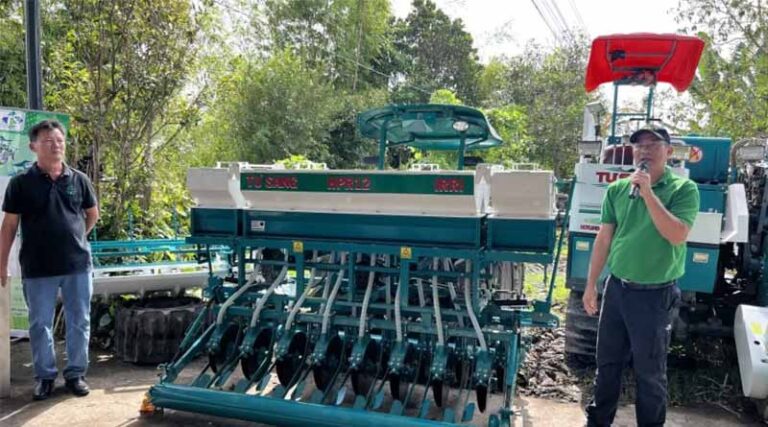
The workshop culminated in a valuable field visit to the Tien Thuan Cooperative, where nearly 150 delegates from five countries (Vietnam, Cambodia, Laos, Myanmar, and Thailand) witnessed five cutting-edge technologies in operation: the integration of rotary tillage and straw incorporation using microbial products, both indoor and outdoor methods for straw mushroom cultivation, the mechanization process for organic fertilizer production, specialized technology for pelletizing organic fertilizer derived from straw, and an innovative method for producing straw pots designed to replace traditional industrial plastic containers.
The demonstration facilitated an exchange on applicability across different local contexts. As Dr. Nguyen Van Hung summarized, “The valuable lessons from these two working days show that sustainable straw management is an opportunity to build new value chains, create jobs, and generate income for farmers.”
The regional Learning Alliance is successfully mobilizing cross-border learning and turning shared challenges into collective action, paving the way for a greener, more profitable, and sustainable rice sector across the region.
This work is part of the MKCF-funded Rice Straw-Based Circular Economy for Improved Biodiversity and Sustainability Project, Capacity Building for Sustainable and Low-Carbon Rice Innovations in Southeast Asia, and the CGIAR Scaling for Impact Program.
Also Read: Cargill Chair and CEO Brian Sikes joins Deere & Company’s Board of Directors
📢 If You’re in Agriculture, Make Sure the Right People Hear Your Story.
From product launches to strategic announcements, Global Agriculture offers unmatched visibility across international agri-business markets. Connect with us at pr@global-agriculture.com to explore editorial and advertising opportunities that reach the right audience, worldwide.