
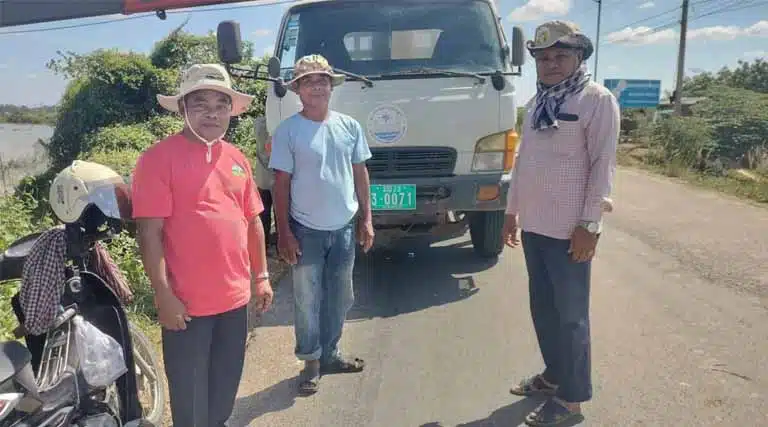
Cambodia: Major Win for Boeng Sneh Water Gate Upgrade
By Sok Sao, Sanjiv De Silva, Deepa Joshi and Mam Kosal
13 January 2026, New Delhi: Boeng Sneh Lake, one of Prey Veng’s most important floodplain ecosystems, has reached a new milestone in its journey toward sustainable water and fisheries management. In late 2025, the District Technical Working Group (DTWG) in Ba Phnom successfully secured support from the Provincial Department of Water Resources and Meteorology (PDoWRAM) to replace the deteriorated water gate that regulates flows in and out of the lake. This achievement is far more than an infrastructure upgrade-it is a clear demonstration of how local cooperation, cross-sector dialogue, and community-centered planning can translate into real investment and tangible improvements for people and ecosystems.
A Turning Point for Boeng Sneh Lake
For many years, communities around Boeng Sneh faced severe water conflicts due to competing demands from rice farmers, fishers, and domestic users. Poor coordination among institutions meant that water decisions were often fragmented, leaving the lake stressed, fish stocks declining, and farmers worried about dry-season shortages.
In 2024-25, the newly established DTWG-comprising district officials, line agencies, local authorities, and Community-Based Organizations-became a platform for practical problem-solving. Through inclusive dialogue, community consultations, and joint planning, the DTWG helped coordinate water-use schedules and raise awareness about reducing dry-season rice cropping. As a result, the lake retained 32 million cubic meters of water, a 28% increase from previous years.
This foundation of collaboration set the stage for the DTWG’s biggest accomplishment yet.
Advocacy in Action: Securing the Water Gate Replacement
The water gate at Boeng Sneh had long been identified as a critical point of vulnerability. Its deteriorated condition made water regulation difficult, contributing to both dry-season shortages and wet-season overflow.
Through the DTWG’s structured problem analysis and consensus-based planning, members jointly prioritized the water gate as essential infrastructure for lake management. With evidence generated through the participatory lake management process, the DTWG made a strong case to the Provincial Department of Water Resources and Meteorology.
Their advocacy paid off…
PDoWRAM has now committed funding and technical support to replace the old water gate-an investment that will:
- Improve water retention during the dry season
- Reduce conflict between irrigation and fisheries users
- Enhance biodiversity recovery in the lake
- Strengthen local ownership of water resource management
- Support long-term climate resilience in the district
This is one of the first major government-funded actions directly catalyzed by the DTWG in Boeng Sneh, showing that the platform is not just a meeting space-it is a mechanism that can unlock real resources.
A Model for Integrated, Inclusive Governance
The success at Boeng Sneh is part of a broader shift in how natural resources are managed in Cambodia’s floodplains. DTWGs, piloted with support from WorldFish, IWMI, and IFReDI under the CGIAR Scaling for Impact program, are proving that local platforms can bridge the gap between community needs and government decision-making.
The Boeng Sneh DTWG demonstrates:
1. Cross-sector coordination works
When departments, communities, and local authorities sit together, they can align priorities and solve shared problems.
2. Evidence-based planning drives investment
The lake’s management plan-developed jointly by DTWG members-provided the justification needed for government action.
3. Community voice matters
CBOs and local users helped identify the need, and their participation made the solution more legitimate and feasible.
4. Small institutional changes can unlock big impacts
A functional DTWG was all it took to turn years of frustration into a funded solution.
What’s Next for Boeng Sneh?
Replacing the water gate is a significant milestone, but it also opens the door to further improvements:
- Strengthened water allocation planning
- Ongoing biodiversity conservation (including Fish Day and conservation zones)
- Enhanced climate resilience through coordinated land and water management
- A stronger link between local action and national food security policies
As the district transitions into a broader District Working Group for Food Security and Nutrition (DWG-FSN) structure under CARD, the DTWG’s success will continue to influence how natural resource management is integrated into wider social and development planning.
A Story of Local Leadership
The water gate upgrade at Boeng Sneh is a testament to what is possible when institutions collaborate, communities participate, and evidence guides decision-making.
It is a story of local leadership driving real change-ensuring that Boeng Sneh Lake remains a lifeline for farmers, fishers, and future generations.
Also Read: Brazil Approves 912 Pesticide Registrations in 2025
Global Agriculture is an independent international media platform covering agri-business, policy, technology, and sustainability. For editorial collaborations, thought leadership, and strategic communications, write to pr@global-agriculture.com




![Tospoviruses & Thrips: Uninvited Guests in your Garden [Orchid Health Blueprint]](https://www.global-agriculture.com/wp-content/uploads/2025/05/agdia-768x427-1-390x205.webp)
