GoN Scales CIMMYT’s Commercial Maize Model in Nepal
06 January 2026, Nepal: Maize is the second most important cereal crop of Nepal after rice in terms of area and production. Traditionally, this crop was considered a major food crop of hills. In Nepal, about 3,000t of poultry feed is consumed in a day, and maize constitutes at least 50% of its total ingredients. The demand for feed is increasing at about 10.0% per annuum, but maize production is growing at 2.5% per annuum. Commercialization of domestic maize sector is hampered by low productivity with inferior grain quality and lack of value chain coordination mechanisms starting from inputs (seeds) to output grains (grains). Due to the lack of an efficient extension, market mechanism and competitive market structure, farmers are not able to embark on commercial maize production.
Maize Commercial Model
In 2021 CIMMYT designed and tested the maize commercial model (MCM), an inclusive market-based innovation system together with public, private and farmers cooperatives to sustainably increase national maize production from spring fallow lands. Driving the MCM process through a cropping system innovation approach, maize is inserted into a 90–120-day fallow period to grow three crops per year, improving farmers’ livelihoods and food security. Maize fits very well in this short window with accompanying risk reducing climate smart technologies leading to resilience of overall farming system.
MCM focuses on 1) market mapping and innovation bundling; 2) capacity development for improved maize production, post-harvest management, and marketing; 3) formation and strengthening of district-level multi-stakeholder maize commercial networks; and 4) public-private partnerships for improved investment and coordination of maize supply chains.
As a result, maize area and yield increased from 548 ha and 5.9t/ha in 2022 to 2,032 ha and 6.5t/ha in 2025, respectively. The yield doubled the national average. The average farm gate price of maize also increased from NPR 21 per kg in 2021 to NPR 35 per kg in 2024. Farmers started earning higher incomes from the upgraded maize-based cropping system with an average of USD 900 compared to USD 500 earlier. Public and private sectors invested around USD 3 M in improving access to inputs, machinery, irrigation and storage. The MCM enabled women and disadvantaged farmers to receive technical and business services to adapt to climate change, reduce workloads, improve overall cropping system and reduce drudgery while generating economic benefits from market participation.
The maize commercial model aligns well with the Scaling for Impact Program in that it focuses on achieving scale as a system outcome anchored in markets, coordination, and bundled solutions rather than a single technology. The approach embeds maize into an underused seasonal window and couples this with coordinated input supply, mechanization, storage, and market arrangements, directly addressing the system constraints that typically limit adoption beyond pilots. Its district-level maize networks and public-private coordination reflect the CGIAR Scaling for Impact Program’s emphasis on delivery systems that can sustain use after project support. Importantly, inclusion is built into how services are organized and delivered—through access to machinery, business services, and market participation for women and disadvantaged farmers—reducing labor burdens and risk exposure while strengthening household and system-level returns.
Scaling by integrating with national programs
Seeing the large-scale impacts of the MCM, in 2025, the Ministry of Agriculture and Livestock Development (MoALD) integrated MCM into its annual program and allocated USD 73,000 to support the institutionalization and scaling out of the MCM in Western Terai. The MoALD program also aimed to scale out the MCM model to eastern Nepal. Under this program, the MoALD would work with the rural municipalities with conditional grants to support maize production. Rural municipalities would in turn allocate counterpart funding and integrate with other maize support programs in the scaling process.
The financing and institutional linkages developed through the funding from MoALD meant that the MCM approach will influence the operations and functioning of many more Government programs leading to wider integration and influence. GoN developed a MCM implementation guideline in 2025 with technical assistance from CIMMYT and support of the CGIAR Scaling for Impact Program. Under this, each palika will directly receive Rs. 1 million (USD 7,000) to support commercial maize production and marketing activities, form and strengthen maize commercial networks, demonstrate innovative technologies and good practices and foster collaboration with public and private stakeholders to expand competitive and sustainable maize production by utilizing the winter fallows after main season rice harvest. These will ensure that the process of implementation will be standardized across the country. Monitoring and learning assessments will also be carried out for feedback and improvement in the program design.
Scaling out from West to East Nepal
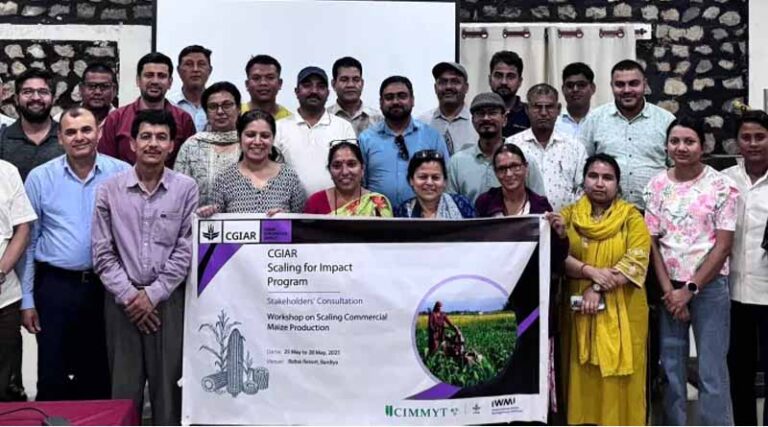
MoALD and the CGIAR Scaling for Impact Program jointly organized a stakeholder’s workshop in Eastern Nepal’s Koshi Province to discuss the issues in maize value chains and share the MCM model with stakeholders. Koshi province covers about 30% (284,340ha) of total maize area (940,256ha) of Nepal. More importantly, three Terai districts: Jhapa, Morang and Sunsari (also called Eastern Terai districts) contribute 26% (73,974ha) to the area and 42% (403,719t) to the maize production of Koshi province. Maize is grown as a winter season crop after rice is harvested in these districts. About 17 formally registered feed mills operate in these districts which demand about 183,600t maize annually.
Despite being a major maize production area, there are several challenges in the maize value chain in Eastern Nepal. During the workshop, stakeholders reported five major problems associated with maize: poorly coordinated value chains, unsustainable production systems due to haphazard use of chemical fertilizers, declining organic matter and increasing soil acidity, climate risks posing threat to production and quality non-reliable input supply (e.g. hybrid seed, fertilizers) and services from public and private stakeholders, and poorly developed aggregation, processing and storage facilities, and market information systems.
The Scaling for Impact Program is supporting CIMMYT’s efforts to provide provide technical support and strategic guidance to maize sector stakeholders for scaling MCM in Koshi province focusing on two pilot rural municipalities viz., Dhalpalthan and Jahada Rural Munnicipality of Morang district in 2025. MoALD will promote innovative technologies and good management practices, build capacity of stakeholders, and foster collaboration, co-creation and co-investment. Similarly, the Scaling for Impact Program is providing strategic guidance to three feed mills (Gaurishankar Agro Pvt. Ltd., Nepal Warehousing Company Ltd., and Nepal Wellhope Pvt. Ltd., for developing farmer-market linkages focusing on service provisions (seed, machinery, credit, drying, grading and storage. It is estimated that these private actors would make USD 3 million additional investment in 2026.
Together with the CGIAR Scaling for Impact Program it is expected that the MCM approach will upgrade the maize market system resulting in increasing maize area, productivity, and profitability to maize stakeholders. Stakeholders mentioned that there is a big potential to double the maize area and yield in Eastern Nepal. Scaling for Impact Program will drive the MCM in Nepal terai with the overall aim to contribute to food and feed and reduce national maize imports by 70% with a value of USD 60 million by 2030.
Global Agriculture is an independent international media platform covering agri-business, policy, technology, and sustainability. For editorial collaborations, thought leadership, and strategic communications, write to pr@global-agriculture.com