
Groundnut Breeding in Eastern and Southern Africa: Regional Review Charts a Clear Path Forward
26 February 2026, Zambia: The Eastern and Southern Africa (ESA) Groundnut Breeding Program held its mid-year review from June 16–18, 2025, in Dar es Salaam, Tanzania, bringing together breeders, researchers, and development partners to reflect on progress, address shared challenges, and shape the next phase of groundnut improvement in the region.
Hosted by CIMMYT and the Tanzania Agricultural Research Institute (TARI), the three-day workshop created a platform for learning, collaboration, and open dialogue about what’s working-and what needs to evolve. The event also reflected a broader commitment to building regional capacity and delivering improved, climate-resilient varieties to smallholder farmers across diverse agro-ecological zones.
Aligning on Priorities and Purpose
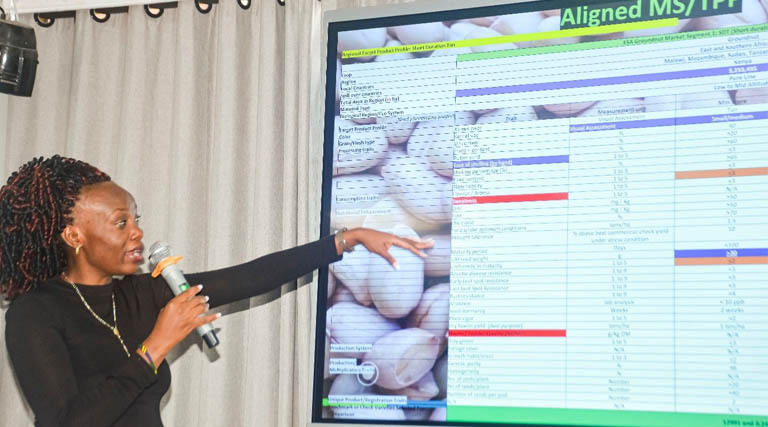
In her welcome remarks, Happy Daudi, CIMMYT groundnut breeder and key organizer of the event, outlinedthe workshop’s strategic focus: “Our goal is to assess how far we’ve come toward meeting our breeding objectives, identify areas that need course correction, and ensure we’re aligned with both market needs and farmer realities.”
The workshop focused on five key areas:
- Evaluating current breeding populations,
- Identifying optimization needs,
- Aligning research with market signals,
- Reviewing trial data and feedback,
- And setting clear priorities for the next season.
Happy also emphasized the importance of network building and strengthening the flow of germplasm, data, and knowledge between national and regional programs. Harish Gandhi expressed appreciation for the participants’ ongoing commitment and reaffirmed CIMMYT’s support for regional collaboration.
He emphasized the need to track implementation of prior recommendations—specifically referencing follow-ups from the previous ESA meeting held in Lusaka, Zambia. “It’s not just about making plans; it’s about ensuring they translate into tangible progress,” Gandhi stated. He also highlighted the growing collaboration between CIMMYT and ICRISAT, underscoring their shared commitment to delivering impact through joint breeding initiatives.
Voices from national Partners: progress and setbacks
Country representatives shared updates on breeding activities and implementation of recommendations made during the last regional meeting in Lusaka, Zambia. While progress was evident in several areas, partners also highlighted specific operational challenges:
- Mozambique: Amade Muitia flagged the inability to carry out TRICOT trials and quality assurance/quality control (QA/QC) activities, largely due to groundnut rosette disease (GRD) complications.
- Uganda: David Kalule reported delays in obtaining plates for sample collection, leading to missed timelines. However, Uganda received promising TSWV-resistant genetics from the United States, opening new avenues for resilience-focused breeding.
- Malawi: Mr. Justus Chintu noted a significant setback: the loss of parent lines, which hindered their ability to perform QA/QC. In contrast, Tanzania, represented by Mr. Joachim Madeni, reported successful execution of QA/QC processes, showcasing operational efficiency.
Participants from Kenya and South Sudan—countries currently outside the core groundnut network—used the platform to request formal inclusion. Their invitation was warmly welcomed, especially given Kenya’s status as CIMMYT’s host country. Inclusion would enhance regional integration and strengthen collective impact.
Data, Germplasm, and the Next Generation of Varieties
One of the most critical sessions of the workshop focused on enhancing the efficiency of crossing and data quality within breeding programs. Happy Daudi presented CIMMYT’s latest efforts to improve the selection and replication process in trials. She announced that starting in 2026, national agricultural research systems (NARES) would gain access to CIMMYT-developed germplasm for regional trials, marking a pivotal step toward scaling impact.
Echoing this focus on data, Abhishek Rathore led an engaging session on standardizing protocols for phenotyping, data collection, and validation. “Data quality is not optional,” he said. “It is the foundation of every sound breeding decision.” His presentation covered:
- The importance of precise measurement techniques,
- Use of digital tools (e.g., GPS-enabled devices) for spatial tracking,
- Protocols for cleaning and cross-checking data before analysis.
Rathore emphasized the need for training field staff on data standards and using accessible tech solutions to reduce errors and prevent data loss.
Biotic Screening and Phenotyping Results from 2024
An update on 2024 biotic screening trials revealed promising phenotyping outcomes:
- Low GRD incidence across several sites,
- Low disease severity scores for early leaf spot (ELS), late leaf spot (LLS), and rust in most lines,
- Varieties such as AGG311831PNUT 1 and AGG112917PNUT 2 performed relatively well despite slightly higher GRD incidence (up to 40%).
The results confirmed that breeding efforts are moving in the right direction but underscored the importance of continual field validation and region-specific testing.
The CtEH Investment: Ambition Meets Reality
Kalule Okello presented a comprehensive overview of the CtEH investment—a platform designed to boost trait phenotyping for biotic, abiotic, and nutritional traits in groundnuts across ESA.
He outlined the program’s goals:
- Build a strong regional groundnut phenotyping network,
- Establish a trait introgression facility to support national programs,
- And enhance the capacity of NARES breeders to respond to market needs.
However, progress has been slow, with project implementation at less than 30%. Kalule shared a frank assessment of barriers:
- Delayed procurement processes and lengthy contracting approvals,
- Slow disbursement of funds and budget diversions,
- Inflation and rising costs affecting initial projections,
- Scarcity of specialized materials such as hybridization kits.
He concluded with a set of proposed solutions:
- Full disbursement of subgrants to NARES partners,
- Greater trust in national procurement systems,
- Active M&E support from CIMMYT and local teams,
- And more flexible budgeting aligned with market fluctuations.
A Collaborative Road Ahead
Throughout the workshop, participants echoed the importance of coordination, transparency, and trust among regional partners. They recognized that while challenges remain, the momentum is strong, and the foundations for progress are firmly in place.
The workshop concluded with an energized call to action: to continue investing in systems that enable scientific excellence, accelerate varietal development, and ensure that the benefits of improved groundnut research reach the farmers and communities who need them most.
Also Read: FMC’s Rimisoxafen Becomes First-Ever Dual Mode of Action Herbicide Classified by HRAC
Global Agriculture is an independent international media platform covering agri-business, policy, technology, and sustainability. For editorial collaborations, thought leadership, and strategic communications, write to pr@global-agriculture.com


