IRRI hosts Thailand-Vietnam Exchange On Rice Straw Strategies For Circular Economy
12 January 2026, Vietnam: The International Rice Research Institute (IRRI) Thailand Office recently held a two-day study visit and policy dialogue for Thai rice cultivation experts in Can Tho, Vietnam, focusing on rice straw-based value chain and circular economy. The exchange brought together representatives from Thailand’s leading agricultural organizations and key Vietnamese partners to share innovative approaches for sustainably managing and using rice straw—a critical step in combating agricultural air pollution and boosting farm income.
The dialogue addressed the challenge of rice straw surplus and the widespread practice of open burning, which significantly contributes to fine particulate matter (PM2.5) pollution causing respiratory disease.
Participants from both nations, including speakers from government agencies, universities, and international organizations, shared evidence-based strategies for sustainable utilization in the Mekong Delta region.
The Thai delegation, composed of experts from the Rice Department (RD), the Department of Agriculture (DOA), the Land Development Department (LDD), the Department of Agricultural Extension (DoAE), and the International Rice Research Institute (IRRI), played a key role in raising awareness to successful national initiatives.
The exchanges centered on scalable and compatible solutions for collaborative, regional efforts. The core ideas involve developing local, effective business models around compost and organic fertilizer production using rice straw mixed with manure or microbial inoculants. This approach tackles the straw surplus while simultaneously lowering fertilizer costs and supporting low-carbon rice production within villages. Emphasis also rested on promoting circular economy approaches for agricultural byproducts and creating value-added products from rice straw (e.g., paper, packaging, and bio-fermented goods).
Ms. Siriluk Charoenpoksub of DoAE discussed Thailand’s 3R Model (Re-Habit, Replace, Re-Crop) and the Environmentally Friendly Agriculture Promotion Project 2025. Her insights focused on practical measures to reduce open burning, such as composting, baling, and mushroom cultivation, emphasizing the promotion of community-based farmer groups and the use of microbial decomposition pilot plots.
Ms. Pattaranapa Sakoonawat of RD, detailed the Department’s actions under the Thailand’s national strategy to reduce PM2.5, including promotion of zero-burning practices, smart farming technologies, and development of low-biomass rice varieties. She also showcased creative, value-added products derived from straw under the BCG (Bio-Circular-Green) model, such as specialized packaging, salted eggs, and even craft beer.
On the Vietnamese side, the Department of Cooperative Economy and Rural Development of the Ministry of Agriculture and Environment set the tone with policy remarks on rice-straw management in Viet Nam. Dr. Nguyễn Hồng Tín from Can Tho University shared new findings from the RiceEco project on how straw flows through the value chain. These inputs fed into a panel on solutions to strengthen rice-straw value chains, moderated by the Viet Nam Rice Industry Association (VIETRISA) and bringing together experts from government, academia, technology partners, and the private sector. Together, they discussed how policy, research, and business can work in tandem to create real markets for straw-based products and services that benefit farmers.
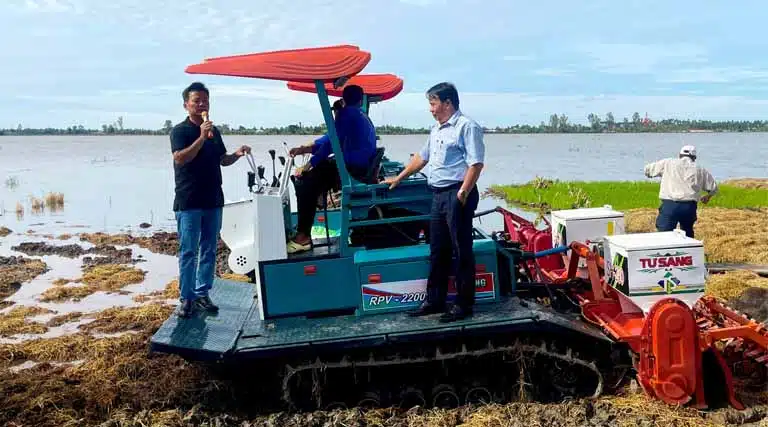
The second day concluded in a field visit to the Tien Thuan Agricultural and Service Cooperative. The delegation witnessed firsthand practical, scalable solutions that enhance the economic value of rice straw and improve farmer livelihoods: from demonstrations of both indoor and outdoor mushroom cultivation using straw to showcasing advanced rice straw management machinery, a newly developed dry-seeding machine, straw-based pot making, and mechanized production of pelletized compost.
The exchange solidified the commitment of both Thailand and Viet Nam to transitioning towards sustainable, circular agricultural practices, ensuring environmental protection and economic benefits for their rice farmers.
Also Read: Brazil Approves 912 Pesticide Registrations in 2025
Global Agriculture is an independent international media platform covering agri-business, policy, technology, and sustainability. For editorial collaborations, thought leadership, and strategic communications, write to pr@global-agriculture.com