Lessening the Loss: IRRI and JICA Train Burundi Technicians On Postharvest Loss And Flatbed Drying
02 December 2025, Burundi: IRRI strengthens post-harvest rice management among public and private technicians in Gihanga and Bubanza, Burundi, to promote sustainable agricultural practices and foster collaboration between research institutions and field practitioners. A series of trainings was conducted as part of the Projet d’Appui à l’Amélioration de la riziculture en République du Burundi (PAARIB) [Project Supporting the Improvement of Rice Cultivation in the Republic of Burundi], which is led by the International Rice Research Institute in Burundi (IRRI-Burundi), in collaboration with the Japan International Cooperation Agency (JICA). By equipping local technicians and agricultural practitioners with the tools and knowledge to implement flatbed dryer systems, IRRI and its partners aim to improve grain quality, reduce spoilage, and enhance food security in the country.
“This training aligns well with the Burundi 2040-2060 vision, as achieving development requires first identifying all factors that hinder productivity levels, quality, and progress. In our case, post-harvest losses are a major obstacle. In short, acquiring knowledge precedes development,” highlighted Willy-Désiré Emera, Director of Research Support Services at the Institut des Sciences Agronomiques du Burundi (ISABU). IRRI’s involvement in this training also directly supports Burundi’s long-term national goals as outlined in the vision of “An emerging Burundi in 2040 and a developed country in 2060”, which emphasizes economic transformation through agricultural modernization, food security, industrialization, and human capital development.
IRRI-Burundi Research and Projects Manager Jean Berchmans Bizimana shared, “Improved rice quality and value addition also align with Burundi’s goal of promoting agro-industrial development and increasing export potential. Furthermore, IRRI’s focus on capacity building and technology transfer empowers local farmers, technicians, and researchers, thereby strengthening human capital, a key pillar of Vision 2040–2060.”
In 2021, the African Postharvest Losses Information System (APHLIS) reported that Burundi lost approximately 12,601 tons of rice produced during harvesting up to field drying. Drying is a critical step after harvesting rice crops. If not dried properly, it may lead to discoloration and pest and mold infestations, driving up postharvest losses. The training addressed a major challenge in rice post-harvest management: the dependence on favorable weather conditions. During rainy or humid seasons, sun drying becomes inefficient and delays the drying process, leading to fermentation, mold growth, and paddy discoloration. Sun drying often results in uneven moisture content, which causes grain cracking and reduces head rice yield during milling.
Open-air drying also exposes rice to contamination from dust, insects, animals, and other impurities, compromising both quality and market value. On the other hand, inadequate drying leads to high postharvest losses due to mold and insect infestation during storage, while the process itself is labor-intensive and time-consuming, requiring large drying areas and constant manual turning.
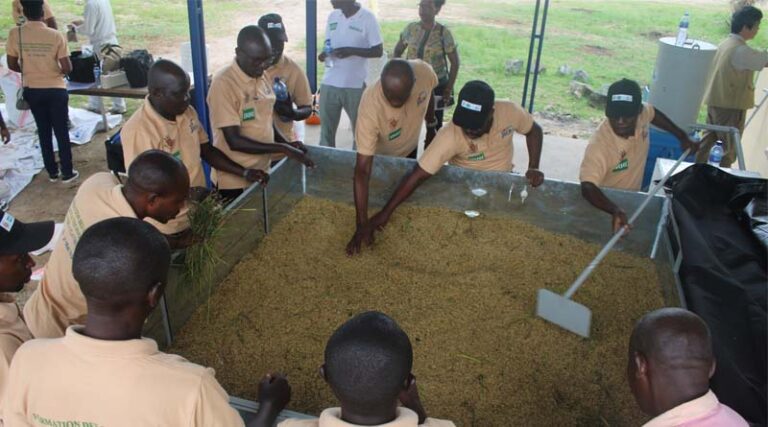
The first phase of the training took place from May 20 to 27, 2025, at the Regional Development Society of Imbo (SRDI) facility. The curriculum covered essential topics, including the design and installation of dryers, as well as operational testing procedures. Through interactive sessions and guided demonstrations, trainees gained a solid understanding of how the technology functions and how it can be adapted to local post-harvest contexts. The second phase followed from October 27 to 31, 2025, at the ISABU Innovation Center, also located in Gihanga. This session was designed as a hands-on continuation, enabling the same participants to apply the knowledge acquired earlier in a practical setting. The technicians practiced installing a flatbed dryer and conducted rice drying tests using real harvest samples. This experimental approach reinforced their technical skills and built confidence in deploying the technology independently.
Once adopted, the flatbed dryer will provide uniform, controlled, and all-weather drying, which can help improve grain quality, reduce postharvest losses, minimize labor requirements, and ensure rice meets the moisture standards required for either high germination rate in the case of seed production or safe storage and efficient milling.
Trainees expressed strong appreciation for IRRI’s leadership in the training program and its role in introducing flatbed dryer technology. Many highlighted the practical value of the sessions and praised the collaborative efforts of IRRI and JICA in delivering high-quality training and hands-on experience. Their feedback underscored the relevance of the training to their daily work and its potential to transform rice production practices in Burundi.
“The practical demonstrations and expert guidance from IRRI have equipped us with tools to improve rice quality and reduce post-harvest losses. We are confident that the flatbed dryer technology will significantly enhance our research and extension efforts across Burundi,” stated Antoine Nitunga, Head of Innovation Center at ISABU. “We deeply appreciate IRRI and JICA’s commitment to strengthening Burundi’s rice sector. The training has not only introduced us to modern drying technologies but also fostered a spirit of innovation and collaboration. Our staff now feel empowered to apply these solutions to improve rice processing and meet industrial standards,” emphasized Donatien Bankibigwira, an Agronomist at SRDI.
As Burundi continues to invest in agricultural modernization, such targeted trainings play a vital role in bridging the gap between research and practice. They empower communities with practical solutions and support the emergence of resilient, knowledge-driven farming systems.
Also Read: XAG’s New R Series Rover Powers Smart Automation in Specialty Crop Farming
📢 If You’re in Agriculture, Make Sure the Right People Hear Your Story.
From product launches to strategic announcements, Global Agriculture offers unmatched visibility across international agri-business markets. Connect with us at pr@global-agriculture.com to explore editorial and advertising opportunities that reach the right audience, worldwide.