Smoked Fish, Stronger Futures – How Indigenous Women in Mandla Are Safeguarding Livelihoods and Nutrition
13 January 2026, New Delhi: On a market morning in Mandla district of Madhya Pradesh, the air often carries a familiar smoky aroma. It signals the presence of Bhunji Machli – smoked fish neatly arranged on cloth sheets, sold by indigenous fisherwomen who have mastered this practice over generations. More than a local delicacy, smoked fish represents a vital link between rivers, food, culture, and women’s livelihoods in central India. Across riverine villages along the Narmada and its tributaries, fish smoking has long been a traditional method of preserving seasonal catches. For many tribal households, especially women-led ones, it is both a source of everyday nutrition and a dependable livelihood option. At a time when rural communities face growing pressures from climate variability, market uncertainty, and ecological stress, this age-old practice is quietly demonstrating how indigenous knowledge can contribute to resilient food systems.
A women-led tradition rooted in local ecosystems
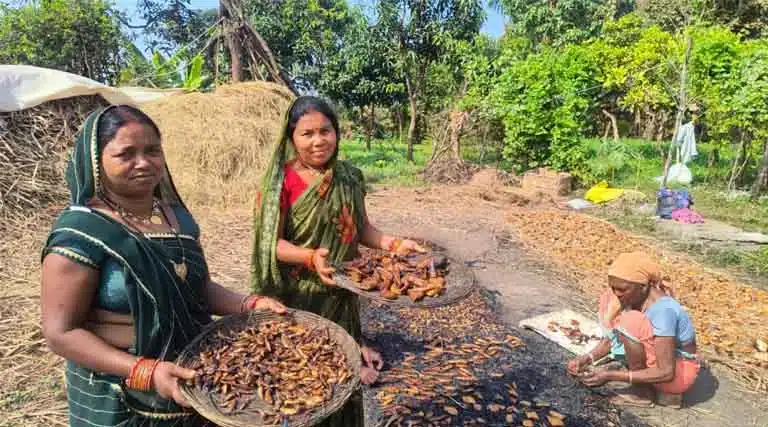
Fish smoking in Madhya Pradesh is largely a women-driven activity. Indigenous fisherwomen are deeply involved in the entire value chain, from harvesting fish in rivers and reservoirs to processing, smoking, and selling the final product in local markets. In districts such as Mandla, Narmadapuram, Betul, and Jabalpur, this work plays a crucial role in household food security and income generation.
The fish used for smoking are mostly small indigenous fish species collected fresh from open water bodies. These species are nutrient-dense, affordable, and culturally preferred. When sold fresh, they fetch modest prices in rural markets. Once smoked, however, their value increases significantly sometimes by two to three times making smoking an important value-addition strategy for fisherwomen with limited access to cold storage or formal markets.
Beyond income, smoked fish is woven into local food cultures. It is easy to store, quick to cook, and forms an important protein source for households with limited dietary diversity.
How fish is traditionally smoked
The smoking process is simple but effective. Freshly harvested fish are cleaned and partially dried. They are then smoked over open fires, commonly using paddy straw that ignites quickly and generates smoke and intense heat. The method is a form of hot smoking, where high temperatures cook the fish while drying it simultaneously. The smoke imparts flavour, inhibits bacterial growth, and extends shelf life.
The final product “Bhunji Machli” has a firm texture and a characteristic reddish-brown appearance. It is sold primarily in weekly village markets or through door-to-door sales, providing flexible livelihood opportunities that women can combine with household responsibilities.
Growing demand, emerging challenges
Demand for smoked fish remains strong across rural Mandla. However, fisherwomen face several constraints that limit the sustainability of this livelihood. Food safety concerns have emerged in some areas, particularly the use of non-edible synthetic chemical colours to enhance visual appeal. Prolonged exposure to smoke during processing also poses occupational health risks for women. In addition, the use of juveniles of larger carp species and occasional inclusion of vulnerable native fish species raise concerns about long-term ecological sustainability. Structural challenges further compound these issues. Limited access to improved smoking infrastructure, lack of scientific guidance, price volatility, and weak market linkages make it difficult for fisherwomen to innovate or scale up their activities beyond local markets.
Scopes for further improvement by considering conservation and hygiene
Co-creating safer and more sustainable practices
Recognising both the value and limitations of traditional fish smoking, WorldFish, under the CGIAR research portfolio, has been working closely with indigenous fish-processing communities in Mandla district to support safer, nutrition-sensitive, and culturally appropriate innovations. In collaboration with fisherwomen from Gurarkhera village, a new smoked fish product locally named Masala Machli (spiced fish) has been co-created. Instead of synthetic chemical colours, locally available spices are used to improve flavour, appearance, and food safety. The innovation retains cultural familiarity while responding to consumer preferences and health concerns. Importantly, the process has been participatory. Women shared their knowledge, tested ideas, and refined the product based on market feedback. This approach has strengthened ownership and built confidence among fisherwomen to adapt traditional practices without losing their identity.
Linking livelihoods, conservation, and health
Building on these community-led innovations, further efforts are underway to address broader sustainability concerns related to biodiversity, hygiene, and environmental health. As part of this work, Barkatullah University, Bhopal, has expressed interest in supporting approaches that link sustainable land management with the conservation of native aquatic biodiversity. A key focus is to promote the smoking of self-recruiting and resilient indigenous fish species such as Gudusia chapra, Rasbora daniconius, Osteobarma cotio, Securricula gora, and Amblypharyngodon mola that can sustain livelihoods without placing additional pressure on aquatic ecosystems. At the same time, pilot efforts are exploring hygienic and environmentally friendly smoking practices that can reduce smoke exposure and improve product safety while remaining affordable and context-appropriate for rural households. Enhancing the populations of indigenous fish species through carefully planned stocking in local water bodies, along with facilitating their effective multiplication, will be essential for sustaining both ecological functions and livelihood benefits.
From local practice to landscape thinking
Experiences from Mandla highlight how small, community-driven innovations can generate multiple benefits including improving household nutrition, strengthening women’s livelihoods, and supporting biodiversity conservation. These efforts align closely with the CGIAR Multifunctional Landscape Science Program, which seeks to enhance the sustainable multifunctionality of landscapes by integrating food systems, water resources, biodiversity, and livelihoods through multi-stakeholder collaboration. By viewing fish smoking not as an isolated activity but as part of a broader landscape system, such approaches help connect local practices to regional sustainability goals. This perspective aligns closely with the CGIAR–IWMI–WorldFish joint emphasis on integrating water management, livelihoods, and ecosystem health to build climate-resilient food systems, particularly within riverine and watershed landscapes.
Looking ahead
As pressures on freshwater resources and rural livelihoods intensify, protecting and strengthening practices like fish smoking becomes increasingly important. The experience from Mandla shows that meaningful change does not always require complex technologies or large investments. Instead, it can begin with listening to communities, valuing indigenous knowledge, and co-creating small but impactful improvements.
For indigenous fisherwomen, smoked fish is more than a product, it is a source of dignity, nutrition, and resilience. With the right blend of community leadership, scientific support, and landscape-level thinking, the smoky aroma of Bhunji Machli can continue to signal not just tradition, but a pathway toward healthier and more sustainable futures.
Also Read: Brazil Approves 912 Pesticide Registrations in 2025
Global Agriculture is an independent international media platform covering agri-business, policy, technology, and sustainability. For editorial collaborations, thought leadership, and strategic communications, write to pr@global-agriculture.com