Strengthening Decentralized Food Systems Governance in Cambodia: Lessons from an Inter-Provincial Workshop
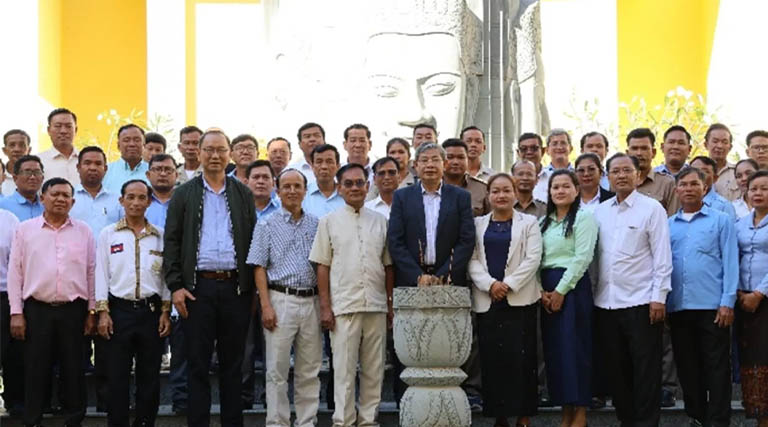
17 January 2026, Cambodia: On 18 December 2025, the Inter-Provincial Workshop on Sharing and Dissemination of Results of Decentralized Governance of Food Systems, Food Security, and Nutrition in Cambodia was convened at the Prey Veng Provincial Administration. The workshop brought together 83 representatives from national and sub-national government institutions, development partners, research organizations, and community stakeholders to reflect on lessons learned and explore pathways for scaling decentralized food systems governance across Cambodia. The workshop was co-organized by the Council for Agriculture and Rural Development (CARD), WorldFish Cambodia, and the International Water Management Institute (IWMI), with support from CGIAR’s Scaling for Impact (S4I), Sustainable Animal and Aquatic Food (SAAF) and Multi-Functional Landscape (MFL) program. It focused on sharing experiences from the implementation of District Working Groups on Food Security and Nutrition (DWG-FSN) in Ba Phnom District (Prey Veng Province) and Santuk District (Kampong Thom Province), including ecosystem-based sub-working groups in Boeng Sneh Lake and Boeng Ream Community Fish Refuge (CFR).
Translating national strategies into local action
Opening the workshop, H.E. Dr. Ouk Makara, Vice Chairman of CARD, reaffirmed the Royal Government of Cambodia’s commitment to strengthening food systems, food security, and nutrition through decentralized and integrated governance approaches. He highlighted the alignment of DWG-FSNs with key national frameworks, including the Pentagonal Strategy Phase I, the National Strategy for Food Security and Nutrition (2024–2028), and the Food Systems Roadmap (2025–2030).
DWG-FSNs are being institutionalized as permanent multi-stakeholder platforms that translate national policy priorities into district-level planning and action. Through sub-working groups linked to specific ecosystems, such as lakes and fish refuges, these platforms maintain strong connections with local communities and community-based organizations, helping to balance competing demands for water, agriculture, and fisheries while improving livelihoods, biodiversity, and nutrition outcomes.
H.E. Chheang Sovannara, Deputy Governor of Prey Veng Province, emphasized the practical value of the DWG-FSN model in Ba Phnom District, particularly around Boeng Sneh Lake, where improved coordination has helped address water management challenges, reduce conflicts, and strengthen local food systems. He reaffirmed the Provincial Administration’s commitment to supporting and expanding these mechanisms.
Evidence, innovation, and local experience
The workshop featured a series of technical presentations highlighting how evidence and innovation are informing decentralized governance. Researchers from WorldFish, IWMI, CDRI, and IFReDI, alongside district officials, local authorities, CBOs and other relevant stakeholders, shared findings on integrated rice-field fishpond systems, hydrological assessments of Boeng Sneh Lake, training needs for district technical staff, and management plans for key wetlands.
Evidence from Prey Veng showed that improved rice-field fishpond systems can significantly boost productivity and incomes, with higher returns per square meter than rice alone, while contributing to household nutrition and climate resilience. Hydrological studies of Boeng Sneh demonstrated how seasonal water shortages, competing demands, and climate variability underscore the need for better water allocation and ecosystem-based planning at the district level.
District representatives from Ba Phnom and Santuk shared their experiences in developing and implementing lake and fish refuge management plans, highlighting both achievements and ongoing challenges, including limited budgets, infrastructure gaps, and capacity constraints. These reflections reinforced the importance of sustained technical support, cross-sector coordination, and community engagement.
Collective learning through dialogue
Group discussions allowed participants to reflect on how DWG-FSNs and Provincial Working Groups on Food Security and Nutrition (PWG-FSNs) can more effectively lead coordination, reporting, and implementation of the Food Systems Roadmap to 2030. Key themes included the need for clear action plans, regular and inclusive meetings, stronger links between district and provincial levels, and reliable funding mechanisms.
Participants also discussed the role of sub-working groups as a practical solution to ensure community voices and ecosystem-specific knowledge remain central to decision-making. Regular reporting, shared leadership, and alignment with district budgets were identified as critical to making these structures operational and sustainable.
Looking ahead
In his closing remarks, H.E. Dr. Ouk Makara underscored that decentralized governance through DWG-FSNs offers a scalable and practical mechanism for advancing inclusive, resilient, and sustainable food systems in Cambodia. He called for continued investment in capacity building, data-driven decision-making, cross-sector collaboration, and community engagement, while encouraging expansion of the model to other districts.
The workshop concluded with a shared understanding that stronger, better-connected governance at district level is essential to reducing trade-offs between agriculture, fisheries, water, and nutrition—and to ensuring that national food system ambitions deliver tangible benefits for communities on the ground.
Also Read: Brazil 2025 Pesticide Approvals: Company-wise List with Brand Name, Product and Type
Global Agriculture is an independent international media platform covering agri-business, policy, technology, and sustainability. For editorial collaborations, thought leadership, and strategic communications, write to pr@global-agriculture.com