ITC Showcases Climate-Smart Agriculture Through ‘Mitti Mera Desh – Tales from the Heartland’ Campaign
Initiative aligned with the Government of India’s ‘Meri Maati Mera Desh’ programme, celebrating farmer-led transformation
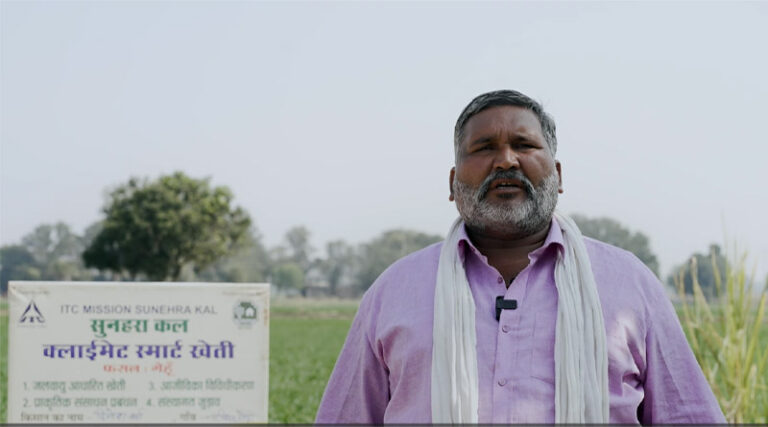
23 December 2025, New Delhi: On the occasion of Kisan Diwas 2025, ITC reiterated its long-term commitment to India’s agricultural transformation, aligned with the national vision of Viksit Bharat 2047. Marking its century-long association with Indian agriculture, ITC launched ‘Mitti Mera Desh – Tales from the Heartland’, a farmer-centric storytelling initiative that captures authentic success stories from the ground.
Rooted in ITC’s Climate Smart Agriculture (CSA) programme, the campaign brings forward real-life narratives of farmers who are building resilience against climate variability while improving productivity and incomes. Through a human-led storytelling format, the initiative highlights how science-based interventions are shaping sustainable agri-value chains across the country.
Aligned with National Priorities
The Mitti Mera Desh series draws inspiration from the Government of India’s Meri Maati Mera Desh initiative launched in 2023 under the Azadi ka Amrit Mahotsav framework. By spotlighting farmer experiences and grassroots impact, the campaign underscores ITC’s contribution to national priorities such as climate resilience, natural resource conservation and inclusive rural growth.
Climate Smart Agriculture at Scale
ITC’s Climate Smart Agriculture programme focuses on de-risking farming from climate change and weather uncertainties through regenerative and resource-efficient practices. The interventions span major crops including wheat, rice, soybean, onion, fruits and spices, and promote practices such as zero tillage, direct-seeded rice, raised-bed planting, mulching, and alternate wetting and drying.
Water stewardship is a key pillar of the programme, with the adoption of crop- and region-specific agronomy and micro-irrigation practices across paddy, sugarcane, wheat, soybean, and horticultural crops. During 2024–25, the CSA initiative benefitted nearly 1.2 million farmers across about 3.2 million acres in 19 states, with a long-term target of covering 4 million acres by 2030.
Climate Smart Villages and Soil Health
In its core agri catchments, ITC is working towards transforming villages into Climate Smart Villages (CSVs), an initiative that currently spans around 7,000 villages across 12 states. The approach is built on four integrated pillars—Climate Smart Agriculture, Natural Resource Management, Livelihood Diversification and Institutional Support—to strengthen village-level resilience.
Soil health remains central to ITC’s agri strategy. The company promotes measures such as tank silt application, composting, zero tillage, site-specific nutrient management, region-wise soil fertility mapping and the use of biofertilizers, aimed at improving Soil Organic Carbon and long-term soil productivity.
Strengthening Women’s Role in Agriculture
ITC is also actively promoting gender inclusivity in agriculture by supporting women farmers and agri-entrepreneurs. Through initiatives such as Women Farmer Field Schools, Krishi Sakhis and Women Agri Business Centres, the company enables women to adopt climate-smart practices that enhance yields and incomes. During 2024–25 alone, scientific and technological best practices reached over 1.8 lakh women across agri value chains.
NextGen Agriculture and ITCMAARS
As part of its NextGen Agriculture vision, ITC is advancing a three-pronged strategy comprising the expansion of the ITCMAARS digital ecosystem, the scaling up of Climate Smart Agriculture, and the growth of its Value-Added Agri Products (VAAP) portfolio.
The ITCMAARS platform accelerates agri-tech adoption by combining digital intelligence with on-ground reach. It offers farmers access to hyperlocal e-markets, credit, AI- and ML-driven crop advisories, weather-based decision tools, drone services, IoT-enabled irrigation solutions and market linkages. Supported by Farmer Producer Organisations as physical aggregation and service hubs, the ecosystem enables scalable, personalised solutions. Currently operational across 11 states, ITCMAARS connects over 2.2 million farmers, 2,050+ FPOs and more than 100 partners. Pilot outcomes indicate up to 30 percent higher farmer returns and 15–20 percent yield improvements, with a 2030 goal of engaging 10 million farmers and 4,000 FPOs.
Value-Added Agriculture and Global Linkages
Under its Value-Added Agri Products portfolio, ITC is scaling high-potential segments such as spices, shrimps, wheat-based products, coffee, processed fruits and vegetables, and medicinal and aromatic plant extracts. Anchored in food safety, traceability and sustainability, the approach shifts value chains from production-led to demand-driven models, enabling Indian farmers to access global markets through exports.
Global Agriculture is an independent international media platform covering agri-business, policy, technology, and sustainability. For editorial collaborations, thought leadership, and strategic communications, write to pr@global-agriculture.com