Are Bio-Pesticides the Future of Safe Farming?
Guest Author: Sanjeev Reddy, Chief Agronomy Officer at AgriBegri
08 January 2026, New Delhi: Increasing consumer demand and stricter government restrictions on pesticide use have driven rapid growth in bio-pesticide use. Synthetic insecticides pose serious risks to human health and are damaging the natural environment for many years to come. There is a growing interest in producing food that is safe, clean, and free of harmful residues.
Essential Factors Influencing Interest in Biopesticides:
- Public health concerns over pesticide residues in food and water sources (WHO, 2022).
- risks to the environment from pesticide distribution and groundwater contamination.
- Regulations like the EU’s 2019–2023 prohibition on more than 75 active pesticide components (EFSA, 2023).
- Consumer demand for organic and residue-free vegetables is rising.
- Agroecology and the UN SDGs are in line with sustainable farming practices.
As the market moves toward more environmentally conscious buyers and the growing number of laws governing ecologically sustainable products, bio-pesticides are becoming increasingly appealing alternatives to synthetic pesticides, thanks to the significant reduction in environmental hazards they pose. In the last section of this report, we outline what bio-pesticides are and how they operate.
What Are Bio-Pesticides?
Biopesticides, sometimes referred to as microbial or plant-based pesticides, are derived from natural sources such as microbes and plants. Biopesticides are generally regarded as safe for humans and other non-target beneficial organisms. Biopesticides primarily address specific pest population levels.
Types of Bio-Pesticides:
| Type | Description | Examples |
| Microbial | To eradicate bugs, use living things or their byproducts. | Bacillus thuringiensis, Trichoderma |
| Botanical | extracted from plants that naturally have pesticidal qualities | Neem extract, pyrethrum, rotenone |
| Biochemical | Natural substances that interfere with insect growth or behaviour | Pheromones, insect growth regulators |
How They Work:
- Microbial bio-pesticides use toxins or spores to infect or poison pests.
- Botanical pesticides use natural ingredients to either kill, suppress, or discourage pests.
- Biochemical pesticides interfere with pests’ mating, feeding, and development.
Due to their selective control of target insect pests and their ability to help restore a healthy ecological balance in their host environment, bio-pesticides (also known as biological pesticides or bio-pest management systems) provide an excellent option for IPM and organic agriculture. The following section will outline the key advantages of using bio-pesticides.
What Are the Benefits of Bio-Pesticides for Agriculture?
Bio-pesticide products are eco-friendly, do not harm the environment, and help promote the health of the population while benefiting the economy through organic/sustainable agriculture. Bio-pesticide products help protect many forms of life while also eliminating the need for harmful chemical pesticides.
Principal Advantages of Bio-Pesticides:
- Low toxicity to humans, livestock, and pollinators.
- Target specificity that protects beneficial organisms and insects.
- Decreased resistance to pesticides as a result of intricate, non-repetitive mechanisms.
- Produce devoid of residues that satisfy export and organic certification requirements.
- Enhanced soil health due to biodegradability.
- IPM compatibility for all-encompassing pest management techniques.
Case Example:
The FAO’s research, performed in 2021 research found that farmers in Vietnam using Beauveria bassiana reduced synthetic pesticide applications by up to 65% without negatively impacting production volumes, and that clean-label produce enabled improved market access.
Despite the apparent benefits of bio-pesticides, substantial disadvantages to their adoption limit their broad-scale application. Further sections of this document contain a more detailed discussion of these limitations.
What Are Bio-Pesticides Drawbacks and Restrictions?
Regulatory, biological, and logistical challenges are slowing the widespread adoption of bio-pesticides in agricultural systems, even as interest in them grows.
Key Restrictions:
- Shorter shelf life, necessitating regulated storage conditions.
- Slower action compared to chemical pesticides (may take days).
- Limited pest range, necessitating precise pest identification.
- Environmental sensitivity, including temperature sensitivity and UV deterioration.
- Higher upfront costs and fewer subsidies than synthetic options.
- Formulation issues that impact efficacy and consistency.
- lengthy regulatory clearance procedure that takes two to four years in many jurisdictions (OECD, 2022).
Practical Challenges Overview:
| Challenge | Impact on Adoption |
| Shelf-life | Limits availability and scalability |
| Pest specificity | Requires pest diagnosis before application |
| Field efficacy | Depends on weather, humidity, UV exposure |
| Regulatory delays | Slows commercialization and investment |
Innovation and encouraging policies are progressively addressing these constraints. How farmers apply bio-pesticides on the ground is described in the following Things.
How Are Bio-Pesticides Used in Practice?
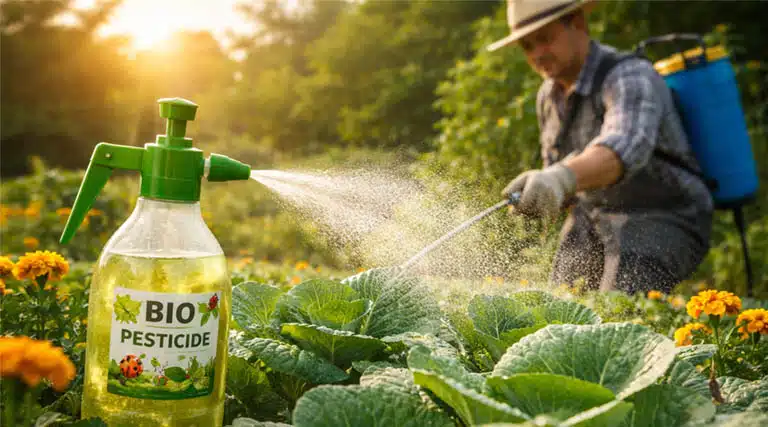
Farmers use bio-pesticides in multiple ways depending on their crop, pest pressure, and climatic conditions. Organic and IPM-based systems increasingly adopt these natural pest control products for foliar sprays, seed treatments, and drip irrigation methods.
Common Application Methods:
- Foliar spray is the most common method for managing pests and fungal diseases.
- Seed treatment protects crops from early-stage soil-borne pathogens.
- Soil drenching applies microbial agents to combat pests that harm roots and nematodes.
- Drip irrigation delivers water-soluble products directly to the root zone.
- Pheromone traps are used for mating disruption in orchard systems.
Key Usage Metrics:
| Parameter | Typical Range |
| Dilution rate | 1–2% depending on crop and product |
| Application frequency | Every 7–14 days during critical pest stages |
| Temperature effectiveness | 20–30°C for optimal microbial activity |
| Compatibility | Often mixed with wetting agents or fertilizers |
Real-World Example:
In Maharashtra, India, tomato farmers who use neem-based bio-pesticides have seen a 40% decrease in pest problems and can sell their tomatoes at a 25% higher price because their crops have no harmful residues.
The practical use of bio-pesticides now needs to be compared directly with chemical pesticides, which will be discussed in the next section.
How Do Bio-Pesticides Compare to Chemical Pesticides?
Bio-pesticides and synthetic pesticides differ significantly in terms of safety, environmental impact, and long-term effectiveness. Both have their own pros and cons, but there’s a growing movement towards using bio-pesticides because they support more sustainable farming practices.
Comparison Table:
| Attribute | Bio-Pesticides | Chemical Pesticides |
| Toxicity to humans | Low | Medium to high |
| Environmental impact | Minimal runoff, biodegradable | Persistent in soil, high runoff risk |
| Resistance development | Low | High (due to repeated use of same compound) |
| Speed of action | Moderate (1–5 days) | Fast (minutes to hours) |
| Spectrum of activity | Narrow, pest-specific | Broad-spectrum |
| Residue on crops | Usually none | Frequently detected |
| Cost over time | Higher upfront, long-term savings | Lower upfront, long-term soil degradation |
Products such as glyphosate and chlorpyrifos, which are synthetic pesticides, have garnered international attention for their association with cancer, soil sterilization, and water pollution. Bio-pesticides present an eco-friendly, healthier option that supports sustainable farming practices globally.
Consumer tastes also indicate this change. A 2022 Eurobarometer poll showed that 72% of EU consumers favour produce cultivated with natural pest control, highlighting the increasing preference for bio-sustainable food.
Subsequently, we evaluate if bio-pesticides will emerge as a crucial component of future agricultural practices.
Are Bio-Pesticides the Future of Safe Farming?
Bio-pesticides are becoming more prominent in the global shift towards sustainable farming practices. Their minimal environmental footprint, adherence to agroecological tenets, and concordance with international food safety regulations position them as indispensable tools for the development of future farming methodologies.
Reasons Bio-Pesticides Are Gaining Long-Term Relevance:
- They advocate for regenerative agriculture by encouraging biodiversity in the soil and maintaining ecosystem health.
- They help meet residue-free export requirements in major food markets.
- They align with UN Sustainable Development Goals, especially SDG 2 (Zero Hunger) and SDG 12 (Responsible Consumption and Production).
- They complement innovation in agritech, including AI-driven pest monitoring and drone-based applications.
- They respond to consumer and policy-driven demand for safe, sustainable food systems.
The global market for bio-pesticide is projected to grow from $5.4bn in 2023 to reach $13.1bn by 2030, at a CAGR of 13.2% during the forecast period (2019 – 2024), as reported in: MarketsandMarkets (2024). This is being driven by tighter rules on the use of synthetic pesticides, growing consumer interest in organic food and greater awareness among farmers.
While bio-pesticides continue to struggle in gaining traction, continued research effort and support from the government is helping allay many initial concerns while private-sector innovation has been accelerating. In a world where agriculture is reorienting toward sustainability, bio-pesticides are no longer niche products — they could soon be essential.
Also Read: Government Of India Invites Public Comments on Draft Pesticides Management Bill, 2025
Global Agriculture is an independent international media platform covering agri-business, policy, technology, and sustainability. For editorial collaborations, thought leadership, and strategic communications, write to pr@global-agriculture.com