Indian Farmers Aren’t Cutting Back, They’re Prioritising Crop Protection Differently: Rajavelu NK, Godrej Agrovet
Guest Author: Rajavelu NK, CEO – Crop Protection Business, Godrej Agrovet Ltd.
07 January 2026, New Delhi: For a long time, scale and seasonality have been impacting India’s crop protection industry. What the 2025 cropping cycle has reinforced, however, is that the industry is operating in a more sophisticated ecosystem that is characterized not only by agronomy and the climate variability, but also by the economics of the farmer and increasing emphasis on responsible use.

From a cropping standpoint, 2025 showcased the strength of the Indian agriculture sector. Kharif sowing increased to 1,121 lakh hectares, exceeding the previous year and the most recent five-year average. Rabi sowing has covered more than 634 lakh hectares, up nearly 16 lakh hectares year-on-year as of 1st week of January, which is equally positive. These trends are a result of farmers’ responsiveness to MSP commitments, the early season rainfall that was positive and the availability of better seeds. Farm income sentiment, however, was cautious.
Farmer Buying Reflects Clear Priorities
Purchasing behaviour during the 2025 Kharif season was shaped by a combination of stable market pricing and uneven weather patterns across regions. While certain crops experienced weather-related yield variability, overall production levels remained broadly in line with expectations. At the same time, relatively range-bound prices for key crops influenced how farmers planned their on-farm investments.
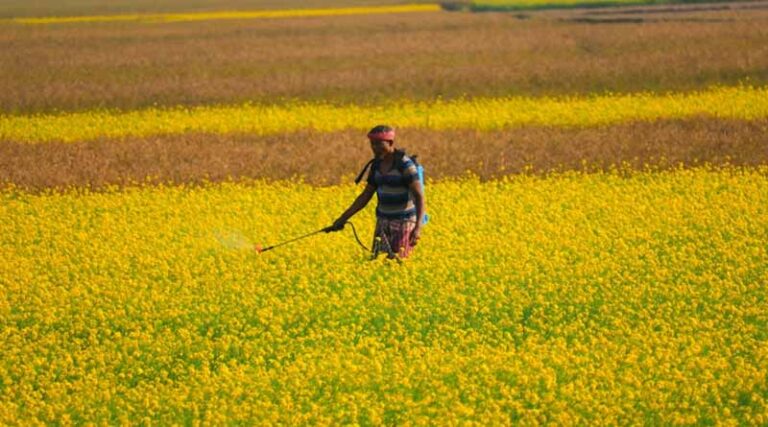
As a result, farmers continued to invest in crop protection, but with sharper prioritisation – applications were more targeted and spend was closely aligned with visible risk. For the industry, this signals a shift toward more informed, judicious and need-based usage, rather than a reduction in relevance.
Climate Variability Is Reinforcing the Need for Precision
The 2025 monsoon highlighted the extent to which climate variability is changing the face of Indian agriculture. While total rainfall for the season was above average, the uneven distribution in terms of both time and area resulted in very different outcomes. Some regions suffered from lack of water at the beginning of the season, whereas the others were confronted with excess rainfall later in the cycle, adversely affecting standing crops.
These conditions resulted in relatively varied pest pressure across regions, reinforcing the importance of timely and well-calibrated crop protection interventions. Spray decisions were guided by field conditions, highlighting the value of applying the right solutions at the right stage to protect crop health and yield. Risk profile of crops (irrespective of the degree of aggregate yield decline) remained dynamic, with rising temperatures and increasing water stress continuing to drive changes in pest and disease prevalence.
Farmers are also having to deal with unrelenting and extreme weather events, with a single season seeing the same weather cycle shift from drought to flood. This volatility has made risk management and crop protection planning much more challenging. The government has responded by further strengthening safety nets like the Pradhan Mantri Fasal Bima Yojana (PMFBY) which, since its inception in 2016, has insured 78.4 crore farmer applications and paid out ₹1.83 lakh crore in claims. Yet, the speed and severity of weather-related events often far exceed the protection provided by insurance.
For the crop protection industry, these evolving conditions reinforce a fundamental shift: the future lies in precision, stewardship, and informed decision-making, applying the right solutions at the right time, rather than relying on blanket application approaches
Managing Inventory and Channel Dynamics: Restoring Balance
The past year has really been a time when the agrochemical industry has had to prove its ability to manage the timing of the market rather than grappling with the demand itself. A softer demand for products, along with an uneven pest situation, has caused many agrochemical companies to start the cycle with elevated inventory levels of products throughout the channel. In a country like India, where the distribution of products is through dealers who usually have a stock of a few months that is supported by trade credit, the working capital cycles are naturally long, especially during times of slower stock turnover.
The industry’s response has been one of disciplined and deliberate. The manufacturers have aligned their production to be more in line with the actual demand and supported the channel partners by providing credit and promotional schemes in a calibrated manner to enable the movement of stock without breaking long-term relationships.
Even though these actions can result in lower margins in the short term, they are absolutely necessary for bringing back balance in the value chain. Institutional farm credit is expected to remain the source of farmer liquidity and thus the process of inventory rationalisation will go on gradually. As the channels get back to normal, the market will be ready for slow but steady growth that is agri-business led, with more intelligent stocking, better timing, and a cautious move towards higher-value, integrated crop protection solutions rather than abrupt volume expansion.
Counterfeits: The Hidden Undermining Risk
Counterfeit and substandard pesticides remain one of the most corrosive threats to this ecosystem. Estimates suggest that nearly 25 percent of the total Indian pesticides market is counterfeit (CropLife). Beyond the immediate crop yield losses, counterfeit products also erode farmers’ trust in the system, create market distortions, and introduce environmental risks to the soil and food systems. Approaching this challenge has expanded to more than just the enforcement side.
Government crackdowns, retail accountability, packaging traceability, and farmer education are integrating into a more synergistic response. The battle against fake products must be fought on not only the front lines of villages with local knowledge but also with regulatory vigilance as a shared responsibility across the entire value chain.
Technology: Promise vs. Practical Adoption
Technology continues to determine the future of Indian agriculture, however, its impact today is varied in various parts of the country. While drones, digital advisories and AI, powered surveillance tools are becoming popular, their usage is still very limited. Industry assessments indicate that a large majority of farmers—nearly nine out of ten—remain outside the effective ambit of most agri-tech innovations. This difficulty of the transition to modern agriculture can be hardly ignored in the case of India’s small and marginal farmers as they make up the majority of the country’s smallholders, and they operate with limited land and capital, having little to no formal extension access, thus their decision, making is highly dependent on simplicity, trust and timely information.
While innovation in agri-tech is accelerating, many solutions still struggle to move from pilot stages to scalable adoption, limiting their impact to select crops and regions. For technology to deliver value at scale, solutions must be designed with local agronomic conditions, farmer cash flows and operational simplicity in mind.
Equally important is capability-building—without sustained efforts to improve digital literacy among farmers and Farmer Producer Organizations, advanced tools remaining underutilised. The future of agri-tech adoption lies in combining the technological agility of new-age companies with the agronomic depth and execution capabilities of legacy players who understand farm-level realities. Technology will only translate into impact when farmers are equipped not just with access, but with the skills and confidence to act on the information provided.
Building the Next Chapter of Indian Agriculture
As India’s crop protection industry looks ahead to 2026, the path forward is increasingly clear. Growth will no longer be driven by acreage expansion or volume alone, but by the sector’s ability to respond intelligently to volatility. Climate variability, income sensitivity, regulatory complexity and rising expectations around responsible use are reshaping the definition of value in crop protection.
The next phase will favour solutions that combine precision with stewardship, technologies and practices that help farmers apply less, but better; intervene earlier, but more accurately; and manage risk proactively rather than reactively. At the same time, restoring trust across the ecosystem through stronger enforcement against counterfeits, clearer regulatory pathways, and sustained farmer education will be as critical as innovation itself.
Ultimately, India’s crop protection story in the coming years will be defined less by how much is sold, and more by how effectively risk is managed across crops, seasons and supply chains. In an era of heightened uncertainty, resilience, precision and trust will determine whether the industry merely adapts or truly leads the next chapter of Indian agriculture.
Global Agriculture is an independent international media platform covering agri-business, policy, technology, and sustainability. For editorial collaborations, thought leadership, and strategic communications, write to pr@global-agriculture.com