New Line Of Defence For Aussie Growers Combating Two-spotted Mite
26 February 2026, AU: A major fruit producer in Victoria’s Goulburn Valley is celebrating the successful use of a new mode of action miticide in his crop protection tool kit, which helped protect his crops from the devastating impacts of two-spotted mite.
Adrian Conti from Conti Orchards recently used Interrupt Miticide for the first time, and welcomed the addition of the IPM-friendly option (when used as per label directions).
“Resistance management is critical to the success of Conti Orchards,” Adrian says.
“Prior to harvest we have very limited methods of control. I wanted to give Interrupt a go because it gives the option to rotate across different product groups. I’m very glad I tried it because it did a fantastic job.
“ Having newer chemistry like Interrupt 240 SC Miticide is fantastic for us as growers. It gives us options, having another tool in the box to be able to fight two-spotted mite under severe conditions.”
On 100 hectares across four properties in Cobram in the Goulburn Valley, the Conti family has been growing pome and stone fruit since emigrating from Italy in 1949.
The region’s fertile land and temperate climate provides ideal growing conditions, but hot summers often leave Adrian’s orchards susceptible to two-spotted mite.
Adrian says managing the pest has been critical for the continued success of the family business.
“Generally when it’s hot and leading up to harvest, two-spotted mite can be catastrophic to growing a commercial crop,” Adrian explains.
“We had a window just prior to harvest to use Interrupt for the first time. We had one go, one shot to get it right and within days we were very excited to see it had done exactly the job we wanted. It was an amazing result.”
Agronomist Cameron Forrest from I K Caldwell works with Adrian to keep levels of two-spotted mite under control around his orchards.
“Adrian practices Integrated Pest Management, so we’re in here regularly checking for mites and the predators, making sure everything’s in balance,” Cameron says.
“But in these hot conditions these measures are often not enough to control the spread.
“Where thresholds are reached, the team implements a miticide side such as Interrupt.”
Cameron says Interrupt’s long lasting residual control of up to 21 days sets it apart from other miticides on the market.
“Due to spray timing opportunities, we put it under extreme pressure in a block of Adrian’s pears, spraying in early December. The excellent level of control got us through to harvest at the end of January,” he says.
”We’re seeing truly excellent results and it hasn’t had any effect on any of our predatory mite levels, which is very important.
“Miticides need to be IPM-friendly, so if we can protect the natural predators, that holds us in good stead for the long term health of the crop.”
As a Group 23 chemical containing the active ingredient spiromesifen, Interrupt’s mode of action offers translaminar movement for full leaf coverage.
”Mites are very small and very hard to hit,” Cameron explains.
“They often congregate on the bottom of the leaf, making it more difficult to provide effective control.
“Having a miticide like Interrupt that can essentially move through the leaf and target the eggs, nymphs and adults is excellent.
“In summer you can go from egg load to adult very quickly, so Interrupt’s ability to target all life stages of the mite is very impressive. It also leaves the residual there, so if eggs hatch, it’ll pick up the nymphs as well. So it gives you the confidence that you’ll get great results.”
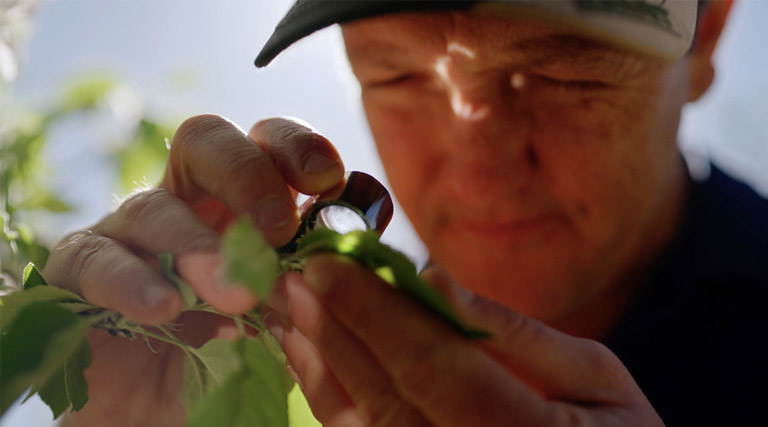
Agronomist Cameron Forrest assesses the impact of Interrupt Miticide’s translaminar activity on a pear tree at Conti Orchards.
With growers facing mounting resistance to existing miticides on the market, Cameron says new products are a necessity for the future of fruit growing.
“Resistance can occur very quickly, particularly in pear blocks that we have in this area,” Cameron adds.
“A lot of the miticides we have on the market now are old. Growers and agronomists need newer products coming through to combat resistance.”
For Adrian Conti, incorporating Interrupt into his ongoing pest management plan is the natural next step.
“Interrupt is definitely a tool that I’ll use going forward,” he says.
“Every season is different and we need to adapt and evolve and be dynamic enough to change our strategies to continually improve.
“At Conti Orchards our vision is simple, to grow the best fresh fruit that we possibly can. For now and for the future.”
Also Read: FMC’s Rimisoxafen Becomes First-Ever Dual Mode of Action Herbicide Classified by HRAC
Global Agriculture is an independent international media platform covering agri-business, policy, technology, and sustainability. For editorial collaborations, thought leadership, and strategic communications, write to pr@global-agriculture.com