Algorithm Renders A Clear Picture Of Wheat Roots
24 February 2026, AU: From germination on, the response of wheat roots to nutrient inputs has been illuminated by AI, giving crop scientists a powerful new research tool.
A computer scientist has combined synchrotron X-ray technology and artificial intelligence to create detailed three-dimensional (3D) images of wheat roots and fertilisers in soil cores.
PhD student Hurriyatul Fitriyah from the University of South Australia (UniSA) has used high-powered X-ray computed tomography (CT) to produce detailed cross-sectional images of wheat roots and fertiliser granules without disturbing the roots.
The technology is particularly beneficial for researchers exploring the response of roots to deep-placed fertiliser. Understanding the distribution of roots and their interactions with soil and fertiliser can inform management practices that improve crop growth and yield through improved efficiencies.
Working under the supervision of Associate Professor Ivan Lee, Ms Fitriyah used the Australian Nuclear Science and Technology Organisation’s synchrotron X-ray CT facility in Melbourne to capture the detailed 3D images.
Brighter light
Synchrotron X-rays are millions of times brighter than those produced by conventional X-ray machines in laboratories and hospitals.
At the Australian Synchrotron, Ms Fitriyah says a 3D X-ray CT scanner directs multiple X-ray beams around the sample, capturing images from many angles. A computer then reconstructs the images to form a 3D cross-section.
“University of South Australia’s Professor Enzo Lombi and Dr Casey Doolette, working with the University of Queensland’s Professor Peter Kopittke, prepared the wheat samples for scanning and worked with us at the synchrotron to gather the X-ray CT data images,” she says.
We used the Imaging and Medical beamline to generate high-resolution X-ray CT images at 39 microns. This resolution allowed us to see the fine fibrous root structures of young wheat plants.
Image analysis
After capturing the images, the next challenge was to analyse them. Usually, this requires separating the roots, soil pores and organic matter from the soil within the image, which is a challenging task.
“Although software exists to assist, manual annotation is time-consuming, labour-intensive and prone to error,” Ms Fitriyah says.
“The datasets produced by X-ray CT are enormous, with roots that spread widely yet remain extremely fine in diameter, making them difficult to detect.”
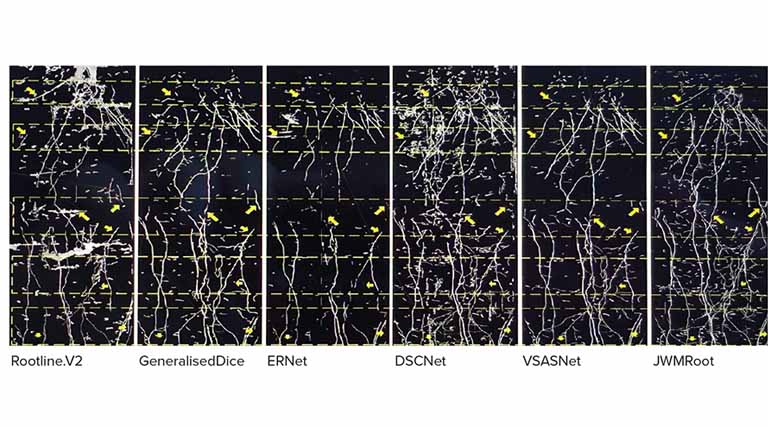
Adding to the complexity, she says the images are greyscale and low contrast, making it challenging to visually distinguish the roots from the surrounding soil. To address this, she and UniSA Postdoctoral Fellow Dr Ke Sun developed an algorithm, using ‘deep learning’ to distinguish between roots and other components, including fertilisers, soil, organic matter and soil pores.
Deep learning
Deep learning is a subset of machine learning that uses artificial neural networks with multiple layers to ‘comprehend’ complex patterns from large amounts of data.
Ms Fitriyah says it enables computers to ‘see’ and interpret images or videos, automating tasks such as identifying objects, monitoring processes or analysing medical and scientific images.
“Deep learning teaches computers to recognise patterns. For example, for root and fertiliser segmentation, the computer is given CT images of a soil sample as input, which contains soil, air, water and other materials, and is trained to identify only the roots and fertilisers.
“In this context, both are the main object of interest [or the foreground], while everything else is considered background.”
She says traditional image processing attempts to separate roots and fertilisers from the background using rules based on brightness or intensity. However, this approach is challenging because their appearances can vary with soil type, moisture or scanning conditions.
New algorithm
Ms Fitriyah says that deep learning overcomes these challenges by learning directly from real examples with diverse image appearances.
The novel algorithm, JWMRoot, was developed using a semi-supervised framework that requires only a small amount of labelled data. “This reduced the time-consuming annotation process and includes an additional root-connecting strategy to refine segmentation results,” Ms Fitriyah says.
“A training dataset is developed to teach the network how to predict which parts of the image are roots, fertilisers or soil,” she says. “This allows the algorithm to consider not only brightness but also the surrounding structures and context, resulting in an accurate discernment of individual parts.”
Once the images were produced, more wheat root proliferation was observed around the deep-placed fertiliser in the soil core than in a control with no fertiliser.
Root phenotyping
Ms Fitriyah says deep learning images can be used for root phenotyping, which involves measuring root length and volume, with volume indicating biomass.
A key factor in determining the impact of soil management practices is knowing the effect of the management practice on the crop’s root systems. The synchrotron 3D X-ray CT technology allowed researchers to generate high-resolution images of roots, including very thin wheat roots just a few days after germination.
Using the algorithm, we detected hidden roots in 3D synchrotron X-ray CT images, even with limited data and manual labelling, preserving the roots and fertiliser granules in their original living form despite low image contrast.
She says the approach they have developed will enable high-throughput phenotyping of root, soil and fertiliser interactions, allowing experiments of multiple samples to be processed more efficiently and accurately. Ultimately, this is hoped to lead to improved soil management practices and the health and productivity of soils.
What is AI and machine learning?
Artificial intelligence (AI) focuses on creating systems capable of performing tasks typically requiring human intelligence, such as learning, reasoning, problem-solving, perception and language understanding. AI enables machines to identify objects and act autonomously in complex situations.
Machine learning focuses on building systems capable of learning from data and continually improving their performance over time without requiring explicit programming for each task. In machine learning, computers use algorithms to analyse patterns in large datasets, derive insights, and make predictions or decisions based on that experience.
Also Read: Bayer Launches Multi-Crop Seed Brand ‘newgold®’ to Help Farmers Tap the Low-Carbon Biofuel Economy
Global Agriculture is an independent international media platform covering agri-business, policy, technology, and sustainability. For editorial collaborations, thought leadership, and strategic communications, write to pr@global-agriculture.com