Canola In The Mix Gives Barley A Lift
24 February 2026, AU: Gindie grower Dwyane Pukallus and his family have successfully added canola to their barley/chickpea rotation in Queensland’s Central Highlands, improving barley health and soil conditions.
The Central Highlands region of Queensland is not known for canola, but for Gindie grower Dwyane Pukallus and his family the past 3 years have shown that growing the crop can be a worthwhile choice.
Dwyane farms with his parents, Russell and Dianne, on 4,000 ha of owned and share-farmed land, growing barley, chickpeas and now canola south of Emerald. He introduced canola to help reduce disease in his family’s barley crops.
“We’ve always had good yields with our barley, and there’s a good market for it, but disease was becoming an issue,” Dwyane says. “Chickpeas do well here, but you can’t just grow chickpeas and cereals – you need something else in the rotation.”
Traditionally using a chickpea/barley rotation, Dwyane added canola in 2023.
“With the rotation of canola in there, having that one extra year is giving us better yields in our barley in the following year, and we are finding far fewer dying barley plants in that next crop,” he says.
Three different seasons
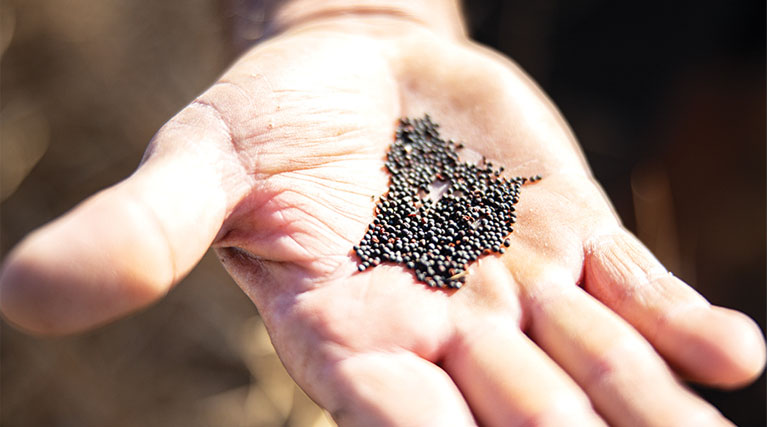
In the first year of trialling canola, 120 ha were planted with 2 hybrid varieties: Pioneer® PY520TC and Pioneer® PY421C.
“Both of these were varieties recommended to us as suitable for a warmer climate with less winter rainfall than in southern states,” Dwyane says.
The crop was planted on 25 April 2023, with ground management the same as for other crops – 100 kg/ha of urea was spread before planting, and 20 kg/ha of a phosphorus and potassium starter fertiliser applied at planting.
With good 2022-23 summer rainfall in Gindie, followed by well-timed rain events during the growing season, 2023 was a successful year for the canola, which averaged 2.93 t/ha.
However, 2024 was a different story. Off the back of the successful 2023 crop, Dwyane planted 240 ha in 2024, half of which was sown at the start of March and the other half at the start of April.
“In our second year, we tried to plant early, as that’s when we got rain, and we have to plant canola when we have moisture.
“But we had no growing-season rainfall, and canola really needs it, especially with shallow soil.
“We also had emergence problems, huge bug pressure, and had to spray many times throughout the season.”
Canola yields in 2024 averaged 0.6 t/ha for the March-planted crop, and 0.2 t/ha for the April-planted crop.
In 2025, Dwyane scaled back his canola area to 70 ha. Growing-season rainfall was well below average, but well timed when it did fall. Dwyane says the canola averaged 2 t/ha.
A unique market
Each year, the crop is direct harvested in late October and sold to a stockfeed company in Atherton, Queensland, to be used in chicken feed. The canola leaves the farm as grain. It is mainly added to chicken feed as pellets and crumbs.
“Sending our canola up north is a market that works for us, but it is also the only market we have, so if we have too many tonnes, we have to store it for a year,” Dwyane says.
I’d love for more growers in the area to have a go at canola, but it’s hard when market options are so limited here.
“There’s talk of a crushing market in Emerald in the future, so if that eventuates, that might increase interest.”
He says growing canola was profitable in 2023 and 2025. In 2025, the crop was sold for $800/t delivered to Atherton. This equated to $680/t on farm. At 2 t/ha, the net profit was $1,360/ha.
Key benefits
Dwyane says the biggest benefit of growing canola is in the health of the barley crop the following year.
“The management of our barley hasn’t changed, yet there seems to be far fewer barley plants dying when barley follows the canola as a result of its biofumigation effects,” he says.
In the canola crop itself, he sprays for powdery mildew as needed but says disease issues in the canola are minimal.
“We’re lucky here as it is warm. We might have a bit of rain and dewy mornings, but the crop doesn’t stay wet, so we generally don’t have to spray it too much.”
Dwyane says he has noticed the canola crop also leaves the ground softer.
“We had a guy here working on some contour banks, and he noticed straightaway that where the canola had been, the soil was nice and loose with no clods – much better than the barley or chickpea sections.”
Lessons learned
Dwyane says success starts with planting into deep soils to retain moisture. In 2025, for example, on flat country with deep soils, the canola averaged 3.6 t/ha. On hilly country with shallow soils, the yields were significantly less.
He recommends keeping sowing depth shallow to make the most of rainfall during emergence. Having upgraded from a tyne to a disc planter, he is particularly mindful of sowing depth.
“With the disc, if you sow at a depth of 5 cm, you’ve got 5 cm of dirt over the top. You’re going to want moisture right over the top, so we try to keep sowing depth as shallow as possible,” he says.
He also recommends planting when it rains, rather than sticking to the calendar.
“Early sowing isn’t always ideal, but if the moisture’s there, it’s worth going early.”
In the future
Looking ahead, Dwyane plans to keep canola in rotation on paddocks yet to grow the crop, but he says if summer rainfall is limited, he will skip it.
“Winter rainfall these past 3 seasons has been varied, but we’ve been very lucky in the way that we’ve planted on a full profile each year. If it’s too dry before planting, the decision makes itself – we can’t grow canola.”
He is also considering skipping every third row when planting canola, after noticing that plants beside accidental gaps grew larger and stayed greener for longer.
At this stage, Dwyane is the only grower in his area producing canola, but he hopes others will add the crop to their rotations.
“We treat canola like anything else – just monitor it, and if something needs to be done, do it.”
He notes that while the yields in his area are not as high as in the south, he has found that he’s not having to fertilise as much or spray “to the enth degree”.
While it’s hard to beat cotton if you get the right season, canola can do well here. It does need moisture, but it seems to be doing the job we want.
For 2026, he has bought enough seed for up to 142 ha, which will be planted on deep soil if conditions are favourable.
Also Read: Bayer Launches Multi-Crop Seed Brand ‘newgold®’ to Help Farmers Tap the Low-Carbon Biofuel Economy
Global Agriculture is an independent international media platform covering agri-business, policy, technology, and sustainability. For editorial collaborations, thought leadership, and strategic communications, write to pr@global-agriculture.com