
Insecticide Toxicity – Protect Your Beneficials
02 March 2026, AU: The first emergence of crops in autumn brings heightened pest activity. Before you spray, however, check the toxicity table to avoid taking the good with the bad.
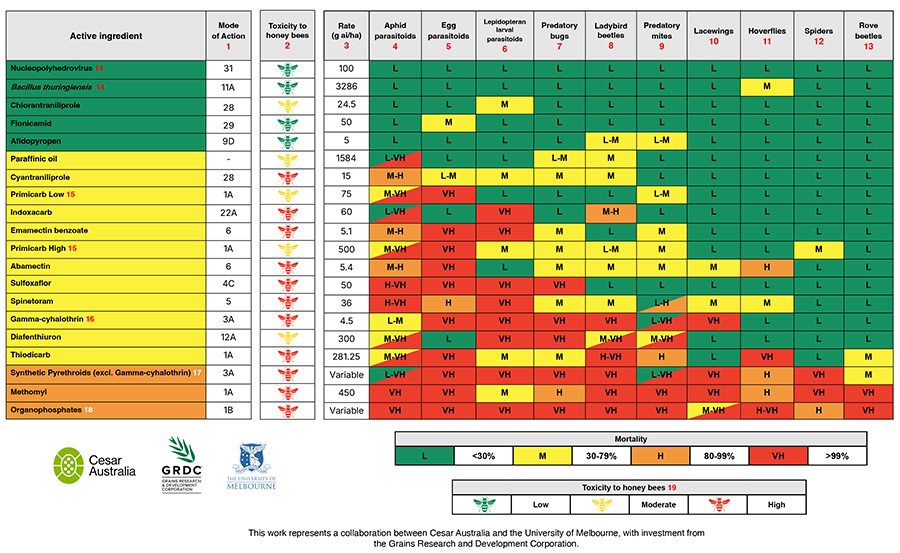
The Beneficials Chemical Toxicity Table was designed to give growers information on how insecticides can affect beneficial insects. The table summarises the toxicity of common insecticide active ingredients registered as foliar sprays in Australian broadacre crops.
The table was updated in August 2025 to include honey bees in the list of beneficial insects.
Developed by Cesar Australia and the University of Melbourne with support from GRDC under the Australian Grains and Horticulture Pest Innovation Program, it can be used to support integrated pest management strategies.
Extension Scientist with Cesar Australia Lilia Jenkins says the table is a useful resource for growers, particularly during the seasons when beneficial insects are active.
“Industry feedback highlighted the importance of adding honey bee toxicity data for crops such as canola,” Ms Jenkins says.
“For crops that rely on bee pollination, informed decisions can be made on which insecticides to use that have less impact on bees and other beneficials but still give control over pests.”
Interpreting the table
For honey bees, toxicity is based on the Organisation for Economic Cooperation and Development protocols and sourced from the UK’s Pesticide Properties Database.
It reflects a worst-case estimate, defined as the dose causing 50% mortality (acute toxicity).
Chemicals considered low toxicity are marked with a green bee icon. Those with a moderate toxicity are shown with a yellow icon. Chemicals that are highly toxic to bees are marked in red.
“I think about the bee toxicity ratings as a little like the UV index forecast,” Ms Jenkins says.
“The UV index shows the sun’s intensity, but whether you get sunburned depends on how long you’re in the sun and whether you wear sunscreen.
“Similarly, the bee toxicity ratings show the general level of risk of the chemical, but the impact depends on exposure and risk mitigation techniques.”
For predatory insects, a traffic light coding system is also used, where red signifies a high toxicity to beneficial insects, while green signifies a lower toxicity.
The ratings reflect the pesticide toxicity at doses based on field rates for Australian grain crops.
Cesar Australia conducted independent research, combined the results with existing data identified through a literature review, and applied the International Organisation for Biological Control ratings as follows:
- low (L) = < 30% mortality
- moderate (M) = 30–79%
- high (H) = 80–99%
- very high (VH) = > 99% mortality.
The table gives the active ingredient, mode of action and spray rate for common insecticides to support informed decision-making when controlling pests.
For example, beneficial insects such as parasitoids are useful for combating aphids. If a grower needs to spray for aphids, the use of an insecticide with afidopyropen or flonicamid as the active ingredient helps to minimise harm to the parasitoids. This keeps the parasitoids in action, slowing pest resurgence and reducing the need for follow-up sprays.
“Some of the information in the table is surprising,” Ms Jenkins says. “Pirimicarb is often regarded as a more selective active ingredient, but it is actually quite toxic to parasitoids in particular. It’s a reminder why checking the table is so important, rather than relying on assumptions.
“The table also highlights how different beneficial insects respond differently to chemicals. Some generalist predators like hoverflies, lacewings and spiders can be pretty hardy. Parasitoids, on the other hand, tend to be far more sensitive.
The table helps growers see those distinctions clearly and make informed decisions on insecticide use that fit their specific pest pressures and beneficial insect populations.
The development of the Beneficials Chemical Toxicity Table is part of a greater investment into novel suppression and resistance management of pests, which aims to assist the grains industry to transition to less reliance on pesticides and improve chemical stewardship.
A part of that program is undertaking research and development into endosymbiont technology. Read more about the R&D progress on endosymbiont technology in GroundCover article Gut health for pests: how microbes could change pest control (Feb 2026).
Also Read: Cargill Invests to Expand Beijing Plant
Global Agriculture is an independent international media platform covering agri-business, policy, technology, and sustainability. For editorial collaborations, thought leadership, and strategic communications, write to pr@global-agriculture.com