Resilient Food Systems Index (RFSI) 2026: 60-Country Ranking Highlights Infrastructure Gaps and Climate Vulnerabilities
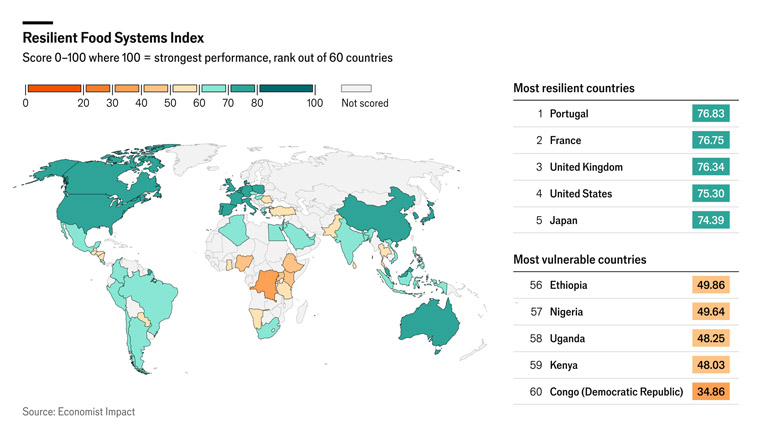
Global Food Resilience Index 2026: 42-Point Gap Exposes Deep Divide Between Portugal and DR Congo
03 March 2026, London: A new global benchmark has revealed a stark 42-point resilience gap between the world’s strongest and weakest food systems, underscoring structural vulnerabilities as the planet prepares to feed 10 billion people by 2050.
The inaugural Economist Impact Resilient Food Systems Index (RFSI) ranks 60 countries on a 100-point scale across four pillars: affordability, availability, quality and safety, and climate risk responsiveness. The findings place Portugal at the top of the ranking, while the Democratic Republic of Congo ranks last, highlighting significant structural disparities in global food system resilience.
Although no country achieved full resilience, nearly half of the nations assessed fall within a “middle zone,” scoring between 56 and 71. This clustering signals both systemic vulnerabilities and substantial room for coordinated policy, infrastructure, and investment improvements.
Affordability Strong — But Access and Nutrition Remain Uneven
Food affordability emerged as the strongest pillar globally, with an average score of 71.8. However, affordability alone does not guarantee food security or nutritional equity.
In 62% of assessed countries, the least expensive healthy diet consumes nearly two-thirds of the poorest households’ income. The divide between income groups is pronounced: high-income countries recorded an average affordability score of 81.1, compared to just 34.9 in low-income countries — a 46-point gap. Over the past five years, food prices have risen fastest in low- and lower-middle-income economies, increasing by 23.1%.
The Index also underscores the stabilizing role of major exporting nations. The world’s 15 largest food exporters recorded an average resilience score of 71. When these systems operate effectively, they help stabilize global markets; disruptions in these countries reverberate worldwide.
“The data show food systems are deeply interconnected: when countries implement targeted, coordinated action across key resilience levers, the benefits ripple across entire systems. But if these interventions fall short or happen in isolation, overall system resilience will deteriorate,” said Jonathan Birdwell, Global Head of Policy and Insights at Economist Impact.
Infrastructure Bottlenecks Constrain Food Availability
Despite progress in agricultural innovation, physical infrastructure remains a critical weak link.
Transportation and logistics systems scored an average of 56.8, limiting efficiency and contributing to food loss. Globally, 13.2% of food is lost before reaching retail markets, while 19% is wasted at the household level.
Although many governments promote agritech adoption, scaling remains constrained by insufficient foundational infrastructure. Reliable electricity and internet access remain below universal levels in many countries, limiting the reach of digital agriculture, supply chain monitoring, and early-warning systems.
Climate Risk Responsiveness: The Weakest Pillar
Climate risk responsiveness — which assesses how countries anticipate, manage, and recover from climate-related shocks — was the lowest-performing pillar, with an average score of 56.4.
While research investments in low-emissions agriculture and sustainable farming practices scored relatively high, agriculture-specific mitigation and adaptation measures averaged just 34. The data indicate a clear implementation gap: research is not yet translating into scalable, measurable climate resilience on the ground.
As climate volatility intensifies, this weakness presents systemic risks to production stability, trade flows, and price predictability.
Three Strategies to Strengthen Global Food System Resilience
The Index identifies three priority strategies to help countries move beyond the “middle zone” and future-proof food systems:
1. Pair Affordability with Access and Nutrition
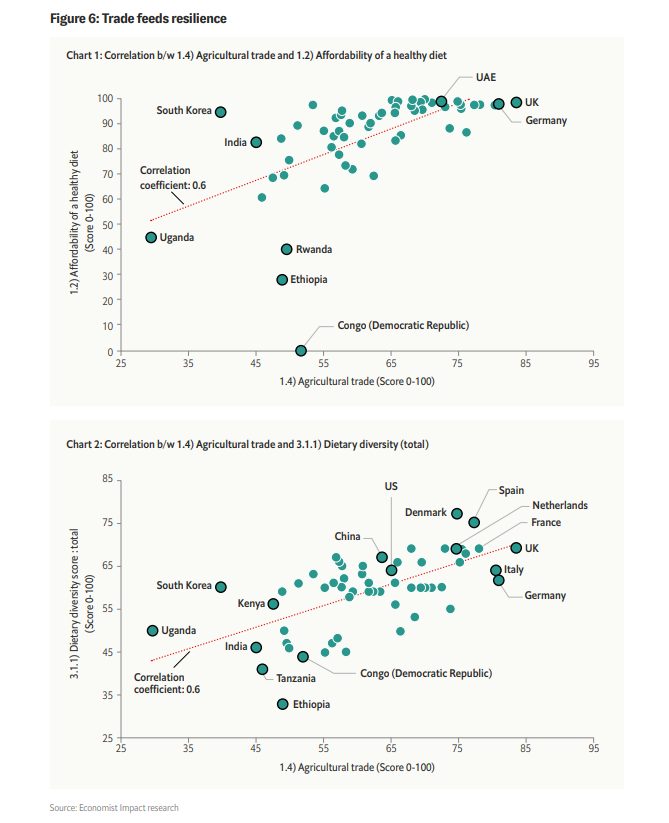
Agricultural trade correlates positively with the affordability of healthy diets and dietary diversity. Diversifying trade partnerships and strengthening supply chains for nutrient-rich foods can reduce costs while improving nutrition outcomes.
2. Scale Infrastructure and Innovation Together
Resilient systems require strong foundations. Expanding equitable access to internet connectivity, transport networks, and cold-chain storage can reduce food loss, widen market access for farmers, and amplify the impact of technological innovation.
3. Translate Climate Innovation into Action
While farmers are piloting innovative climate-smart practices, adoption remains uneven. Countries must convert research into scalable adaptation and mitigation strategies, backed by enabling policies and targeted financing mechanisms.
“Everyone needs dependable access to nutritious, affordable food,” said Brian Sikes, Board Chair and CEO of Cargill. “This research offers valuable insights that can help strengthen the world’s food systems. Cargill is proud to do our part to advance this important work, innovating with farmers, customers, and partners across our global supply chains to help ensure food moves where it’s needed, when it’s needed.”
Also Read: Atish Chandra Assumes Charge as Secretary, Department of Agriculture & Farmers Welfare
Global Agriculture is an independent international media platform covering agri-business, policy, technology, and sustainability. For editorial collaborations, thought leadership, and strategic communications, write to pr@global-agriculture.com