Certified Planting Material Key to India’s Citrus Growth: Experts at National Citrus Symposium 2025
23 December 2025, Jalgaon: India’s citrus sector is emerging as a strong growth engine for farmers, particularly as domestic processing capacity expands and export opportunities increase. To fully realise this potential, closer coordination is required among policymakers, private institutions, research bodies and academia, with a sharp focus on orchard health, certified planting material and modern production practices. This was emphasised by Dr N. K. Krishnakumar, former Director General of Horticulture, while addressing scientists and stakeholders at the valedictory session of the National Citrus Symposium 2025.
Dr Krishnakumar underlined that certified, virus-free planting material is the foundation of productive and sustainable citrus orchards. He noted that mandatory laboratory certification of nurseries, preventive care to block virus entry at the root and plant level, scientific nutrient and water management, and the adoption of modern irrigation and orchard technologies are no longer optional, but essential for long-term viability. According to him, quality planting material combined with scientific management is the only pathway to improving orchard longevity, productivity and fruit quality.
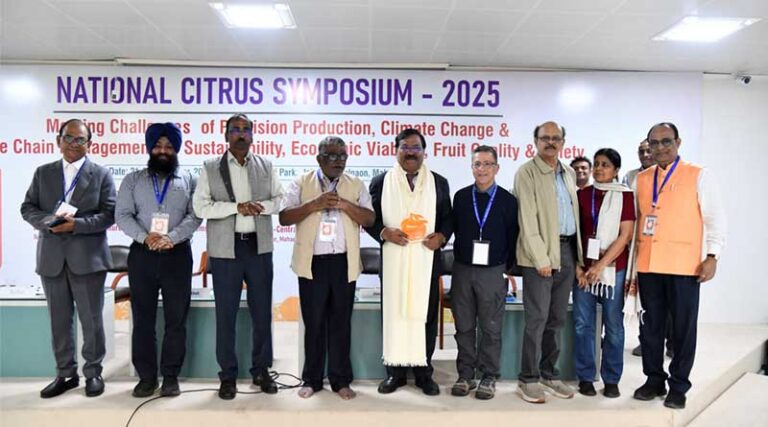
The National Citrus Symposium 2025 was jointly organised by the Indian Society of Citriculture and Jain Irrigation Systems Limited at Jain Hills, with the objective of providing new direction to citrus production in India. The closing ceremony was attended by leading scientists, industry experts and growers from across the country. Certificates were distributed to participants in the presence of senior dignitaries, including scientists from the Badnapur Citrus Research Centre.
Technical sessions were conducted across multiple halls, where experts shared research findings and field experiences. Presentations covered topics such as the use of drones in orchard monitoring, global comparative studies in citrus production, and environmentally responsible spraying technologies. India’s citrus sector currently contributes around nine per cent of global citrus output, but speakers highlighted that climate change, increasing pest and disease pressure, limited availability of quality plants and price volatility continue to pose serious challenges.
Several sessions focused on the role of technology and mechanisation in improving efficiency across production and processing. Research insights were shared on citrus-based machinery, juice processing, nano-packaging and its relevance for the citrus industry, and the integration of value chains to enhance farmer returns. Case studies illustrated how targeted interventions are transforming citrus cultivation in regions such as Nagpur and Bundelkhand, which are emerging as important citrus belts.
Institutional support and financing also featured prominently in the discussions. Experts stressed the need for modern, containerised citrus nurseries supported by institutional finance to ensure the steady supply of healthy and vigorous planting material. Emphasis was placed on the fact that without strong nursery infrastructure backed by technology, the sector’s expansion would remain constrained.
The symposium also examined emerging opportunities beyond farming, including citrus-based horticulture tourism and regional development models. Presentations highlighted how citrus cultivation can generate broader socio-economic benefits when linked with processing, branding and rural enterprises. Scientific analyses were shared on regional growth dynamics, sustainability challenges and future prospects of India’s citrus industry.
Despite the multiple challenges facing the sector, participants agreed that citrus offers significant untapped opportunities. Experts concluded that sustained growth will depend on healthy and certified plants, scientific orchard management, adoption of advanced technologies and adequate investment across the value chain.
On the final day, a joint technical interaction was held among farmers, entrepreneurs, scientists, academicians and policymakers on the theme of citrus sector development, focusing on expansion, innovation, entrepreneurship, policy support and trade growth. The deliberations reaffirmed that with the right mix of science, policy and industry participation, India’s citrus sector can achieve both domestic strength and global competitiveness.
Global Agriculture is an independent international media platform covering agri-business, policy, technology, and sustainability. For editorial collaborations, thought leadership, and strategic communications, write to pr@global-agriculture.com