India Reinforces Seed Regulation Framework to Prevent Circulation of Fake Seeds
09 February 2026, New Delhi: India’s existing seed laws and regulatory framework provide State Governments with wide powers to act against the sale and circulation of spurious and sub-standard seeds, the Ministry of Agriculture and Farmers Welfare informed Parliament on Thursday.
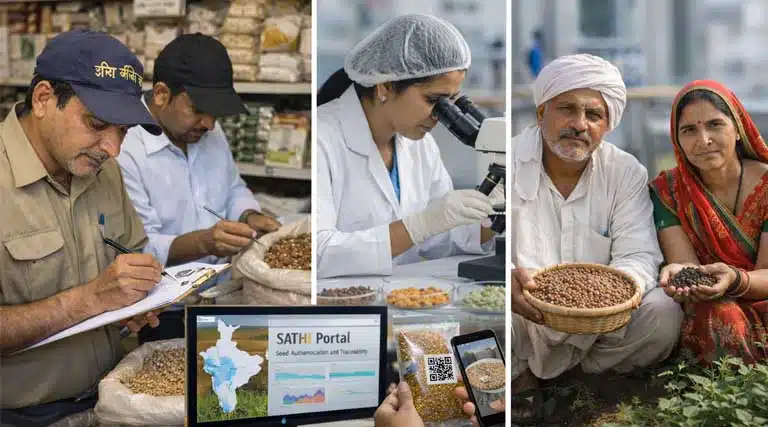
Under the Seeds Act, 1966, Seed Rules, 1968, and the Seeds (Control) Order, 1983, State Governments are authorised to appoint Seed Inspectors who can inspect seed outlets, draw samples, and initiate enforcement action. Such action includes cancellation of licences, seizure of seed stocks, issuance of stop-sale orders, and prosecution of violators involved in the sale of spurious seeds.
To strengthen oversight across the seed supply chain, the Government of India has also launched the Seed Authentication, Traceability & Holistic Inventory (SATHI) portal. The digital platform enables end-to-end traceability of seeds, improving transparency and helping prevent the circulation of spurious or sub-standard seed material. In addition, advisories have been issued to all States and Union Territories to strictly enforce the existing legal framework and intensify vigilance at storage points and retail outlets.
Protection of Traditional and Farmers’ Varieties
The government stated that legal provisions already exist to protect traditional and farmers’ seed varieties under the Protection of Plant Varieties and Farmers’ Rights Act, 2001 and the Biological Diversity Act, 2002. These laws support conservation and sustainable use of indigenous varieties and recognise farmers’ rights to save, use, sow, re-sow, exchange, share, or sell their own farm-saved seeds.
This information was provided by the Minister of State for Agriculture and Farmers Welfare, Shri Ramnath Thakur, in a written reply in the Rajya Sabha.
Support for Traditional Seed Production and Conservation
Under the National Food Security and Nutrition Mission (NFSNM), financial assistance is being provided to boost seed production of traditional varieties. This includes distribution of seeds at 50 percent cost, seed production incentives of ₹1,000 per quintal for cereals and millets and ₹2,000 per quintal for pulses and oilseeds, capacity-building programmes, and one-time assistance of ₹50 lakh for the establishment of community seed banks.
Further, under the Protection of Plant Varieties and Farmers’ Rights Act, 2001, farmers are encouraged to conserve and cultivate indigenous varieties through registration of farmers’ varieties with intellectual property protection, recognition through Plant Genome Saviour Community Awards and farmer recognitions, and financial support of up to ₹15 lakh for conservation activities under the National Gene Fund, in line with the PPVFR Rules, 2025.
Seed Licensing, Pricing and Research Support
The ministry clarified that any individual, seed company, or firm engaged in the seed business must obtain a seed dealer licence under Clause 3 of the Seeds (Control) Order, 1983 from the concerned State Government. Horticulture nurseries are registered and regulated separately under State Nursery Acts.
To ensure fair pricing of Bt cotton hybrid seeds, the Cotton Seeds Price (Control) Order, 2015 has been issued under the Essential Commodities Act, 1955, with maximum sale prices of Bt cotton seeds fixed annually.
Financial assistance is also provided to research institutions, including the Indian Council of Agricultural Research (ICAR), State Agricultural Universities, and public sector organisations, to strengthen seed infrastructure and support research on high-yielding, stress-tolerant, climate-resilient, and bio-fortified varieties. Between 2014 and 2025–26, a total of 3,236 high-yielding varieties, including 2,996 climate-resilient varieties, of field crops have been released and notified.
Improving Access to Affordable Quality Seeds
The government has taken multiple steps to ensure the availability of quality seeds at affordable prices. These include financial assistance to States, Union Territories, and public sector agencies for breeder seed procurement, distribution of certified seeds, strengthening of seed infrastructure, strategic adaptive research projects, and free distribution of minikits of new high-yielding varieties of pulses and nutri-cereals.
These interventions are implemented under schemes such as the National Food Security and Nutrition Mission, National Mission on Edible Oils – Oilseeds, and Rashtriya Krishi Vikas Yojana, aimed at improving productivity and reducing the cost of cultivation. Public sector seed production is also being encouraged to ensure reliable access to quality seeds for farmers across the country.
Also Read: Tanmiah Partners with PHYLA and RECYCLEE to Bolster Circular Economy and Food Security
Global Agriculture is an independent international media platform covering agri-business, policy, technology, and sustainability. For editorial collaborations, thought leadership, and strategic communications, write to pr@global-agriculture.com