
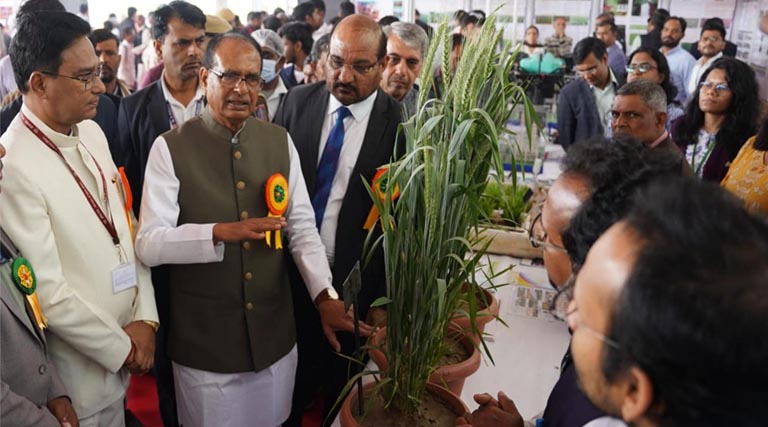
Shivraj Singh Chouhan Opens Pusa Krishi Vigyan Mela 2026, Outlines Roadmap for Payment Reforms, KCC Accountability and Direct Subsidy to Farmers
25 February 2026, New Delhi: Union Minister for Agriculture & Farmers’ Welfare and Rural Development Shivraj Singh Chouhan inaugurated the three-day Pusa Krishi Vigyan Mela at the Indian Agricultural Research Institute(IARI), outlining a series of proposed agricultural reforms focused on payment timelines, institutional accountability, licensing processes and subsidy delivery.
The annual fair, held at the ICAR–IARI campus in Pusa, brings together scientists, progressive farmers, agri-entrepreneurs and policymakers. The inauguration began with plantation activities. Among those present were Agriculture Secretary Devesh Chaturvedi, ICAR Director General Dr. M. L. Jat, and IARI Director Dr. C. H. Srinivasa Rao.
During the event, seven farmers were honoured with the IARI Krishi Adhyeta Award. The Minister also interacted with farmers at the venue, reiterating that policy implementation must remain farmer-centric.
12% Interest on Delayed Farmer Payments
Addressing delays in farmer payments, Chouhan stated that any agency or state government holding back payments due to farmers would be required to pay 12% interest on the pending amount. He said the practice of delaying payments or retaining funds in official accounts would not be accepted.
He added that the central government would not delay its share of payments under any scheme and is examining options to transfer the Centre’s portion directly into farmers’ bank accounts in cases where state-level delays occur.
Monitoring of Farm Mechanisation and Scheme Implementation
Referring to subsidies for agricultural mechanisation, drip irrigation, sprinkler systems, polyhouses and greenhouses, the Minister said that the Centre provides financial support to states under more than 18 schemes. However, he noted that fund allocation alone is insufficient without monitoring actual delivery.
He cited an example where, despite 700 farmers being listed in a district, only 158 reportedly received machinery. He said monitoring systems would be strengthened to ensure that benefits reach eligible farmers.
KVKs as District-Level Reform Centres
Chouhan said that Krishi Vigyan Kendras (KVKs) would be strengthened as district-level units linking research and field extension. He proposed that KVKs function as coordination centres to facilitate the dissemination of new crop varieties, improved agronomic practices and successful farm models in collaboration with state governments.
Structural strengthening of KVKs was described as part of the reform agenda.
KCC Loans at 4% Interest, Banks to Ensure Timely Disbursal
The Minister stated that around 75% of small farmers are currently covered under the Kisan Credit Card (KCC) scheme and can access credit at an effective interest rate of 4%. He said that while concessional credit is available, delays in loan processing are not acceptable.
Financial institutions and banks, he added, must ensure timely and simplified loan disbursal so that farmers do not depend on informal lenders.
Streamlining Pesticide Licensing
On pesticide regulation, Chouhan acknowledged that the existing licensing process is lengthy and complex. He said efforts would be made to simplify procedures, reduce layers of approval, define timelines and improve transparency.
According to the Minister, a streamlined system would help quality products reach the market faster while strengthening action against substandard and counterfeit inputs.
Proposal to Complete MSP Procurement Within One Month
Referring to Minimum Support Price (MSP) procurement, Chouhan said the current three-month procurement window is not practical, as farmers often lack the capacity to store produce for extended periods.
He proposed working with states to complete procurement within a maximum of one month so that farmers receive timely payment and unintended gains by intermediaries are avoided.
Fertiliser Subsidy and Direct Benefit Transfer
The Minister said the Centre spends over ₹2 lakh crore annually on fertiliser subsidy, enabling farmers to purchase urea at around ₹265–270 per bag against a higher market cost.
He suggested that the possibility of transferring fertiliser subsidy directly into farmers’ bank accounts through Direct Benefit Transfer (DBT) could be examined, allowing farmers to decide the type and quantity of fertiliser they wish to purchase.
‘Viksit Krishi Sankalp Abhiyan’ to Resume in April
Chouhan also referred to the “Viksit Krishi Sankalp Abhiyan,” under which scientific teams engage directly with farmers at the village level. He said the campaign would be relaunched in April ahead of the kharif season, focusing on crop protection, integrated farming models, improved seed varieties and export-oriented production.
National Platform for Lab-to-Land Linkages
Describing the Pusa Krishi Vigyan Mela as a national platform, the Minister said the event facilitates interaction between researchers and farmers and supports the transfer of technologies from laboratories to fields. He directed IARI to expand the scale of the fair in the coming year.
The three-day event is expected to feature technology demonstrations, seed and input exhibitions, farmer–scientist interactions and discussions on production, marketing and policy issues relevant to Indian agriculture.
Also Read: FMC’s Rimisoxafen Becomes First-Ever Dual Mode of Action Herbicide Classified by HRAC
Global Agriculture is an independent international media platform covering agri-business, policy, technology, and sustainability. For editorial collaborations, thought leadership, and strategic communications, write to pr@global-agriculture.com


