Sustainability Under Pressure: Citrus Production Challenges Highlighted by Dr. Himanshu Pathak at National Citrus Symposium 2025
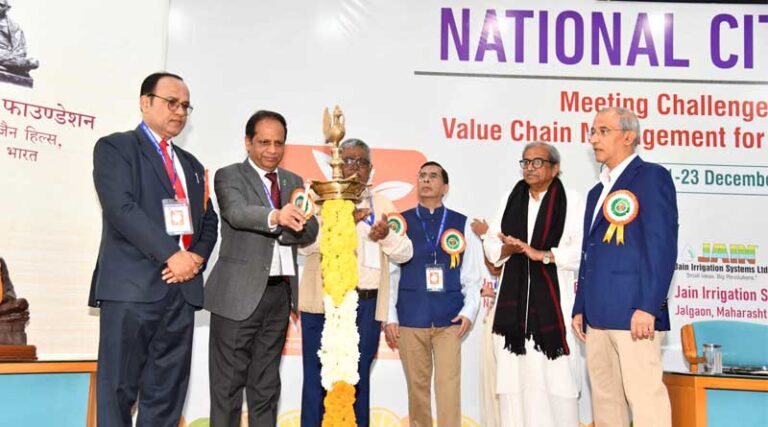
National Citrus Symposium 2025 inaugurated at Jain Hills
22 December 2025, Jalgaon: India has made significant progress in agriculture over the past few decades, achieving self-reliance in food security while also expanding fruit production. However, the key challenge ahead is to preserve and enhance nutritional value, which requires focused attention on soil health, efficient water management, and judicious use of fertilisers. Emphasising this, Dr. Himanshu Pathak, President of the National Academy of Agricultural Sciences (NAAS), said that science-based technologies such as tissue culture, drip and sprinkler irrigation must see wider adoption to ensure sustainable horticultural growth.
Dr. Pathak was speaking at the inauguration of the National Citrus Symposium 2025 (NCS-2025), jointly organised by the Indian Society of Citriculture (ISC) and Jain Irrigation Systems Ltd., at Jain Hills, Jalgaon. The symposium aims to provide new direction to citrus production in India, covering crops such as orange, sweet lime (mosambi) and lemon.
Farmer-centric, science-led citrus development
Dr. Pathak noted that India has transitioned from being a food importer to a global supplier and exporter, a role that became especially evident during the COVID period when the country supported global food needs. This transformation, he said, was possible due to the combined efforts of farmers, scientists and technologists. He stressed that farmers must remain at the centre of all agricultural interventions.
While significant work is underway in citrus crops, Dr. Pathak cautioned that declining productivity, water stress and emerging challenges require collective and coordinated efforts. Sustainable, environment-friendly technologies must be delivered to farmers at scale. He highlighted how science-backed water and soil management practices have helped expand fruit cultivation even in regions like Bundelkhand. Government programmes are supporting such initiatives, but continued innovation in science and technology will be critical, he added.
India ranks third globally in citrus production
In his keynote address, Dr. Dilip Ghosh, President, ISC said India ranks third in global citrus production, after China and Brazil. Despite this, the sector faces major challenges including climate change, increasing pest and disease pressure, shortage of quality planting material, and market price volatility. Against this backdrop, the central theme of NCS-2025 — “High Productivity, Climate Change and Value Chain Management” — is highly relevant, as it focuses on identifying sustainable solutions to these issues.
Dr. Ghosh emphasised that scientific knowledge generated through research must reach every stakeholder in the value chain. Integrating science and technology can significantly improve citrus productivity and quality. Given the high nutritional value of citrus fruits, he said, strengthening this sector is essential for building a healthy and prosperous India.
Grow nutritious food to build the nation
Addressing the gathering, Dr. N. Krishnakumar, Trustee, Gandhi Research Foundation highlighted that while India has achieved food security, it still lags in nutritional security. Rising lifestyle diseases such as diabetes underline the need for greater consumption of nutrient-rich foods. Fruit cultivation, he said, offers an effective solution by combining nutrition with farm income enhancement.
He pointed out that regular consumption of citrus, such as a glass of orange juice every morning, contributes to better health. Indian citrus-based processed products, including pickles, also have strong export potential. Increasing production of safe, high-quality and nutrient-rich fruits for both domestic consumption and export can directly benefit farmers. He stressed that disease-free planting material should be sourced only from accredited nurseries, preferably through scientifically managed mother nurseries under protected conditions.
Farmers as agents of innovation
Special guest Dr. Sudarshan Iyengar Trustee, Gandhi Research Foundation said that economics must be guided by ethics, and research should always consider its relevance and utility for society. Referring to Mahatma Gandhi’s philosophy, he said farmers who adopt and demonstrate change on their own fields become living models of innovation. He cited the example of Bhavarlal Jain, who transformed from a farmer into an agri-entrepreneur and inspired change at the grassroots level.
Value addition is more important than volume
Anil Jain, Vice Chairman, Jain Irrigation stressed that the real measure of success in horticulture is not just production volume, but the income earned per acre by farmers. He underlined the need to treat citrus as a value-added “super food” for end consumers. Effective use of libraries (knowledge), laboratories (research) and land (field application) is essential to deliver science to farmers. Knowledge dissemination and technology transfer must be prioritised so that research outcomes translate into on-ground impact.
During the event, dignitaries released the Citrus Cultivation Guide published by Jain Irrigation, along with the symposium souvenir. Technical presentations on various aspects of citrus cultivation were also made.
New citrus varieties launched
Jain Irrigation announced the launch of two newly developed citrus varieties — Jain Sweet Orange-6 and Jain Mandarin-1. Saplings of these varieties were distributed to ten progressive farmers in recognition of their contribution. According to Dr. Milind Ladaniya, Jain Mandarin-1 begins yielding from the second year itself and has the potential to emerge as a strong alternative to Nagpur orange.
Fellowships conferred
As part of the symposium, fellowships of the Indian Society of Citriculture were conferred on eminent scientists from India and abroad, recognising their contribution to citrus research and development.
Also Read: BASF | Nunhems Launches Percyst Carrot Variety with Nematode Resistance for the U.S. Market
Global Agriculture is an independent international media platform covering agri-business, policy, technology, and sustainability. For editorial collaborations, thought leadership, and strategic communications, write to pr@global-agriculture.com