Strengthening Civil Society Leadership in the DRC’s Fight Against Deforestation
09 January 2026, Africa: The Democratic Republic of Congo (DRC) is home to about 139 million hectares of forest, representing the largest share of the Congo Basin rainforest. This globally significant ecosystem, rich in biodiversity, plays a critical role in regulating the Earth’s climate. Yet, it is under growing pressure from deforestation and unsustainable exploitation.
Forest degradation weakens the ability of these ecosystems to absorb carbon dioxide. It also releases greenhouse gases and accelerates climate change. As an African proverb reminds us, “When a tree falls, it makes noise; when the forest grows, there is silence.” Today, the trees are anything but quiet, and the steady loss of Congolese forests is an unmistakable call to action.
In response, the Center for International Forestry Research and World Agroforestry (CIFOR-ICRAF) and the REDD+ Renovated Climate Working Group (GTCRR) are working together to address this challenge through the recently launched SC-REDD+ project, which is funded by the DRC REDD+ National Fund (FONAREDD) and the Central African Forest Initiative (CAFI) with a budget of USD 5.5 million.
The three-year project aims to strengthen the constructive and informed participation of civil society in the REDD+ process in the DRC; improve collaboration with other stakeholders; and increase awareness of deforestation challenges.
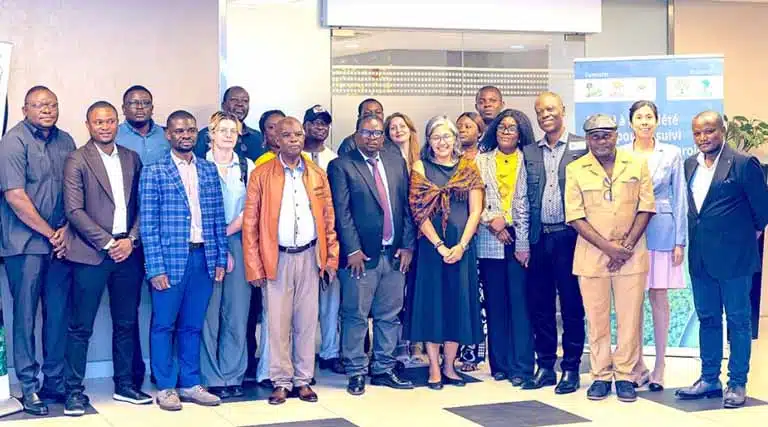
“Civil society plays a central role in combating deforestation and in shaping inclusive, effective forest and climate policies,” said Stibniati Atmadja, SC-REDD+ project co-lead at CIFOR-ICRAF, during the launch of the project in Kinshasa on 3 December 2025.
The GTCRR, which is comprised of a large national network of Congolese environmental civil society organizations (CSOs), plays a leading role as a platform for dialogue and exchange between state and non-state actors in national decision-making processes related to climate and forests.
The SC-REDD+ project aims to support the GTCRR in strengthening its structures and capacities, particularly in promoting more decentralized operations as well as more transparent and participatory governance mechanisms. The objective is to build on existing strengths while responding to the need for adaptation among diverse actors and in local contexts.
An inclusive approach for grassroots civil society in REDD+
Guy Kajemba, national coordinator of GTCRR, emphasized that civil society’s involvement is essential to safeguarding the DRC’s forests.
He further stressed that civil society goes beyond formal organizations to include local communities and Indigenous Peoples, whose livelihoods, cultures and survival are closely tied to forests.
“Despite ongoing challenges – such as limited funding, gaps in technical capacity, and low levels of climate awareness – civil society organizations remain central to the credibility and effectiveness of REDD+ processes,” Kajemba said.
Highlighting the project’s inclusive approach, he stated: “There is no selective approach when it comes to civil society organizations. We aim to bring actors together and work collectively because REDD+ and climate issues concern the whole community.”
“More than 100 organizations are already engaged, with continued efforts underway to mobilize civil society more broadly, as long-term forest protection depends on sustained, inclusive participation,” Kajemba said.
A call for collective action and accountability
Speaking at the project launch on behalf of the Executive Secretariat of FONAREDD, André Musafiri Misa described the Fund’s mission through the metaphor of a tree: roots anchoring communities, a trunk symbolizing commitment, branches representing transparency, and fruits embodying results for future generations.
He highlighted the partnership between CIFOR-ICRAF and the GTCRR as intertwined roots, underscoring the importance of collaboration, knowledge sharing and collective action.
Musafiri also urged all stakeholders to work together to ensure that commitments made under the SC-REDD+ project translate into concrete results for forests and communities in the DRC.
Emphasizing accountability and ownership, he reaffirmed civil society’s central role in monitoring REDD+ actions, noting that its active engagement is essential to ensuring vigilance, transparency and long-term impact.
Voices from partners and participants
Olivier Nzengue, representing the Executive Board of CAFI, expressed confidence in the initiative: “We hope this project will have a real impact in supporting communities across the DRC. Civil society lies at the heart of our partnership.”
Sarah Pattem, a climate adviser at the UK Foreign, Commonwealth and Development Office (FCDO) reaffirmed donor commitments and highlighted the joint efforts of CIFOR-ICRAF and the GTCRR to meaningfully engage local communities and Indigenous Peoples in forest protection.
Emmanuel Musuyu, executive secretary of CORAP – a coalition of civil society organizations in the DRC – praised the project’s participatory approach for strengthening community ownership. He noted that the initiative places a strong emphasis on capacity building for civil society organizations, enabling them to more effectively support REDD+ implementation and promote sustainable forest governance.
How SC-REDD+ supports civil society organizations
The SC-REDD+ project strengthens CSOs by promoting decentralized oversight and building the capacities of local actors. This approach contributes to more inclusive policy development while supporting national efforts to address deforestation and climate change.
Through targeted training and field missions, the project seeks to enhance the technical skills of CSOs and raise awareness of the links between deforestation and climate impacts.
The dedicated financial support offered through the project further enables CSOs to work alongside local communities and Indigenous Peoples in implementing REDD+ actions on the ground.
To date, CIFOR-ICRAF and the GTCRR have hosted five training sessions to strengthen the constructive and informed participation of civil society in the REDD+ process. The topics covered included monitoring and evaluation processes for REDD+ initiatives; REDD+ pillars and milestones; the Cancún safeguards; as well as administrative and financial procedures. These activities have been conducted in the DRC provinces of Kinshasa, Équateur, Sud-Ubangi and Mongala, boosting engagement and building the foundations for sustainable and accountable forest governance.
Also Read: Government Of India Invites Public Comments on Draft Pesticides Management Bill, 2025
Global Agriculture is an independent international media platform covering agri-business, policy, technology, and sustainability. For editorial collaborations, thought leadership, and strategic communications, write to pr@global-agriculture.com