23 November 2026, Nottingham, UK: Liming acidic farmland, a long-used soil treatment that raises soil pH, could help plant roots survive and recover from heatwaves better than previously understood, according to research from the University of Nottingham published November 15 in the journal Nature Communications. The study, led by researchers in Nottingham’s School of Biosciences working with Ghent University and the VIB Center for Plant Systems Biology in Belgium, identifies soil pH as a previously overlooked factor in how plant roots respond to extreme heat, a finding with direct relevance to farmers as heatwaves grow more frequent and more severe.
Soil pH, a measure of how acidic or alkaline soil is, is already managed by farmers worldwide through liming: the practice of spreading ground limestone or other calcium-based material to raise the pH of acidic fields. Nottingham researchers Dr Aneesh Lale and Dr Rahul Bhosale, working with their Belgian collaborators, set out to test whether soil pH itself changes how roots cope with sudden heat, at a time when extreme temperature events are becoming harder to avoid. The researchers note that July 2022 was the first time UK temperatures exceeded 40 degrees Celsius, and that, according to the Met Office, ten of the UK’s warmest years on record have occurred since 2000, context the team cites as the practical motivation for the work.
Testing Roots in Soil Columns
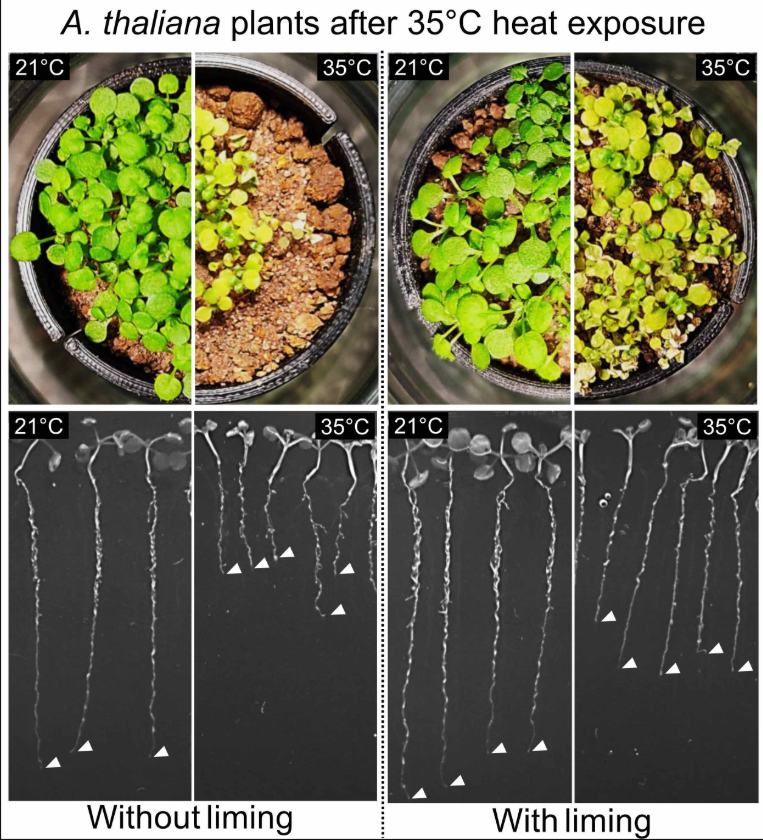
To isolate the effect of pH from other variables, the team grew plants in soil columns, some treated with calcium carbonate, the lime-based compound used in agricultural liming, and some left acidic, for 10 days at a steady 21 degrees Celsius. Plants were then exposed to one day of heat stress before being allowed to recover for two more days back at 21 degrees Celsius. Researchers uprooted and washed the plants afterward to image root growth and damage directly rather than relying on above-ground symptoms alone. The experiments, carried out in Arabidopsis thaliana, a small weed widely used as a model plant in laboratory genetics rather than a commercial crop, showed that heat affects root tissue chemistry differently depending on soil pH. Moderate warming in neutral soil raised levels of a reactive molecule called superoxide inside root tissue, a change the study links to continued root growth, while more severe heat in acidic soil instead raised a different reactive molecule, hydrogen peroxide, which suppressed root growth and slowed recovery. The researchers traced this divergence to proteins called plasma-membrane H+-ATPases, pumps that help control a cell’s internal pH balance and are themselves switched on or off by two signaling proteins the study identifies, named TOT3 and TOI5.
Raising the pH of acidic soil, the effect liming has in a farm setting, reduced hydrogen peroxide buildup in root tissue and improved both root and shoot recovery after heat stress in the experiments, with the researchers noting that the pH change itself, rather than the calcium supplied by the lime, appeared to drive the benefit. Because the work was conducted in a laboratory model plant rather than a field crop, the specific benefit has not yet been measured in wheat, maize or other commercial crops growing in real farm soil under field conditions, and the authors frame the finding as a new mechanism worth testing further rather than a ready-to-use recommendation. Dr Rahul Bhosale, associate professor of functional genomics at Nottingham, said soil management is “a potentially valuable tool” for helping agriculture adapt to climate change, and that farmers may be able to reduce some of the negative effects of extreme heat on their crops by managing soil pH through practices such as liming, which are already part of standard agronomy in most cropping regions and require no new infrastructure or technology to apply.
Roots are the part of a plant most directly exposed to soil temperature, and heat damage to root tissue can limit a plant’s ability to take up water and nutrients long after an above-ground heatwave has passed, a lag effect that agronomists point to when explaining yield losses that only become visible weeks after a hot spell. Soil pH management through liming is already routine in many cropping systems, primarily to improve the availability of nutrients such as phosphorus and to support the soil microbes that break down organic matter, rather than as a heat-stress response; the Nottingham-led study is among the first to link the same practice to root heat tolerance specifically.
Dr Aneesh Lale, the study’s lead researcher, said liming could create conditions “more favourable for root growth and recovery during periods of extreme heat,” adding that the research team is now extending the work into further studies examining whether the same pH-driven mechanism holds across other plant species, including commercial crops, and under field rather than laboratory conditions.
Global Agriculture is an independent international media platform covering agri-business, policy, technology, and sustainability. For editorial collaborations, thought leadership, and strategic communications, write to pr@global-agriculture.com