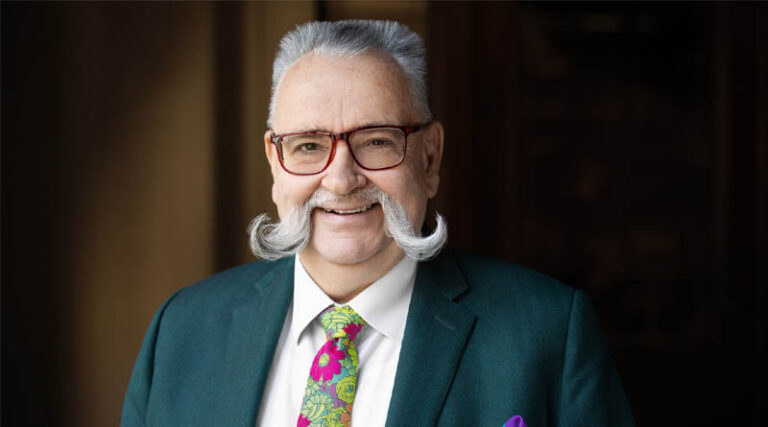
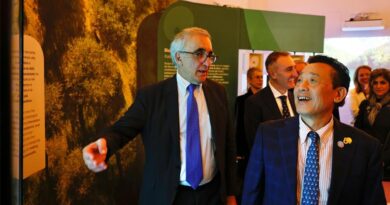
23 November 2026, Leverkusen: The Bayer Foundation is awarding the 2026 Ernst-Ludwig Winnacker Prize to Prof. Johannes Vogel, Director General of the Museum für Naturkunde Berlin and Professor of Biodiversity and Science Dialogue at Humboldt-Universität zu Berlin. With the award, the Foundation recognizes his longstanding commitment to an open and democratic science culture, societal participation, and dialogue between science and the public. The prize also includes funding for a joint project of the Museum für Naturkunde Berlin and the initiative “Maarifa for Transition”, which places migrant perspectives at the heart of Berlin’s climate adaptation debate.
“I am delighted to receive this award. For me, it is not only personal recognition, but above all an encouragement to continue advancing the dialogue between science and society. Science thrives when people ask questions, contribute different perspectives and actively participate in the creation of knowledge. Especially at a time when scientific findings and democratic values are increasingly under pressure, it is important to shape science as an open, transparent, and collaborative process. I therefore also see this award as recognition of the work of many colleagues at the Museum für Naturkunde Berlin, who work every day to make the museum a place of encounter, participation and societal dialogue,” says Prof. Johannes Vogel.
Science as a shared societal process
For many years, Prof. Johannes Vogel has worked to make science accessible to as many people as possible and to actively involve them in research and knowledge processes. A particular focus is on citizen science, meaning research conducted with the participation of citizens. As President of the European Citizen Science Association and in various national and international science policy bodies, he is committed to strengthening cooperation between research institutions, policymakers and society.
Under his leadership, the Museum für Naturkunde Berlin is consistently evolving into an open, integrated research museum. Research, collections and knowledge transfer are closely interlinked. The museum sees itself as a place where scientific findings are not only communicated but also questioned and further developed together. The participation of different social groups and the transparent handling of scientific processes are essential prerequisites for strengthening trust in science and enabling democratic debate on a well-founded knowledge base.
Beyond the museum, too, Prof. Johannes Vogel helps shape a forward-looking relationship between science and society. With the Berlin Hub for Science and Society, developed together with Charité Berlin, and the Berlin School of Public Engagement, new structures are emerging that bring science and society closer together. The School sees itself as a training institution that supports scientists in engaging with society with confidence, expertise, and enthusiasm. The aim is to establish public engagement as an integral part of scientific practice and to enable researchers to incorporate societal perspectives, shape dialogues and develop new forms of participation.
A prize for dialogue between science and society
The Bayer Foundation established the Ernst-Ludwig Winnacker Prize in 2021 on the occasion of Ernst-Ludwig Winnacker’s 80th birthday to recognize his outstanding and lasting contribution to the dialogue between science and society. As a renowned biochemist, science manager, former President of the German Research Foundation and first Secretary General of the European Research Council, Winnacker has long advocated close dialogue between science and society.
The prize honors individuals who are committed to science, make scientific knowledge accessible to society and promote public dialogue on scientific topics. In doing so, they strengthen the societal impact of science.
The Ernst-Ludwig Winnacker Prize will be awarded for the third time in 2026; previous recipients were marine researcher Prof. Antje Boetius as the first laureate and, in 2024, Prof. Alena Buyx.
The prize carries a monetary award of €3,000. Additional funds may be awarded for implementing a project on science communication and societal participation.
Migrant perspectives for climate adaptation in Berlin
Prof. Johannes Vogel will use the prize money to support the project “Migrant Perspectives on Urban Water Change” together with the Museum für Naturkunde Berlin, a research museum of the Leibniz Association. The project will be carried out from January to August 2027 together with the Berlin-based knowledge organization “Maarifa for Transition”.
The project will focus on the experiences and knowledge of people with migrant backgrounds, in particular Arabic-speaking Berliners and people with roots in the Middle East and North Africa. In workshops in Berlin districts particularly affected by heat, their perspectives on topics such as heat, water scarcity and the fair distribution of green spaces will be explored. Many participants bring experience of extreme climatic conditions and of different strategies for dealing with scarce resources from their regions of origin. This knowledge can provide valuable insights for the development of local climate adaptation measures.
Using methods such as storytelling, mapping and photography, experiences and ideas will be documented and incorporated into the collection “Water Futures. Voices from Berlin and Brandenburg” as well as into the political dialogue on climate adaptation. The project exemplifies how societal participation can open up new perspectives on scientific and societal issues.
Global Agriculture is an independent international media platform covering agri-business, policy, technology, and sustainability. For editorial collaborations, thought leadership, and strategic communications, write to pr@global-agriculture.com