23 November 2026, St. Louis, US: CoverCress Inc., a St. Louis, Missouri, company that has spent more than a decade turning the roadside weed pennycress into a commercial winter oilseed crop, has used gene editing to give the plant tolerance to two major classes of herbicide. A study published November 6 in the journal Plant Biotechnology Journal, co-authored with fellow St. Louis firm BioHeuris Inc., shows that one of the two edited traits worked cleanly once installed in the plant, while the other fell short.
Pennycress (Thlaspi arvense) is a fast-growing member of the mustard family that already grows wild across much of North America as a weed. CoverCress has spent years breeding, and now editing, a domesticated version with lower fiber content, reduced seed dormancy and lower erucic acid, changes that make its seed meal usable as animal feed and its oil usable for low-carbon biofuel production. Because it is planted after a corn or soybean harvest and taken off the field again before the next crop goes in, pennycress is marketed as a cash cover crop: a plant that protects soil over winter while also producing a sellable commodity, rather than one grown purely for soil benefit.
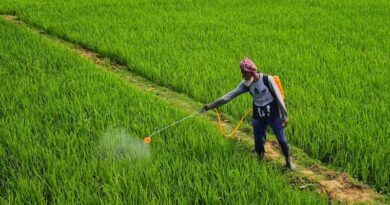
The catch is weed control. Corn and soybean growers across the U.S. Midwest rely heavily on ALS-inhibitor and HPPD-inhibitor herbicides, two widely used chemical classes that break down slowly in soil and can carry over into the next crop planted. Pennycress itself is highly sensitive to both. That sensitivity threatens to limit how widely farmers can plant it into existing herbicide programs, which is why CoverCress and BioHeuris set out to engineer tolerance into the crop directly rather than ask growers to change their weed-control programs around it.
One Trait Works, One Falls Short
For ALS tolerance, researchers first chemically mutated pennycress seed using a compound called EMS, then field-sprayed roughly 20,000 of the resulting plants with standard rates of two commercial herbicides, Thunder (imazethapyr) and Volta (thifensulfuron-methyl). A small number of survivors carried a mutation, labeled P187S, in the plant’s ALS gene, the enzyme both herbicides target. Rather than breed from that original mutant plant, the team used CRISPR-Cas9, a gene-editing tool that lets researchers make a specific, targeted change to a single gene, guided by a DNA repair template, to install the exact same mutation directly into elite CoverCress breeding lines. The edited lines held up against twice the standard field rate of Volta with no measurable loss of seed yield, and showed no stunting or delayed flowering until herbicide rates reached eight to sixteen times normal. Only at double the standard rate did yield slip, by about 10%, giving CoverCress a precision-edited pennycress line that, in principle, growers could spray with ALS herbicides at normal field rates without crop damage.
The second trait proved harder to transfer. BioHeuris, which specializes in engineering microbial enzymes, screened lab-grown bacteria carrying mutated versions of the HPPD enzyme, the target of herbicides such as Tenacity (mesotrione), and identified a variant called G419A that kept most of the enzyme’s natural activity while resisting the chemical in bacterial and plant-overexpression tests. When researchers used a strong, always-on genetic switch to overexpress that gene throughout the plant, tolerance held. But when the same gene-editing process was used to install the G419A mutation at its own natural location in the pennycress genome, rather than overexpressing it elsewhere, the resulting plants bleached and suffered leaf damage from the herbicide much like unedited plants, even at a fraction of the normal field rate. The study’s authors describe the gene’s behavior at its native location as “context-dependent,” a sign that where and how a trait sits in the genome can matter as much as the mutation itself.
For CoverCress, the practical result is one usable trait rather than two. The ALS-tolerant line offers growers a weed-control option built around a widely available, already-registered herbicide class, strengthening the case for fitting pennycress into existing corn-soybean rotations across the Midwest without asking farmers to adopt new chemistry. The HPPD outcome, by contrast, illustrates a broader lesson for gene editing in any newly domesticated crop: proving a trait works in a lab construct or an overexpression line is not the same as making it work once installed at its natural address in the genome, and that gap can determine whether an edited trait is commercially usable at all.
Editing efficiency for both traits was low, underscoring how much screening is still needed to turn a gene-editing concept into a stable crop line. Researchers recovered just three ALS-edited survivors from roughly 20,000 screened seeds, and a single working HPPD-edited line from about 800 screened seedlings, figures the authors present as a realistic measure of the work still required to move precision-edited traits from the laboratory into a seed bag.
Global Agriculture is an independent international media platform covering agri-business, policy, technology, and sustainability. For editorial collaborations, thought leadership, and strategic communications, write to pr@global-agriculture.com