NDSU’s Row-Crop Robot Hits 96.5% Weeding Accuracy in Sugar Beet Trials
01 October 2026, North Dakota: Engineers at North Dakota State University have built and field-tested an autonomous mechanical weeding robot that removed weeds from row-crop fields with 96.5 percent efficacy while cutting unnecessary soil disturbance nearly in half, offering a non-chemical option for growers facing both herbicide resistance and rising labour costs.
The system, developed by Shafi Md. Istiak, Mohammad Aftabi Talami, James Y. Kim and Dr Sulaymon Eshkabilov of NDSU’s Department of Agricultural and Biosystems Engineering in Fargo, was described in a paper published in the journal Precision Agriculture in early September. It targets sugar beet and similar row crops planted on standard spacing, a segment where mechanical cultivation has historically struggled to work close enough to the crop row without damaging plants or missing weeds between them.
How the system works
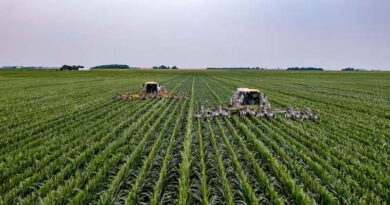
The robot combines a commercially available mobile platform, known as the Amiga robotic base, with a three-row cultivator the team built specifically for site-specific, individually controlled weeding. Each of the three cultivator units has its own electric linear actuator, a motorised arm that can push a sweep blade down into the soil or lift it clear, independent of the other two. A four-bar parallelogram linkage, a simple mechanical arrangement of connected rods, lets each sweep automatically adjust its depth as it follows the ground contour, rather than relying on a fixed setting that would either miss weeds in low spots or dig too deep in high ones.
For positioning, the robot uses RTK-GPS, a satellite navigation method that corrects standard GPS signals against a fixed reference station to achieve centimetre-level accuracy rather than the metre-level accuracy of ordinary GPS. That precision is combined with strain gauge load cells, which measure the force on each sweep as it engages the soil, and laser distance sensors tracking how far each actuator has extended. Together, this lets the robot’s control system know in real time whether a blade is cutting through soil as intended or needs to adjust.
Live Newsroom
In field trials, the sweeps covered a working width of 355.6 millimetres within a 558.8 millimetre row spacing, typical for sugar beet production. The robot achieved 96.5 percent weeding efficacy measured by tillage length, meaning it mechanically disturbed the intended proportion of the inter-row soil to uproot weeds. Notably, the team found the system could achieve 50 percent weed coverage while reducing overall soil disturbance by 48.7 percent compared with less targeted cultivation, an efficiency gain that matters because excessive tillage dries out soil, breaks up its structure and can expose it to erosion. Positional tracking stayed within roughly 15 to 30 centimetres of lead or lag error relative to the target path, with a tillage depth held to within about 2 millimetres of the 30-millimetre target on average.
From prototype to commercial-scale deployment
The clearest limitation the researchers reported is speed: the robot currently operates at about 0.5 metres per second, roughly half a kilometre per hour, a pace set by how quickly the RTK-GPS system updates position and how fast the actuators can respond to new commands. That is far slower than a tractor-mounted cultivator or a herbicide sprayer covering the same ground, which means the platform, as tested, is better suited to research plots, seed multiplication blocks or high-value specialty fields than to large-scale commercial row-crop production in its current form. The authors frame the work as a proof of concept for the sensing and control architecture, with faster actuators, higher-frequency positioning updates and multiple units working in parallel identified as the logical next steps toward a field-ready, commercial-scale version.
Even at this stage, the approach matters because it tackles a problem that has limited robotic weeding until now: most commercial weeding robots either use lasers or targeted herbicide droplets to kill individual weeds, or rely on simple mechanical hoes that cannot vary their depth or position precisely enough to work safely close to a crop row. By combining real-time force feedback with centimetre-level navigation, the NDSU system points toward mechanical weeding that is precise enough to replace, rather than merely supplement, chemical weed control in sensitive crop stages.
Also Read: Dhanuka Agritech Launches Adjuvant Wetcit Neo and Rice Blast Fungicide Fujita for the Indian Market
Global Agriculture is an independent international media platform covering agri-business, policy, technology, and sustainability. For editorial collaborations, thought leadership, and strategic communications, write to pr@global-agriculture.com