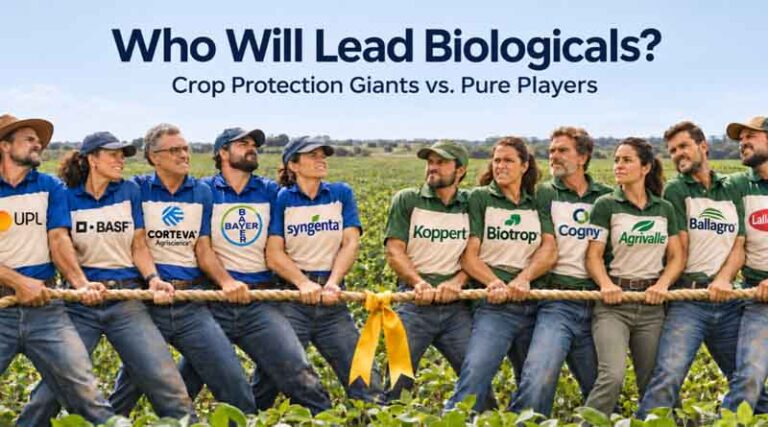
Who Will Lead Biologicals: Crop Protection Giants or Pure-Players?
Guest Author: Christian Pereira, Agribusiness Strategist at Bizup Strategy, specializing in growth strategies and M&A.
14 November 2026, São Paulo: Two announcements within a month show two different ways to consolidate the biologicals market.
On one side, crop protection companies fold biologicals into the season program they sell to growers. On the other, pure-players are building multinationals of their own.
In October, Belgium’s BioFirst Group bought the remaining 15% of Biotrop Soluções Biológicas, one of Brazil’s leading biological companies, and now owns all of it. It had taken control three years earlier. On November 4, Bayer launched Biológicos Bayer, a Latin American brand with 17 launches planned through 2030, eight of them in Brazil. Apart, they look like routine news. Together, they show the contest that will define the next phase of biologicals.
Bayer wants biologicals to gain weight inside a diversified agricultural platform. BioFirst is building a global platform dedicated only to them. Two models of consolidation, running in parallel.
My bet for Brazil through 2030 has two parts. In market share, the large companies will advance. In grower preference and probably in margin, the pure-players stay ahead. I also believe Brazil will still have at least one pure-player among the leaders, if it adapts to the new competitive scenario.
Brazil in a nutshell
Brazil is where biologicals are moving fastest. A few facts help readers from other markets follow the rest of this piece.
Growers plant soybeans and then a second crop of corn on the same land in the same year. Depending on the region, a field can take up to three crops a year. More crops mean more seasons to apply a product and to judge it.
The numbers, in Brazilian reais (R),withapproximateUS conversions at R$5.50 per dollar:
- The biologicals market reached R6.2 billion (about US 1.1 billion) in 2025, up 15.2% on 2024 according to CropLife Brasil.
- Kynetec Brasil estimates that biologicals reached about 64% of second-crop corn and 74% of cotton in the 2025/26 season. For second-crop corn, the figure was around 6% in 2020.
- Biologicals are still small next to chemicals. Kynetec puts them at R5.3 billion (about US 960 million) in 2025/26, against more than R$ 100 billion for chemical crop protection (about US$18.5 billion) in 2025. That is roughly 5%.
- The market is fragmented with hundreds of companies operating in Brazil and the leader holds 8% to 10% at most.
Growers typically buy through input retailers and agricultural cooperatives. These channel partners also carry much of the credit relationship. The person in front of the grower is usually a technical sales representative, known in Brazil as an RTV. Manufacturers and retailers both employ them.
Why the giants moved now
I see Bayer, Syngenta, Corteva, BASF and UPL as the five large companies that come from crop protection and seeds. All of them are reorganizing. Corteva completed the separation of its seed and crop protection businesses on October 1. BASF is preparing an IPO of its agricultural division for mid-2027. Syngenta has reportedly pushed its own listing to 2027. Bayer is still dealing with the glyphosate liabilities.
Investors want a growth story, and chemicals face price pressure in Latin America. Biologicals grew 15% in Brazil in 2025 and reached R6.2billion (about US1.1 billion). They are still roughly 5% of the value of chemical crop protection. But they are the slice that grows fastest.
The paths vary. Syngenta bought Valagro, an Italian biostimulants company, and wants to lead the Brazilian market within five years. Corteva bought Stoller and Symborg and placed five biologicals among the 12 new active ingredients of the next decade. BASF bought AgBiTech, which specializes in viruses that control caterpillars. UPL gathered everything in its Natural Plant Protection (NPP) division. Bayer bets on partners: Curvet comes from Sound Agriculture, a US company backed by Leaps by Bayer, and the new biofungicide will be developed with Brazil’s Ideelab Biotecnologia.
Bayer’s bet is among the boldest. It wants to show that a company can lead a category commercially even when much of the innovation is born outside.
The giants’ edge is the season program
People talk a lot about the size of the multinationals’ sales teams. I would look at something else.
Picture two companies with biofungicides of similar performance. For the pure-player, the product has to pay for the research, the plant, the channel and the technical support on its own. For the large company, the same product can help hold a fungicide program it would otherwise lose to another brand. Both act logically and reach very different prices. One calculates the return of the product. The other calculates the return of the whole account.
This logic gets stronger in the channel, because of rebates. The large companies agree annual targets with retailers and cooperatives for the whole portfolio, with a bonus at the end of the season. When a biological enters that package, the distributor gets a concrete reason to push it. Selling the multinational’s biological may be what is missing to hit the target that unlocks the rebate on everything else.
The pure-player has no portfolio to build a deal of that size. To me, this is the most underrated strength of the large companies. Where products are equivalent and the channel can swap one for another, the rebate tends to decide, and I give them the edge.
But this weapon has limits. The first is inside the company. If biologicals are 5% of the business, they hardly weigh on the target of a rep who sells the whole portfolio. Between closing a fungicide order and going back to a demonstration plot, the rep knows what the manager will ask about.
The second limit is discount. The biological goes into the package, the sale shows up in the report, and the grower switches product at the first chance. Category revenue says little. What matters is the margin of the account and the customer’s preference in the next season.
The pure-player can also be the consolidator
The thesis that large companies will end up buying the best pure-players often carries a silent assumption: that every successful biologicals company is, at some point, for sale to a crop protection company. Biotrop’s path points the other way. BioFirst, the group that now owns 100% of it, wants to combine microbials, macrobials (beneficial insects and mites) and pollinators to expand its global presence. There is capital financing consolidation inside the pure-players.
This changes the comparison. When we think of a pure-player, it is easy to imagine a regional company with excellent technology and little distribution muscle. BioFirst allows another picture: a pure-player with international scale, several technologies, the ability to acquire and a portfolio broad enough to matter to the channel on its own merit. It can capture part of the scale benefits of the giants while keeping its focus on biologicals.
In Brazil, Cogny, which brings together Simbiose, Bioma and Biagro, is an example of a pure-player gaining scale through consolidation, with its own brands and presence in other countries. Several other good companies with Brazilian capital keep getting stronger.
The giants will not buy everyone, either. Of the hundreds of Brazilian companies in this field, only a minority looks like a realistic target for a sale or for private equity. Many founders want to stay independent, even if that limits their scale. And deal activity has cooled worldwide in recent years, while distribution agreements have become a common route for multinationals to reach new technology.
I see room for two kinds of pure-player: the one with technology that is hard to copy, and the one that controls a commercial relationship other companies want to reach. My worry is with the one that has a plant and registrations but depends on third parties to differentiate the product and to reach the grower. That one sits in the middle. In a market of some 600 companies, the middle will get squeezed.
Partnership is also a fight over value
If Ideelab’s biofungicide works, the sale goes into Bayer’s books and part of the value pays the Brazilian startup. Both win. The balance, though, depends on what happens next.
If Bayer can choose among several suppliers for the next generation, bargaining power is hers. If Ideelab creates something hard to reproduce and has other routes to sell it, it keeps its options. The startup already serves Syngenta and ICL and kept that freedom in the agreement. For the leader of a biotech, this is a decision of corporate strategy. Exclusivity can be a great deal if the partner opens markets that the company would take years to reach.
For the multinational, the question is the mirror image: what is worth owning, and what is enough to have access to? BASF decided to own AgBiTech and its skill in insect control. Bayer secured commercial exclusivity for Curvet in Brazil and chose to co-develop with Ideelab. Syngenta bought Valagro, but for Avakitt Neo it turned to the Israeli company Groundwork BioAg which makes and supplies the product while Syngenta sells it under its own brand. All three accept that some capabilities deserve an acquisition and others can be contracted. The quality of that choice only shows when the market matures and the contracts have to be renewed.
What could change the picture
The discussion that followed the Portuguese edition raised points that deserve space here.
Trust is a shared asset
Weak products can hurt the whole category. A grower who tries one that fails often blames biologicals, not the brand. Economists call this a market for lemons, after George Akerlof: when buyers cannot tell good from bad before they use it, the bad drags down everyone’s reputation. With a living product the grower only finds out in the field, and a failed season is expensive.
Process is part of the technology. Two companies can sell the same species and deliver different results, depending on fermentation and formulation. The competitor cannot see that on the label. The grower sees it in the field. Companies with good products should make quality visible, with field data under conditions the grower recognizes and with batch traceability.
On-farm production
Some large growers multiply microorganisms on their own farm. Brazil’s 2024 bioinputs law, allows this for the grower’s own use without product registration. Selling the output is prohibited. As of March 2026, the implementing regulation was still pending.
Where a grower can make the organism himself, neither rebate nor brand supports a price. Only technology he cannot replicate does. How far on-farm production spreads is an open question. Doing it well takes structure and trained people, and products built on several organisms or on metabolites are harder to reproduce on a farm.
Credit and working capital
In a country with high interest rates, finance weighs as much as technology. Brazil’s benchmark rate, the Selic, stayed at 15% from June 2025 to March 2026, the highest in almost two decades. After the central bank’s decision on November 4 it stands at 13.75%. Retailers and manufacturers often carry the grower’s payment terms for months, and they feel the cost first. A company with deep pockets can finance the chain and still offer a competitive price. A pure-player with a better product and a thin balance sheet may not.
Sales teams
Biologicals need follow-up from planning to the end-of-season review. That is a different job from selling a chemical, and the agenda of a rep with a full portfolio rarely has room for it. Some argue for fully separate teams. Others want chemistry and biology integrated inside the farm gate. Both have a point. Syngenta, for one, describes a hybrid: 200 dedicated biologicals specialists, with another 500 crop protection professionals also selling the biologicals. A simple test for any company: does the biologicals team have its own target, or does it share the chemical one? These teams also need practice handling the grower’s objections before they face them in the field.
So who wins, for now?
In market share, my bet is on the large companies gaining ground. I would give them the edge above all in segments where the biological fits into a protection program they already help define, and where several technologies perform about the same. Under those conditions, commercial reach and portfolio economics weigh heavily.
In the ability to capture value in a market this competitive, I see room for some pure-players to lead relevant businesses. This tends to happen where they hold technology that is hard to replace, master an agronomic problem better than competitors, or have built their own access to the grower and the channel. Consolidation among pure-players raises the chance that some of them combine all three conditions.
Grower preference is still up for grabs, and a giant can win it too. I keep a bias toward pure-players, and the reason is the quality of the presence in the field. A pure-player’s technical rep does not split the agenda with other product categories and tends to be better trained. That edge disappears if the pure-player cannot take the same level of assistance to more areas. The winner reaches more hectares without diluting the quality.
So I would watch two things until 2030. The first is who buys the next relevant pure-players. Each acquisition made by another biologicals group strengthens a consolidation route that is independent of the crop protection industry. The second is the next generations of products that the main players are talking about: metabolites, peptides, RNA and bioherbicides. What matters is whether any of them creates real differentiation in the field, and not only technological differentiation. A product that solves a problem the grower already has, and that he can see working, will do more than a new mode of action that only looks good on paper.
Bayer’s announcement deserves attention because it shows which part of the business the company believes it can control even when the technology comes from outside. BioFirst’s purchase of Biotrop deserves attention for the complementary reason: it shows that a pure-player can also have the capital and the ambition to decide the future of other pure-players.
One question for the boardroom
If I were on the board of a biological inputs company today, I would ask one question before approving the next plant, acquisition or partnership: five years from now, what will we have built that forces others to negotiate with us? The answer says more about who can win this market than any leadership target announced so far.
Also Read: Crystal Crop Protection to Launch Rs 455 Crore IPO on November 18
Global Agriculture is an independent international media platform covering agri-business, policy, technology, and sustainability. For editorial collaborations, thought leadership, and strategic communications, write to pr@global-agriculture.com